

Direct And Indirect Speech (Statements, Questions, Command And Requests): Narration
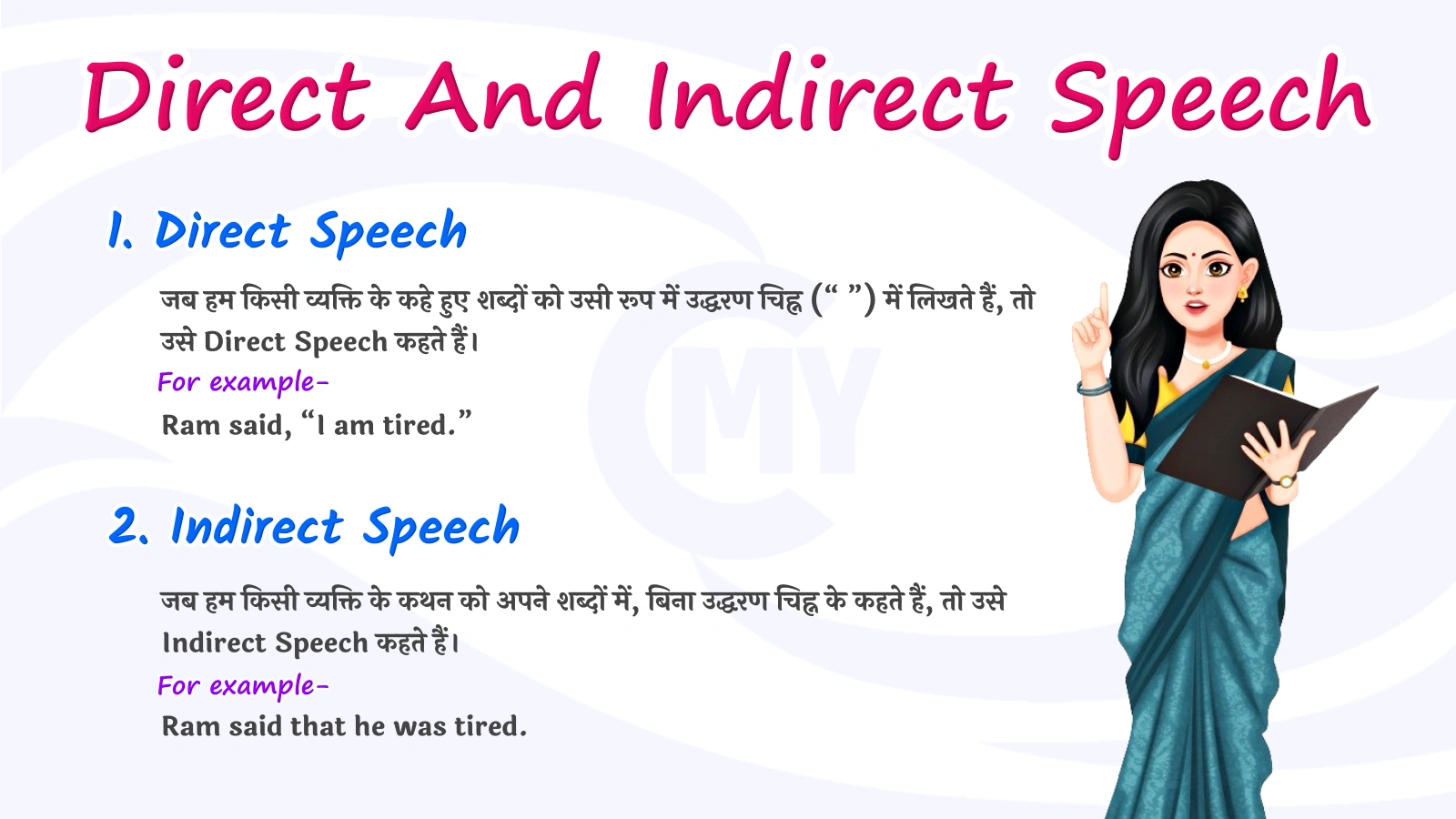
Direct Speech (प्रत्यक्ष कथन) और Indirect Speech (अप्रत्यक्ष कथन) किसी द्वारा कही गई बात को किसी को लिखने के दो रूप हैं। ये अंग्रेज़ी व्याकरण के महत्वपूर्ण भाग हैं। इनके बारे में सरल हिन्दी भाषा में आगे बताया गया है-
1. Direct Speech (प्रत्यक्ष कथन)
जब हम किसी व्यक्ति के कहे हुए शब्दों को उसी रूप में उद्धरण चिह्न (“ ”) में लिखते हैं, तो उसे Direct Speech कहते हैं। उदाहरण के लिए-
- Ram said, “I am tired.”
- Sita said, “I will go to school.”
यहाँ बोलने वाले के शब्द बिल्कुल नहीं बदले गए हैं।
2. Indirect Speech (अप्रत्यक्ष कथन)
जब हम किसी व्यक्ति के कथन को अपने शब्दों में, बिना उद्धरण चिह्न के कहते हैं, तो उसे Indirect Speech कहते हैं। उदाहरण के लिए-
- Ram said that he was tired.
- Sita said that she would go to school.
यहाँ वाक्य की संरचना और tense बदल जाता है। Direct And Indirect Speech के इस वाक्य को पढ़िए-
Ramesh says, “Vijay will buy a scooter.”
इस वाक्य के आधार पर निम्न प्रश्न बनाया-
Question: What does Ramesh say?
Ans. Ramesh says that Vijay will buy a scooter.
इस प्रकार स्पष्ट है कि, Speaker (वक्ता) के कथन को निम्नलिखित दो प्रकार से व्यक्त किया जा सकता है-
- Direct Speech या Direct Narration – Ramesh says, “Vijay will buy a scooter.”
- Indirect Speech या Indirect Narration – Ramesh says that Vijay will buy a scooter.
Rules for Changing Direct Speech into Indirect Speech
Rule 1. Direct Speech में Inverted Commas (“……”) का प्रयोग किया जाता है। जबकि Indirect Speech में Inverted Commas का प्रयोग नहीं होता है। निम्न उदाहरण को ध्यानपूर्वक पढिए-
- He says to his friend, “I have been working since morning.”
→ He tells his friend that he has been working since morning.
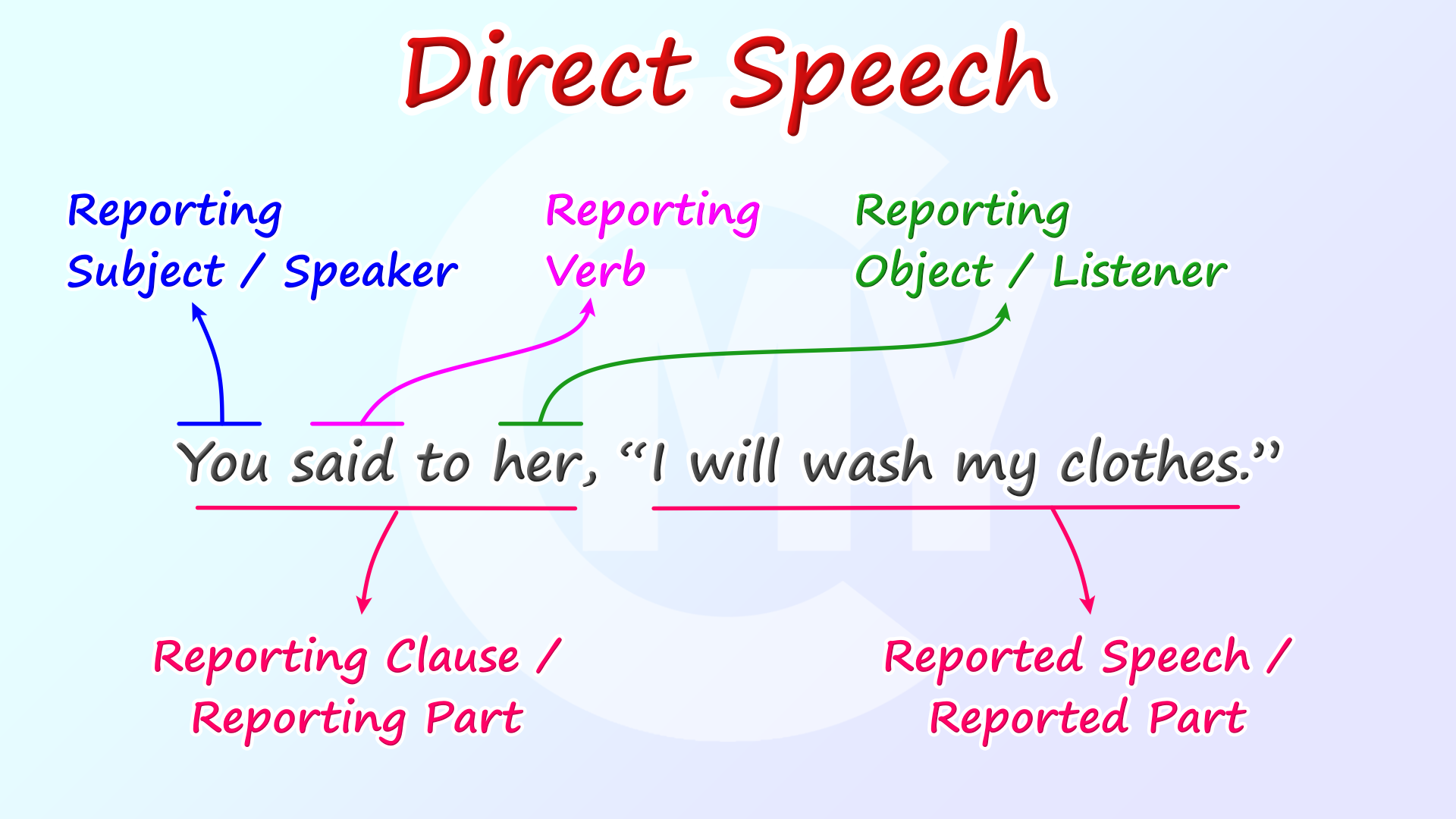
Direct Speech में प्रयुक्त ‘He’ – Speaker है। “Says” Reporting Verb है। “I have been working since morning” Speaker का कथन है। परम्परागत व्याकरण में इसे Reported Speech कहा गया है। Modern Grammar में इसे Reported Clause या Reported Part कहा जाने लगा है। इस परिवर्तन का कारण यह है कि Indirect Speech को Reported Speech भी कहा जाता है।
Rule 2. Assertive Sentences में Reporting verb के बाद ‘that‘ Conjunction का प्रयोग होता है। Reporting Verb said के पश्चात Object नहीं है, तो said को ज्यों का त्यों रहने देते हैं, यदि Reporting Verb-said के बाद कोई Object है, तो said to के स्थान पर told का प्रयोग करके Object लिख देते हैं।
Rule 3. यदि reporting verb Present या Future में हो तो tense में कोई परिवर्तन नहीं होता है। लेकिन, यदि reporting verb Past Tense में हो तो tense में परिवर्तन होता है।
- says → says
- will say → will say
- said → said
- said to + object → told + object
Tense परिवर्तन के नियम निम्न हैं-
| Direct Speech | Indirect Speech |
|---|---|
| Present Simple | Past Simple |
| Present Continuous | Past Continuous |
| Present Perfect | Past Perfect |
| Present Perfect Continuous | Past Perfect Continuous |
| Past Simple | Past Perfect |
| Past Continuous | Past Perfect Continuous |
| will / shall | would / should |
| can | could |
| may | might |
| must | had to |
Rule 4. कुछ समयसूचक, स्थानसूचक और संकेतवाचक शब्दों (Adverbs) को बदला जाता है-
| Direct | Indirect |
|---|---|
| now | then |
| today | that day |
| tomorrow | the next day |
| yesterday | the previous day |
| here | there |
| this | that |
| these | those |
| ago | before |
| tonight | that night |
| last | previous |
| next | following |
Rule 5. Pronoun speaker के अनुसार बदलता है, Pronoun का बदलाव speaker और listener अर्थात reporting verb के subject/object पर निर्भर करता है।
- First person → Reporting verb के subject के अनुसार
- Second person → Reporting verb के object के अनुसार
- Third person → No change
| Case / Type | First Person | Second Person | Third Person |
|---|---|---|---|
| Subjective Case | I, We | You | He, She, It, They |
| Objective Case | Me, Us | You | Him, Her, It, Them |
| Possessive Adjective | My, Our | Your | His, Her, Its, Their |
| Possessive Pronoun | Mine, Ours | Yours | His, Hers, Its, Theirs |
| Reflexive Pronoun | Myself, Ourself, Ourselves | Yourself, Yourselves | Himself, Herself, Itself, Themselves |
1. First Person (I, me, my, mine, we, us, our, ours): Reporting verb के subject के Person, Number और Gender अनुसार बदलते हैं। प्रायः third person बन जाते हैं, लेकिन हमेशा नहीं। For Example-
- Ram said, “I am tired.”
→ Ram said that he was tired. (third person) - I said, “I am tired.”
→ I said that I was tired. (first person ही रहेगा) - You said to her, “I will wash my clothes.”
→ You told her that you would wash your clothes. - I said to you, “I have not bought my books.”
→ I told you that I had not bought my books. - They said to me, “We shall not call our friends.”
→ They told me that they would not call their friends. - Hamid said, “I have bought my books.”
→ Hamid said that he had bought his books. - Anita said, “I shall teach my younger brother.”
→ Anita said that she would teach her younger brother.
2. Second Person (you, your, yours): Reporting verb के object के अनुसार बदलते हैं। For Example-
- He said to me, “You are late.”
→ He told me that I was late. - He said to Ram, “You are late.”
→ He told Ram that he was late. - He said to me, “You can go home.”
→ He told me that I could go home. - Ravi said to Reema, “You have become idle.”
→ Ravi told Reema that she had become idle. - Mohan said to Sita, “You should go home.”
→ Mohan told Sita that she should go home. - Sachin said to Saurabh, “You play well.”
→ Sachin told Saurabh that he played well. - The master said to me, “You have become lazy.”
→ The master told me that I had become lazy.
3. Third Person के Pronouns (he, she, it, they, him, his, her, hers, it, its, they, them, their, theirs) तथा Nouns में कोई परिवर्तन नहीं होता है, जैसे-
- Mohan said, “He is a good student.”
→ Mohan said that he was a good student. - Mother said, “She will never fail.”
→ Mother said that she would never fail. - Govind said, “They did their work well.”
→ Govind said that they had done their work well. - Azhar said, “Kapil is a good player.”
→ Azhar said that Kapil was a good player.
Rule 6. यदि वाक्य Universal Fact (सार्वभौमिक सत्य) या Habitual Action (नियमित क्रिया) हो तो Indirect Speech में tense में कोई परिवर्तन नहीं होता है।
- The teacher said, “The sun rises in the east.”
→ The teacher said that The sun rises in the east.
Rule 7. यदि वाक्य प्रश्नवाचक हो तो said को asked / enquired में बदलते हैं, तथा conjunction “if या whether” का प्रयोग किया जाता है। Indirect Speech के अन्त में प्रश्नवाचक चिन्ह (?) नहीं लगता है-
- She said, “Are you ready?”
→ She asked if I was ready.
Rule 8. यदि वाक्य Wh-Questions (what, when, where, why, how…) प्रकार का है तो said को asked / enquired में बदलते हैं, तथा conjunction के स्थान पर उसी प्रश्नवाचक शब्द को conjunction की तरह प्रयोग किया जाता है-
- He said, “Where are you going?”
→ He asked where I was going.
Rule 9. यदि वाक्य Imperative है तो said को ordered / requested / advised / suggested में बदलते हैं, तथा conjunction के स्थान पर Positive Sentences में ‘to’ का प्रयोग और Negative Sentences में not to का प्रयोग होता है, जैसे-
- The teacher said to the boy, “Leave the class.”
→ The teacher ordered the boy to leave the class. - The teacher said to the boys, “Don’t make a noise.”
→ The teacher ordered the boys not to make a noise.
→ The teacher forbade the boys to make a noise. - The doctor said, “Take rest.”
→ The doctor advised him to take rest. - The boy said to the teacher, “Please give me one day’s leave.”
→ The boy requested the teacher to give him one day’s leave. mi
Rule 10. ‘Let’ वाले वाक्यों की Indirect बनाते समय said को proposed में बदलते हैं, तथा conjunction के स्थान पर that का प्रयोग करके वाक्य के object को reporting verb के subject/object के अनुसार subject में बदलकर सहायक क्रिया should का प्रयोग करते हैं।
- He said, “Let us wait for the award.”
→ He proposed that they should wait for the award. - Rama said, “Let us wait for the award.
→ Rama proposed that they should wait for the award.
Rule 11. Exclamatory Sentences की Indirect बनाने के लिए निम्नलिखित उदाहरण को ध्यानपूर्वक पढ़िए-
- He said, “Alas! I am undone. (Exclamation)
→ He exclaimed sadly that he was undone. - He said, “May you succeed.” (Wish/Prayer, said → wished/prayed)
→ He wished that I might succeed. (Promise/Assurance, said → promised/assured) - He said, “I will help you.”
→ He promised that he would help me. - He said, “I will punish you.” (Threat/Warning, said → threatened/warned)
→ He threatened to punish him.
Rule 12. यदि Reporting Verb भूतकाल में है और Reported Speech की क्रिया में Could, Might, Would, Should, Must का प्रयोग हुआ है तो इन क्रियाओं (Verbs) में कोई परिवर्तन नहीं होता है।
- Meera said, “Ruchi must work hard.”
→ Meera said that Ruchi must work hard. - Mohan said to Sohan, ” Hamid could help Rashid.”
→ Mohan told Sohan that Hamid could help Rashid. - Father said to me, ” Good boys should obey their teachers.”
→ Father told me that good boys should obey their teachers. - Mother said to my sister, “Rohini might complain to the manager.”
→ Mother told my sister that Rohini might complain to the manager.
Rule 13. Reporting Verb के Past Tense में होने पर भी Reported Speech की क्रिया (Verb) में कोई परिवर्तन नहीं होता है यदि Reported Speech की क्रिया द्वारा सामान्य सत्य (Universal Truth) या आदत (Habitual Action) अथवा ऐतिहासिक तथ्य (Historical Fact) या भूतकाल में एक ही समय पर दो कार्यों के होने का प्रसंग हो, अथवा किसी कहावत (Proverb) का वर्णन हो।
- Mother said, “Honesty is the best policy.” (सामान्य तथ्य)
→ Mother said that honesty is the best policy. - Mother said to me, “Dogs bark at the strangers.” (आदत)
→ Mother told me that dogs bark at the strangers. - My uncle said to me, “Dr. Rajendra Prasad became the President of India in 1950.” (ऐतिहासिक तथ्य)
→ My uncle told me that Dr. Rajendra Prasad became the President of India in 1950. - Our captain said “When the game began, it began to rain. (भूतकाल में एक समय पर दो कार्य)
→ Our captain said, that when the game began, it began to rain. - The hermit said, “Where ignorance is a bliss, it is folly to be wise.” (कहावत)
→ The hermit said that where ignorance is a bless, it is folly to be wise.
Practice Exercise: Write the first column in your notebook and match it with the second column.
| Direct Speech | Indirect Speech |
|---|---|
| 1. I said to Mohan, “Sohan must work hard to get good marks.” | I told Mohan that Sohan must work hard to get good marks. |
| 2. He said to me, “You shall go home at once.” | He told me that I should go home at once. |
| 3. Praveen said to Navin, “Hari should help Mr. Gupta.” | Praveen told Navin that Hari should help Mr. Gupta. |
| 4. Sinni said to Binni, “Some time grandfather would get angry.” | Sinni told Binni that sometime grandfather would get angry. |
| 5. Ruchi said to Rekha, “Grandfather would tell stories at night.” | Ruchi told Rekha that grandfather would tell stories at night. |
| 6. Komal said to Kanta, “It might rain before night.” | Komal told Kanta that it might rain before night. |
| 7. The teacher said, “Maithli Sharan Gupta could write poems when he was seven years old.” | The teacher said that Maithli Sharan Gupta could write poems when he was seven years old. |
| 8. Father said, “The sun rises in the east.” | Father said that the sun rises in the east. |
| 9. Mother said, “The earth moves round the sun.” | Mother said that the earth moves round the sun. |
| 10. Punita said, “The moon is smaller than the earth.” | Punita said that the moon is smaller than the earth. |
| 11. The hermit said, “God is all powerful.” | The hermit said that God is all powerful. |
| 12. “Slow and steady wins the race,” said Mr. Gupta. | Mr. Gupta said that slow and steady wins the race. |
| 13. “Time and tide wait for none,” said the wise man. | The wise man said that time and tide wait for none. |
| 14. “Truth is beauty and beauty is truth,” Keats wrote. | Keats wrote that truth is beauty and beauty is truth. |
| 15. Mr. Sharma said, “Evil is defeated in the end.” | Mr. Sharma said that evil is defeated in the end. |
Use of Conjunction in different kinds of sentences
Sentences चार प्रकार के होते हैं-
- Assertive Sentence,
- Imperative Sentence, तथा
- Interrogative Sentence,
- Exclamatory Sentence.
नियम-
1. Assertive Sentence की Indirect बनाते समय that संयोजक (Conjunction) जोड़ा जाता है, जैसे-
- Rama said to Mohan, “Sohan is a good player.”
→ Rama told Mohan that Sohan was a good player.
3. Imperative Sentences में वाक्य का कर्ता छिपा रहता है, ऐसे वाक्यों में छिपा हुआ कर्ता (Understood Subject) सदैव You ही होता है। ऐसे वाक्यों में Reported Speech (Reported Part) की Verb से पहले to बढ़ा देते हैं। जबकि Negative वाक्यों में not to बढ़ा देते हैं। जैसे-
- Rama said to Mohan, “Open the door.”
→ Rama asked (ordered या told) Mohan to open the door. - Rama said to his servant, “Do not talk loudly.”
→ Rama ordered his servant not to talk loudly.
2. Interrogative Sentences दो प्रकार के होते हैं-
- Yes/No Answer Type Sentences.
- Question Word-Questions (अर्थात ऐसे वाक्य जिनमें Who, Where, How, Why, When, What आदि वाक्य में सर्वप्रथम आते हैं।)
पहले प्रकार के वाक्यों में if या whether का प्रयोग होता है, जैसे-
- Rama said to Mohan, “Will you go to Agra today?”
→ Rama asked Mohan if (या whether) he would go to Agra that day. - Rama said to Mohan, “Are you going home?”
→ Rama asked Mohan if (or whether) he was going home. - He said to me, “Is your name Ahmed?”
→ He asked me if my name was Ahmed. - I said to you, “Are you not lazy?”
→ I asked you if you were not lazy. - She said to me, “Will you listen to Hamid?”
→ She asked me if I would listen to Hamid. - “Are you going to Khair?” he said to Ramesh.
→ He asked Ramesh if he was going to Khair. - “Do you really want to go to Delhi?” the boy said to his father.
→ The boy asked his father if he really wanted to go to Delhi. - “Have you anything to tell me, old bird?” asked Rama.
→ Rama asked the old bird if it had anything to tell him. - “Don’t you know the way home?” Ramesh asked Rekha.
→ Ramesh asked Rekha if she did not know the way home. - The poor man said to them, “Will none of you help me?”
→ The poor man asked them if none of them would help him. - The teacher said to his son, “Can you solve the question?”
→ The teacher asked his son if he could solve the question. - He said to the policeman, “Are you angry, my friend?”
→ Addressing the policeman as his friend, he asked him if he was angry.
दूसरे प्रकार के प्रश्नवाचक वाक्यों की Indirect बनाने में Direct Speech में दिये हुए Question word ही संयोजक का कार्य करते हैं। जैसे-
- Rama said to Mohan, “Where are you going?”
→ Rama asked Mohan where he was going. - Hari said to Mohan, “How did you solve the question?”
→ Hari asked Mohan how he had solved the question. - He said to her, “Where will you sleep tomorrow?”
→ He asked her where she would sleep the next day. - Rama said to the girl, “What is your name?”
→ Rama asked the girl what her name was. - The teacher said to the stranger, “Who are you?”
→ The teacher asked the stranger who he was. - The policeman said to the scout, “When will you leave this place?”
→ The policeman asked the scout when he would leave that place. - Rajnish said to Komal, “Where will you sleep today?”
→ Rajnish asked Komal where he would sleep that day. - I said to you, “Why did you beat my brother?”
→ I asked you why you had beaten my brother.
Exercise:
| Direct Speech | Indirect Speech |
|---|---|
| 1. She said to Mohan, “What are you doing?” | She asked Mohan what he was doing. |
| 2. He said to you, “Where will you go tomorrow?” | He asked you where you would go the next day. |
| 3. Hamid said to Majid, “Whose pen is this?” | Hamid asked Majid whose pen that was. |
| 4. The teacher said to the boy, “What is the name of your father?” | The teacher asked the boy what the name of his father was. |
| 5. “Where do you live?” Satish said to Vijai. | Satish asked Vijai where he lived. |
| 6. “How are you?” said Abhay to me. | Abhay asked me how I was. |
| 7. The policeman said to the boy, “Where do you wish to go now?” | The policeman asked the boy where he wished to go then. |
| 8. Anil said to Ramesh, “Why could you not finish the work?” | Anil asked Ramesh why he could not finish the work. |
| 9. Mohan said to Kanta, “Who has broken my plate?” | Mohan asked Kanta who had broken his plate. |
| 10. James said to Charles, “How could I eat the butter?” | James asked Charles how he could eat the butter. |
| 11. The boy said to his mother, “How could I eat the butter?” | The boy asked his mother how he could eat the butter. |
| 12. The master said to the servant, “Why have you disturbed me again?” | The master asked the servant why he had disturbed him again. |
| 13. “How old is your brother?” Rajni said to Meera. | Rajni asked Meera how old her brother was. |
| 14. “Do you suppose you know better than your own father?” his angry mother jeered. | His angry mother jeered and asked him if he supposed he knew better than his own father. |
| 15. Madan said to Sadan, “Will you listen to such a man?” | Madan asked Sadan if he would listen to such a man. |
Exercise:
| Direct Speech | Indirect Speech |
|---|---|
| 1. My father said to me, “Why did you not go to college today?” | My father asked me why I had not gone to college that day. |
| 2. Govind said to Meera, “How did you reach my office?” | Govind asked Meera how she had reached his office. |
| 3. “Boy, which is the shortest way to Sangam?” the traveller asked. | The traveller asked the boy which was the shortest way to Sangam. |
| 4. “What do you want?” he said to me. | He asked me what I wanted. |
| 5. “Are you coming home with me?” he asked. | He asked if I was coming home with him. |
| 6. She enquired, “When do you intend to pay my salary?” | She enquired when I intended to pay her salary. |
| 7. “Do you really come from Delhi?” Mr. Gupta said to his son. | Mr. Gupta asked his son if he really came from Delhi. |
| 8. The poor man exclaimed, “Will none of you help me?” | The poor man exclaimed and asked if none of them would help him. |
| 9. “Which way did she go?” Rama asked Jatayu. | Rama asked Jatayu which way she had gone. |
| 10. “Don’t you know the way home?” asked the police. | The police asked if I did not know the way home. |
| 11. The boy enquired, “Which is the proper way to answer the question, father?” | The boy enquired of his father which was the proper way to answer the question. |
| 12. They cried, “Who are you, sir, and what do you want?” | They cried and asked who he was and what he wanted. |
| 13. “How can I leave my mother who gave me birth and nourished me?” said the gin. | The gin asked how he could leave his mother who had given him birth and nourished him. |
| 14. The policeman said, “Are you hungry, my friend?” | The policeman asked him if he was hungry, addressing him as his friend. |
| 15. Akbar said to Ram Singh, “Who are you? What do you want? Why have you come to my court?” | Akbar asked Ram Singh who he was, what he wanted and why he had come to his court. |
Some Other Important Examples:
- The man said to the girl, “I know you and your father.”
→ The man told the girl that he knew her and her father. - “Where do you live?” asked the stranger of Alice.
→ The stranger asked Alice where she lived. - My teacher often says to me, “If you don’t work hard, you will fail.”
→ My teacher often says to me that if I don’t work hard, you will fail. - He said, “Let us wait for the award.”
→ He proposed that they should wait for the award. - “The annual examination will begin on 15th March,” the Principal said.
→ The Principal announced that the annual examination would begin on 15th March. - “Don’t let anyone in,” said the master to the gatekeeper.
→ The master ordered the gatekeeper not to let anyone in. - Gita : Are you coming with me for a swim?
Rita : Yes.
→ Gita asked Rita whether she was going with her for a swim.
Rita replied that she was. - He said, “Let’s stop here and rest for a while.”
→ He suggested stopping there and resting for a while. - He said, “Let’s not do anything to discourage the boys.”
→ He suggested not doing anything to discourage the boys. - “Let us punish that boy,” said I. “Let us not,” said my friend.
→ I suggested punishing the boy. My friend opposed it. - He said to me, “Thank you very much for your help.”
→ He thanked me very much for my help. - He said to me, “Good morning.”
→ He wished me good morning. - He said to me, “Congratulations.”
→ He congratulated me. - He said to me, “You needn’t wait.”
→ He said that I needn’t wait.
उदाहरण 12, 13 और 14 में Direct speech के वाक्यों में said to me (या said) की Indirect speech बनाने में कोई अन्तर नहीं पड़ता है। Needn’t का प्रयोग Present तथा Past Tense में समान रूप से होता है।
Exercise:
| Direct Speech | Indirect Speech |
|---|---|
| 1. She said to her husband, “Please don’t leave me alone.” | She requested her husband not to leave her alone. |
| 2. She said to him, “Please reconsider the matter.” | She requested him to reconsider the matter. |
| 3. His father said, “Let us first understand the matter.” | His father suggested that they should first understand the matter. |
| 4. He said, “Good night.” | He wished good night. |
| 5. He said, “Sorry.” | He apologized. |
| 6. She said, “I beg your pardon.” | She begged pardon. |
| 7. He said, “Happy Christmas.” | He wished a happy Christmas. |
| 8. He said, “Good-bye.” | He bade good-bye. |
| 9. He said, “Will you come with me?” She said, “Yes.” | He asked her if she would come with him. She replied that she would. |
| 10. John said to Samuel, “Can you write this?” Samuel said, “No.” | John asked Samuel if he could write that. Samuel replied that he could not. |
| 11. Rama says, “Let us first understand the problem.” | Rama suggests that they should first understand the problem. |
| 12. Lalita said to Shankar, “I have decided to continue my studies. What are your plans?” | Lalita told Shankar that she had decided to continue her studies and asked him what his plans were. |
| 13. He said, “I know that hard work is not suitable for me. So I should think out a plan for my laziness.” | He said that he knew that hard work was not suitable for him and that he should think out a plan for his laziness. |
| 14. Babu said, “Gopu, please don’t tell father that I have quarrelled with Rajan.” | Babu requested Gopu not to tell their father that he had quarrelled with Rajan. |
| 15. Fatima said, “I am going to Calcutta during the vacation.” Rahiman said, “I will remain at home and help my mother.” | Fatima said that she was going to Calcutta during the vacation. Rahiman told her that he would remain at home and help his mother. |
Exercise:
| Direct Speech | Indirect Speech |
|---|---|
| Hari said to Sohan, “Get out of this hall.” Sohan said to him, “Who are you?” He said, “I am a constable and I have been posted here.” Sohan asked him, “Will you stay here all day and night?” | Hari ordered Sohan to get out of that hall. Sohan asked him who he was. He replied that he was a constable and had been posted there. Sohan then asked him if he would stay there all day and night. |
| He said to me, “I will give you a book.” He said, “The sun rises in the east and sets in the west.” Sohan said, “Will you give me your brother’s pen?” He said to the student, “Go home and bring your book.” | He told me that he would give me a book. He said that the sun rises in the east and sets in the west. Sohan asked him if he would give him his brother’s pen. He ordered the student to go home and bring his book. |
| The teacher said to the boy, “Have you finished your work?” The boy replied, “Yes sir, I have.” The teacher said, “What will you do now?” The boy said, “I will do some more questions.” | The teacher asked the boy whether he had finished his work. The boy replied respectfully that he had. The teacher then asked what he would do then. The boy replied that he would do some more questions. |
| The master said to the servant, “Did my friend come here?” The servant replied, “Yes sir.” The master said, “What did you tell him?” The servant said, “I told him that you will come back after an hour.” | The master asked the servant whether his friend had come there. The servant replied respectfully that he had. The master then asked what he had told him. The servant replied that he had told him that he would come back after an hour. |
| I asked my friend, “Where are you going?” He replied, “I am going to the market.” I asked again, “What do you intend to buy?” He said, “I need some books which I intend to purchase.” | I asked my friend where he was going. He replied that he was going to the market. I then asked what he intended to buy. He said that he needed some books which he intended to purchase. |
| The doctor asked the patient, “What is the matter with you?” The patient replied, “I am not feeling very well.” The doctor again asked, “What is the trouble?” The patient replied, “I feel uncomfortable.” | The doctor asked the patient what the matter was with him. The patient replied that he was not feeling very well. The doctor again asked what the trouble was. The patient replied that he felt uncomfortable. |
| The teacher said to the boy, “Why have you come so late?” The boy replied, “I am sorry sir, but my cycle needed repairs.” The teacher remarked, “You should have got it repaired earlier.” The boy said, “I will be careful in future.” | The teacher asked the boy why he had come so late. The boy replied politely that his cycle had needed repairs. The teacher remarked that he should have got it repaired earlier. The boy said that he would be careful in future. |
| The boy said to the teacher, “Please sir, may I leave the room?” The teacher replied, “Be a good boy and sit quietly for five minutes.” The boy said impatiently, “I cannot sit here any longer.” The teacher remarked, “You should find another school and need not come here at all.” | The boy requested the teacher to allow him to leave the room. The teacher advised him to sit quietly for five minutes. The boy said impatiently that he could not sit there any longer. The teacher remarked that he should find another school and need not go there at all. |
Indirect Speech को Direct Speech में बदलना
अब तक आप Direct speech से Indirect Speech बनाने के नियम पढ़ चुके हैं। इन नियमों का उल्टा प्रयोग करने से Indirect Speech को Direct Speech में सरलतापूर्वक परिवर्तित किया कता है। यह विधि आपको निम्नलिखित उदाहरणों के अध्ययन से पूर्ण रूप से स्पष्ट हो जायेगी।
I. Assertive Sentences (Statement)
- He said that he was unwell.
→ He said, “I am unwell.” - I said that she was a pretty girl.
→ I said, “You are a pretty girl.” - I told him that his coat was torn.
→ I said to him, “Your coat is torn.” - He told me that fire burns.
→ He said to me, “Fire burns.”
(Universal Truth / Habitual Action) - Father told us that dogs bark at strangers.
→ Father said to us, “Dogs bark at strangers.”
II. Interrogative Sentences
- The old man asked me where the post office was.
→ The old man said to me, “Where is the post office?” - He asked me if (whether) I played chess daily.
→ He said to me, “Do you play chess daily?” - Mohan asked Sohan if (whether) he would depend on Abdul.
→ Mohan said to Sohan, “Will you depend on Abdul?” - The judge asked the lawyer if he had anything to say on behalf of the prisoner.
→ “Have you anything to say on behalf of the prisoner?” said the judge to the lawyer.
III. Imperative Sentences
- The judge ordered the witness to tell the truth.
→ “Tell the truth,” said the judge to the witness. - Rama advised Harish to give up smoking.
→ Rama said to Harish, “Give up smoking.” - The captain ordered his men to run away and save their lives.
→ The captain said to his men, “Run away and save your lives.” - Amzad requested Azhar to wait there till he came back.
→ Amzad said to Azhar, “Wait here till I come back.” - Mother advised me not to waste time as the examinations were not far away.
→ Mother said to me, “Don’t waste time. The examinations are not far away.” - He proposed that they should wait for the result.
→ He said, “Let us wait for the result.”
Exercise:
| Indirect Speech | Direct Speech |
|---|---|
| 1. The man told the girl that he knew her and her father. | The man said to the girl, “I know you and your father.” |
| 2. He told me that I had done well. | He said to me, “You have done well.” |
| 3. The teacher told us that when the cat is away, the mice will play. | The teacher said to us, “When the cat is away, the mice will play.” |
| 4. Our history teacher told us that Sher Shah Suri defeated Humayun in 1540. | Our history teacher said to us, “Sher Shah Suri defeated Humayun in 1540.” |
| 5. You told me that you would meet me the next day. | You said to me, “I will meet you tomorrow.” |
| 6. Hari told that he could not do that then. | Hari said, “I cannot do this now.” |
| 7. He inquired where the post-office was. | He said, “Where is the post-office?” |
| 8. He asked me whether I played tennis. | He said to me, “Do you play tennis?” |
| 9. The young policeman asked the shopkeeper where the thief had gone. | The young policeman said to the shopkeeper, “Where has the thief gone?” |
| 10. The servant asked his master when he would intend to pay him. | The servant said to his master, “When do you intend to pay me?” |
| 11. Rama ordered his servants to leave the field. | Rama said to his servants, “Leave the field.” |
| 12. Rama forbade his servant to tell lies. | Rama said to his servant, “Do not tell lies.” |
| 13. He ordered them to follow their leader. | He said to them, “Follow your leader.” |
| 14. The swami asked the villagers to bring him a cup of milk. | The swami said to the villagers, “Bring me a cup of milk.” |
| 15. The officer ordered his men to halt and not to fire. | The officer said to his men, “Halt and do not fire.” |
| 16. John begged Mary to forgive him. | John said to Mary, “Please forgive me.” |
| 17. He said that virtue is its own reward. | He said, “Virtue is its own reward.” |
| 18. He told us that honesty is the best policy. | He said to us, “Honesty is the best policy.” |
| 19. Mr. Gupta said that he was tired and he wished to go to bed. | Mr. Gupta said, “I am tired and I wish to go to bed.” |
| 20. The magistrate asked the pick-pocket what he was doing with his hand in the gentleman’s pocket in the court. | The magistrate said to the pick-pocket, “What are you doing with your hand in the gentleman’s pocket in the court?” |
| 21. He asked me if he could borrow my dictionary. | He said to me, “May I borrow your dictionary?” |
Asked In Up Board Examination Papers
Set 1.
| Direct Speech | Indirect Speech |
|---|---|
| 1. “Where were you last night, Mr. Khanna?” he said. | He asked Mr. Khanna where he had been the previous night. |
| 2. He said to her, “Get out of my way.” | He ordered her to get out of his way. |
| 3. “Let us go to a cinema,” said Mary. | Mary suggested that they should go to a cinema. |
| 4. “Can you answer this question?” the teacher asked her. | The teacher asked her if she could answer that question. |
| 5. The teacher said to the boys, “Don’t write on both sides of your answer sheets.” | The teacher forbade the boys to write on both sides of their answer sheets. |
| 6. She said to me, “I know you and your father.” | She told me that she knew me and my father. |
| 7. My father said to me, “Take some more money for the journey.” | My father advised me to take some more money for the journey. |
| 8. “One day I’ll drop dead and then you’ll be sorry,” she said. | She said that one day she would drop dead and then I would be sorry. |
| 9. “Whose car did you borrow last night?” I said to him. | I asked him whose car he had borrowed the previous night. |
| 10. “Wait for me at the bridge,” said the young man. | The young man requested me to wait for him at the bridge. |
| 11. “Let no one speak to that man,” said the strike leader. | The strike leader ordered that no one should speak to that man. |
| 12. The teacher said to me, “I am pleased with you.” | The teacher told me that he was pleased with me. |
| 13. “What is this strange outcry?” said Socrates. | Socrates asked what that strange outcry was. |
| 14. He said to him, “Please wait here till I return.” | He requested him to wait there till he returned. |
| 15. His angry mother said, “Do you suppose you know better than your own father?” | His angry mother asked him if he supposed he knew better than his own father. |
Set 2.
| Direct Speech | Indirect Speech |
|---|---|
| 1. Meera said to her mother, “I visited my uncle yesterday.” | Meera told her mother that she had visited her uncle the previous day. |
| 2. “Did you lock the front door?” my mother asked me on our way to the cinema. | My mother asked me on our way to the cinema whether I had locked the front door. |
| 3. “Please excuse me this time,” the boy said to his father. | The boy requested his father to excuse him that time. |
| 4. “Do not take the trouble of coming all the way,” I said to the little boy. | I advised the little boy not to take the trouble of coming all the way. |
| 5. He said to me, “What do you want?” | He asked me what I wanted. |
| 6. I said to my friend, “Please help me.” | I requested my friend to help me. |
| 7. She said, “Let it rain ever so hard. I will go today.” | She said that though it might rain very hard, she would go that day. |
| 8. The teacher said to us, “Don’t shout in the class.” | The teacher forbade us to shout in the class. |
| 9. The king said, “It is enough. I don’t want further discussion.” | The king said that it was enough and that he did not want further discussion. |
| 10. Ram said to Shyam, “Will you help me?” | Ram asked Shyam if he would help him. |
| 11. He said to his mother, “Let us play in the garden.” | He suggested to his mother that they should play in the garden. |
| 12. The teacher said, “Bravo! You have done well.” | The teacher applauded and said that he had done well. |
| 13. The doctor asked the patient, “Did you sleep well last night?” | The doctor asked the patient whether he had slept well the previous night. |
| 14. The teacher said, “The earth rotates on its own axis.” | The teacher said that the earth rotates on its own axis. |
| 15. “Who is going to lead the team?” the boys asked. | The boys asked who was going to lead the team. |
| 16. “Post these letters today,” the manager said to the clerk. | The manager ordered the clerk to post those letters that day. |
| 17. Father said, “My son, take this jug and fetch some water from the well.” | Father told his son to take that jug and fetch some water from the well. |
| 18. The policeman said to me, “What have you in your bag?” | The policeman asked me what I had in my bag. |
Set 3.
| Direct Speech | Indirect Speech |
|---|---|
| 1. He said, “My father likes the company of children.” | He said that his father liked the company of children. |
| 2. Mr. Das asked his wife, “Why is the baby crying?” | Mr. Das asked his wife why the baby was crying. |
| 3. “Can you answer this question?” the teacher asked Ashok. | The teacher asked Ashok if he could answer that question. |
| 4. He said, “I have seen the Taj.” | He said that he had seen the Taj. |
| 5. The teacher said to the boys, “Don’t write on both sides of your answer-sheets.” | The teacher forbade the boys to write on both sides of their answer-sheets. |
| 6. He said, “We have locked the door.” | He said that they had locked the door. |
| 7. She said to her friend, “Please come again.” | She requested her friend to come again. |
| 8. I said to him, “How old are you?” He said, “I do not know exactly.” | I asked him how old he was. He replied that he did not know exactly. |
| 9. Hema said, “She heard the news yesterday.” | Hema said that she had heard the news the previous day. |
| 10. Anil said to his sister, “Please put these papers on my table.” | Anil requested his sister to put those papers on his table. |
| 11. My friend said to me, “Do you know Shekhar’s address?” I said, “No.” | My friend asked me if I knew Shekhar’s address. I replied that I did not. |
| 12. She said, “I can do it myself.” | She said that she could do it herself. |
Set 4.
| Direct Speech | Indirect Speech |
|---|---|
| 1. The doctor said to him, “Do not go to bed very late.” | The doctor advised him not to go to bed very late. |
| 2. “Would you like to live in a village?” he asked me. | He asked me if I would like to live in a village. |
| 3. The prisoner said to the judge, “Please do not send me back to prison.” | The prisoner begged the judge not to send him back to prison. |
| 4. He said to me, “Would you like to have tea at half-past four?” | He asked me if I would like to have tea at half-past four. |
| 5. The teacher said, “The earth moves round the sun.” | The teacher said that the earth moves round the sun. |
| 6. “Please excuse me this time,” the boy said to his father. | The boy requested his father to excuse him that time. |
| 7. He said to me, “Let us have some tea.” | He suggested that they should have some tea. |
| 8. “When does the school reopen for the next session?” said Rita. | Rita asked when the school reopened for the next session. |
| 9. “How lovely your sari is!” said Lila to her mother. | Lila exclaimed that her mother’s sari was very lovely. |
| 10. He said to me, “What are you doing?” | He asked me what I was doing. |
| 11. The clerk said to the manager, “Please give me leave for a day.” | The clerk requested the manager to give him leave for a day. |
| 12. My friend said to me, “I will see you tomorrow. Wait for me at your house.” | My friend told me that he would see me the next day and asked me to wait for him at my house. |
| 13. Rajesh says, “She has brought a fair name to her family.” | Rajesh says that she has brought a fair name to her family. |
| 14. Shyam said to Rani, “Are you not my sister?” | Shyam asked Rani if she was not his sister. |
| 15. He said to her, “What can I do for you? May I send for the doctor?” | He asked her what he could do for her and if he might send for the doctor. |
Set 5.
| Direct Speech | Indirect Speech |
|---|---|
| 1. “Did you lock the front door?” my mother asked me on our way to the cinema. | My mother asked me on our way to the cinema whether I had locked the front door. |
| 2. “Please, excuse me this time,” the boy said to his father. | The boy requested his father to excuse him that time. |
| 3. “Do not take the trouble of coming all the way,” I said to the boy. | I advised the boy not to take the trouble of coming all the way. |
| 4. He said, “My mother used to tell me stories from the Mahabharat.” | He said that his mother used to tell him stories from the Mahabharat. |
| 5. The captain said, “If the rain stops, the match will be played.” | The captain said that if the rain stopped, the match would be played. |
| 6. Raghav said, “I am learning Tamil these days.” | Raghav said that he was learning Tamil those days. |
| 7. “How do you like your new house?” said Mahesh. | Mahesh asked how I liked my new house. |
| 8. My friend said to me, “I prefer coffee to tea.” | My friend told me that he preferred coffee to tea. |
| 9. Raghav said, “I am learning Tamil these days.” | Raghav said that he was learning Tamil those days. |
| 10. He said to me, “Have you ever been to Nainital?” | He asked me whether I had ever been to Nainital. |
| 11. She said, “Please do not disturb me in my studies.” | She requested that she should not be disturbed in her studies. |
| 12. They said, “We heard the news yesterday.” | They said that they had heard the news the previous day. |
| 13. Heera said to his friend, “Can you help me in unloading my cart?” | Heera asked his friend if he could help him in unloading his cart. |
| 14. My brother said to me, “Improve your handwriting if you want to get good marks.” | My brother advised me to improve my handwriting if I wanted to get good marks. |
| 15. She said to Mamta, “You may come and stay with me and stay as long as you like.” | She told Mamta that she might come and stay with her as long as she liked. |
Set 6.
| Direct Speech | Indirect Speech |
|---|---|
| 1. Ramesh said to him, “You are not doing your work seriously.” | Ramesh told him that he was not doing his work seriously. |
| 2. He said, “What is your name?” | He asked what my name was. |
| 3. The teacher said, “He may be allowed to go.” | The teacher said that he might be allowed to go. |
| 4. He said to me, “Where were you yesterday?” | He asked me where I had been the previous day. |
| 5. The teacher said to me, “Work hard otherwise you will fail.” | The teacher advised me to work hard otherwise I would fail. |
| 6. Father said, “Dogs bark at strangers.” | Father said that dogs bark at strangers. |
| 7. He said to me, “Is not your name Ahmed?” | He asked me if my name was not Ahmed. |
| 8. My brother said to him, “Please wait here till I return.” | My brother requested him to wait there till he returned. |
| 9. She said, “My parents were fighters of freedom.” | She said that her parents had been freedom fighters. |
| 10. The customer said to the seller, “Are these mangoes being sold at three rupees a kilo?” | The customer asked the seller whether those mangoes were being sold at three rupees a kilo. |
| 11. My mother said, “Please prepare food as uncle will come early today.” | My mother requested that food should be prepared as uncle would come early that day. |
| 12. Madan said to his friend Gopal, “Let us go to the movie.” | Madan suggested to his friend Gopal that they should go to the movie. |
| 13. The doctor said to me, “Take rest for a month.” | The doctor advised me to take rest for a month. |
| 14. He said to his sister, “I can do it myself.” | He told his sister that he could do it himself. |
| 15. She said to her friend, “When did the game begin in your presence?” | She asked her friend when the game had begun in his presence. |
| 16. He said, “I can do it myself.” | He said that he could do it himself. |
| 17. The teacher said, “The earth rotates on its axis.” | The teacher said that the earth rotates on its axis. |
| 18. The stranger said, “I slept here for four hours.” | The stranger said that he had slept there for four hours. |
| 19. He said, “Dogs bark at strangers.” | He said that dogs bark at strangers. |
| 20. I said, “Come here, Rama.” | I called Rama and told him to come there. |
| 21. Gopal said, “Let us have a cup of tea.” | Gopal suggested that they should have a cup of tea. |
Set 7.
| Direct Speech | Indirect Speech |
|---|---|
| 1. The teacher said, “What have you got in your bag?” | The teacher asked what I had got in my bag. |
| 2. I said to him, “I promise to be punctual in future.” | I promised him to be punctual in future. |
| 3. Ashok said to his sister, “Please put these papers on my table.” | Ashok requested his sister to put those papers on his table. |
| 4. I said to my friend, “Let us go out for a walk in such fine weather.” | I suggested to my friend that we should go out for a walk in such fine weather. |
| 5. He said to me, “Will you go to school today?” | He asked me if I would go to school that day. |
| 6. The teacher said, “Premchand wrote many meaningful novels.” | The teacher said that Premchand wrote many meaningful novels. |
| 7. He said to me, “Will you help me with money?” | He asked me if I would help him with money. |
| 8. “What shall I do, father?” he said. | He asked his father what he should do. |
| 9. Alexander said to Porus, “How do you desire to be treated?” | Alexander asked Porus how he desired to be treated. |
| 10. He said, “I shall pay back the money by the month end.” | He said that he would pay back the money by the month end. |
Learn other English Grammar in Hindi Translation: