

In English grammar, verbs have six main features: form, tense, voice, number, person, and mood. Most students learn the first five easily because they are taught again and again. But the mood of a verb is often ignored or not clearly understood. You may quickly remember tenses or voices, but mood can seem confusing. Don’t worry, this guide will help you understand what verb mood means, its different types, and how to recognise and use them in simple sentences.
Moods in English Grammar : Definition and Meaning
Mood बताता है कि speaker वाक्य के माध्यम से कौन-सा भाव (attitude/intention) दिखा रहा है- जैसे fact बताना, आदेश देना, इच्छा जताना आदि।
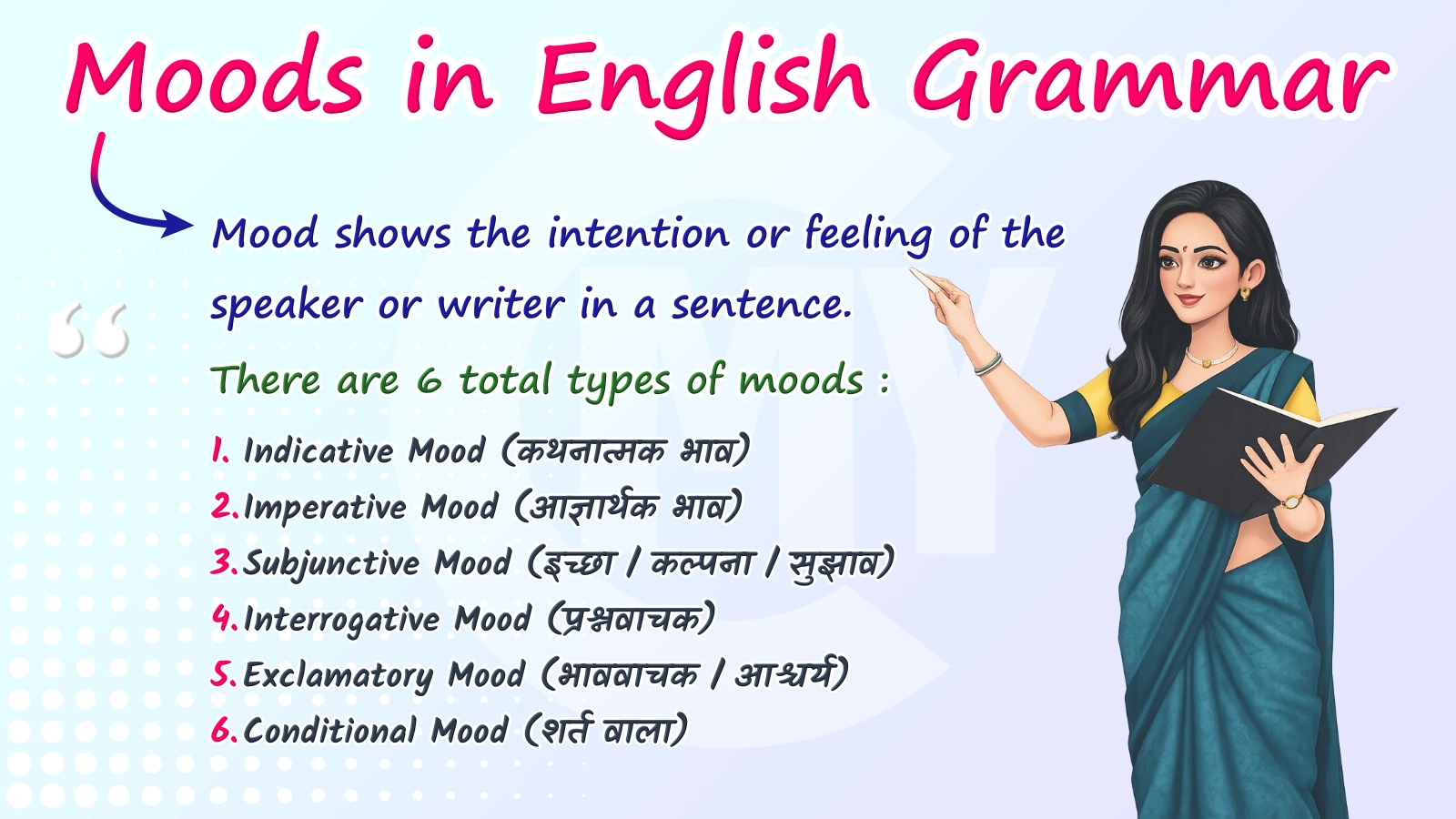
Mood shows the intention or feeling of the speaker or writer in a sentence. It tells us whether the sentence is giving a request, an order, a suggestion, a real fact, or something imaginary.
Different dictionaries explain mood in similar ways. The Oxford Learner’s Dictionary says that mood is a type of verb form that shows facts, orders, questions, wishes, or conditions. The Oxford Dictionary of English Grammar explains mood as a grammatical category of verbs that tells us if a sentence expresses a fact, a command, or a possibility. According to the Cambridge Dictionary, mood refers to the form of a verb that shows whether the speaker is stating a fact, giving an order, or expressing a hope.
📌 Simple Meaning: Mood = Sentence का भाव
Main Types of Mood
English grammar में मुख्यतः 3 Moods होते हैं:
- Indicative Mood (कथनात्मक भाव)
- Imperative Mood (आज्ञार्थक भाव)
- Subjunctive Mood (इच्छा / कल्पना / सुझाव)
कुछ books में 6 प्रकार के moods बताए जाते हैं। जो Main Types of Moods से अलग करके बनाए जाते हैं, जिनकी संख्या 3 है, जो निम्नलिखित हैं-
- Interrogative Mood (प्रश्नवाचक)
- Exclamatory Mood (भाववाचक / आश्चर्य)
- Conditional Mood (शर्त वाला)
1️⃣ Indicative Mood (कथनात्मक भाव)
जब वाक्य में fact, statement, question या real situation हो।
The indicative mood is the most commonly used mood in English. It is used to express facts, opinions, and general statements. We use it to talk about real situations and to tell whether something happened or did not happen. Below are some examples of sentences that show the indicative mood.
Uses:
- Statements
- Questions
- Real actions
Examples:
- She plays tennis.
👉 वह टेनिस खेलती है। - They are happy.
👉 वे खुश हैं। - Are you ready?
👉 क्या तुम तैयार हो?
⭐ Note: Daily conversation में सबसे ज़्यादा use यही mood होता है।
2️⃣ Imperative Mood (आज्ञार्थक भाव)
Sentences that give commands, orders, or requests are in the imperative mood. In simple words, every imperative sentence shows the imperative mood. The action in these sentences has not happened yet, and sometimes it may not happen at all. Imperative sentences usually start with the base form of the verb and do not mention the subject, as “you” is understood. However, you can add a name or noun at the beginning to show who the order or request is meant for.
जब sentence में order, request, advice, suggestion, instruction हो।
Structure:
- Sentence verb (V1) से शुरू होता है।
- Subject (you) hidden रहता है।
Examples:
- Close the door.
👉 दरवाज़ा बंद करो। - Please help me.
👉 कृपया मेरी मदद करो। - Sit down quietly.
👉 चुपचाप बैठ जाओ।
Negative Imperative:
- Don’t run.
👉 मत दौड़ो।
3️⃣ Subjunctive Mood (इच्छा / कल्पना / सुझाव)
जब वाक्य में wish, doubt, unreal condition, suggestion या imagination हो।
The subjunctive mood does not talk about real or definite facts. It is used to express opinions, wishes, intentions, beliefs, and feelings. In general, it shows a person’s thoughts or state of mind. We also use the subjunctive mood to describe imaginary or hypothetical situations.
Common Patterns:
- I wish…
- If I were…
- Suggest / Recommend + that
Examples:
- I wish I were rich.
👉 काश मैं अमीर होता। - If I were you, I would study.
👉 अगर मैं तुम्हारी जगह होता, तो पढ़ता। - The teacher suggested that he work harder.
👉 शिक्षक ने सुझाव दिया कि वह और मेहनत करे।
⭐ Note: Subjunctive में अक्सर were सभी subjects के साथ आता है।
4️⃣ Interrogative Mood (प्रश्नवाचक)
यह mood question पूछने के लिए होता है।
The interrogative mood is used in question sentences. It shows that the speaker is asking a question in order to get an answer.
Examples:
- Are you planning to take up the course on resin art?
👉 क्या तुम रेज़िन आर्ट का कोर्स करने की योजना बना रहे हो? - What are your plans for the weekend?
👉 वीकेंड के लिए तुम्हारी क्या योजनाएँ हैं? - When are you coming back to Coimbatore?
👉 तुम कोयंबटूर कब वापस आ रहे हो? - Is this Priya’s new car?
👉 क्या यह प्रिया की नई कार है? - Did you find the answer to that differential equation?
👉 क्या तुम्हें उस अवकल समीकरण (डिफरेंशियल इक्वेशन) का उत्तर मिला?
👉 Helping verb या WH-word से शुरू होता है।
5️⃣ Exclamatory Mood (भाववाचक / आश्चर्य)
Strong emotion या surprise दिखाने के लिए।
The exclamatory mood is used to show strong feelings or sudden emotions. These sentences usually start with “what” or “how” and always end with an exclamation mark (!).
Examples:
- What a beautiful day it is!
👉 क्या ही सुंदर दिन है! - How fast he runs!
👉 वह कितनी तेज़ दौड़ता है! - What a wonderful idea!
👉 क्या ही शानदार विचार है! - How amazing this place looks!
👉 यह जगह कितनी अद्भुत लगती है! - What a big surprise!
👉 क्या ही बड़ा आश्चर्य है!
👉 Sentence में “!” आता है।
6️⃣ Conditional Mood (शर्त वाला)
Condition पर dependent action।
The conditional mood is used to talk about situations that depend on certain conditions. It shows that an action may or may not happen depending on something else. Words like “if” and “when”, and modal verbs such as “would”, “might”, and “could” are often used to make sentences in the conditional mood.
Examples:
- You will reach on time if you leave home by 7 a.m.
👉 अगर तुम सुबह 7 बजे तक घर से निकलोगे, तो तुम समय पर पहुँच जाओगे। - We will meet you when we come to Bangalore the next time.
👉 जब हम अगली बार बैंगलोर आएँगे, तब हम तुमसे मिलेंगे। - They will make an exception if you have genuine reasons.
👉 अगर तुम्हारे पास सही कारण होंगे, तो वे अपवाद बना देंगे। - You could enrol if you are interested in learning about cultural diversity.
👉 अगर तुम्हें सांस्कृतिक विविधता के बारे में सीखने में रुचि है, तो तुम नामांकन कर सकते हो। - Windy can make you another drink if you’d like.
👉 अगर तुम चाहो तो विंडी तुम्हारे लिए एक और ड्रिंक बना सकती है।
👉 “if” clause बहुत common है।
Comparison Table
| Mood | Purpose | Example |
|---|---|---|
| Indicative | Fact | She works hard. |
| Imperative | Order | Sit down. |
| Interrogative | Question | Are you ready? |
| Exclamatory | Emotion | What a day! |
| Subjunctive | Wish/Unreal | I wish I were rich. |
| Conditional | Condition | If it rains, stay inside. |
⭐ Why It Is Important to Learn Moods in English
Learning moods helps you write clear sentences and good essays. It also makes grammar questions easier in exams and improves your daily communication. When you understand different moods like declarative, imperative, and others, you can make correct sentences and avoid common mistakes.
🔎 Easy Tips to Recognise Moods in Sentences
- If the sentence gives an order or request, it is imperative mood.
- If it asks a question or has a question mark (?), it shows interrogative mood.
- If it tells a fact or real information, it is indicative mood.
- If it shows strong emotion and ends with (!), it is exclamatory mood.
- If you see words like if, wish, or suggest, it may be subjunctive or conditional mood.
✏️ Practice: Find the Mood
Read the sentences below and identify the mood of the underlined verbs.
- Finish this today.
- Our car broke down.
- It is better you finish the project by Thursday.
- Where is their house?
- My feet are paining.
- I would sleep all day if I were a baby.
- Do you like me?
- Emmet drank a glass of water.
- The teacher demanded that we keep quiet.
- She will repay when she gets her salary.
📝 Answers
- Finish this today. – Imperative Mood
- Our car broke down. – Indicative Mood
- It is better you finish the project by Thursday. – Subjunctive Mood
- Where is their house? – Interrogative Mood
- My feet are paining. – Indicative Mood
- I would sleep all day if I were a baby. – Subjunctive Mood
- Do you like me? – Interrogative Mood
- Emmet drank a glass of water. – Indicative Mood
- The teacher demanded that we keep quiet. – Subjunctive Mood
- She will repay when she gets her salary. – Conditional Mood
FAQs
⭐ What is mood in English grammar?
⭐ What are the 3 main moods in English?
- Indicative Mood
- Imperative Mood
- Subjunctive Mood
⭐ Give 5 examples of moods.
- Moana played on the seashore. — Indicative
- Teena will contact you if she has doubts. — Conditional
- Where is the government hospital? — Interrogative
- Do not take the bypass road. — Imperative
- I wish my friends were here today. — Subjunctive