

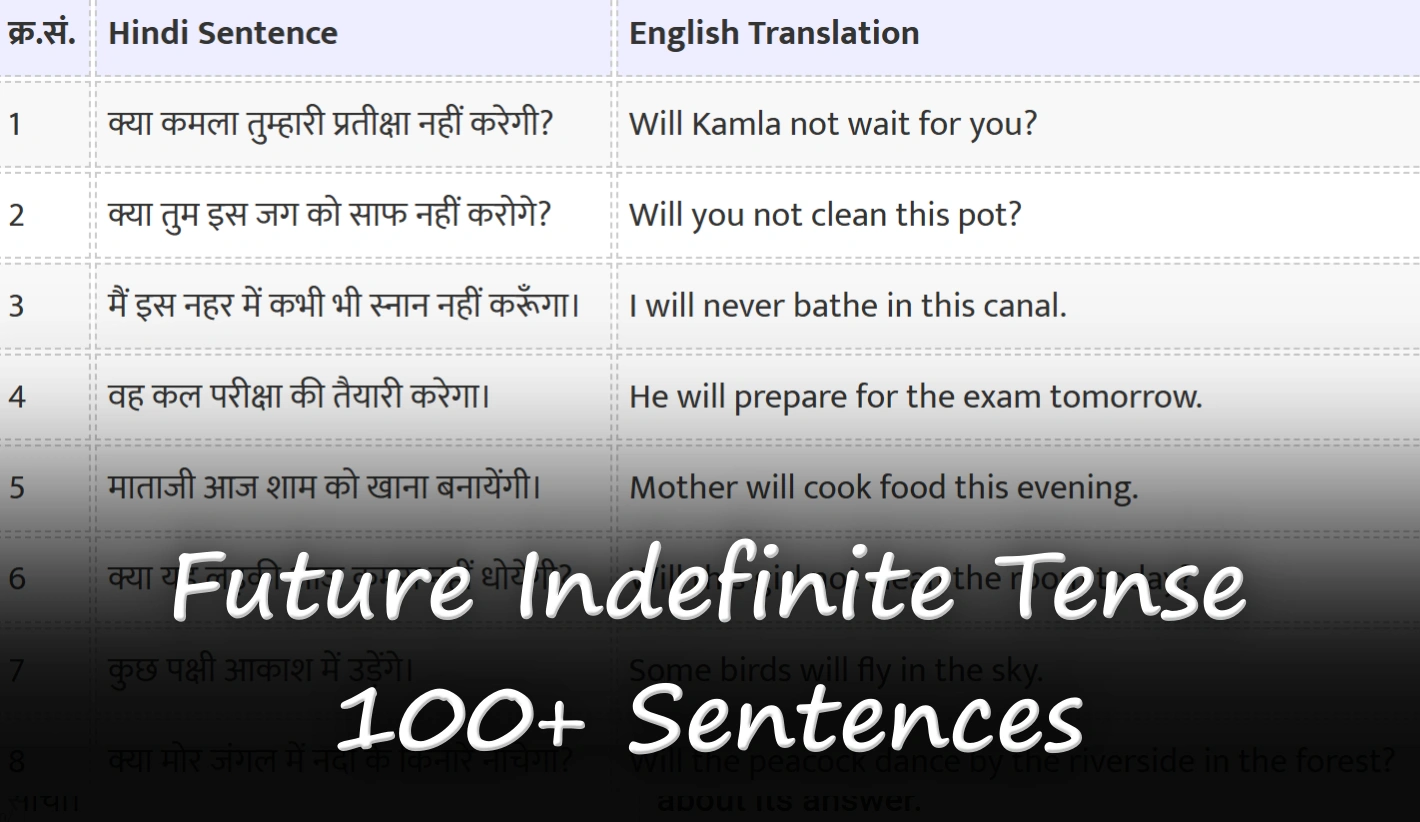
Future Indefinite Tense (Simple Future) in Hindi: Rules, Examples and Exercises
Future Indefinite Tense से काम का भविष्य में होना प्रकट होता है किन्तु काम के जारी रहने या पूर्ण होने के विषय में कुछ भी पता नहीं चलता है। इस Tense में Will/Shall का प्रयोग सहायक क्रिया की -तरह होता है तथा मुख्य क्रिया की First Form का प्रयोग होता है। इस Tense के वाक्यों में ‘गा, गे, गी’ आदि शब्दों का प्रयोग होता है किन्तु रहा होगे, रहे होंगे, चुकेगा, चुकूंगा का प्रयोग नहीं होता है।
नीचे दी गई टेबल को ध्यानपूर्वक पढ़िए:
| Person (पुरुष) |
Singular (एकवचन) |
Plural (बहुवचन) |
|---|---|---|
| I Person | I shall play. मैं खेलूंगा। |
We shall play. हम खेलेंगे। |
| II Person | You will play. तुम खेलोगे। |
You will play. आप खेलेंगे। |
| III Person | He (She, It) will play. वह खेलेगा। |
They will play. वे खेलेंगे। |
Rules (नियम):
- I. We के साथ Shall और फिर मुख्य क्रिया की First Form आती है।
- He, She, It. They तथा सभी Singular और Plural Nouns के साथ Will और फिर मुख्य क्रिया की First Form आती है।
नोट –
- इस Tense में Will/Shall का प्रयोग सहायक क्रिया (Helping Verbs) के रूप में होता है।
- इस Tense में Yesterday का प्रयोग नहीं होता है।
- कल के लिए Tomorrow का प्रयोग होता है।
(A) Affirmative (Positive) Sentences
1. मैं आज यह पुस्तक पढूँगा।
I shall read this book today.
2. हम तुम्हारे साथ इलाहाबाद चलेंगे।
We shall go to Allahabad with you.
3. तुम अपने मित्रों की सहायता करोगे।
You will help your friends.
4. वे तुम्हारी सहायता कल करेंगे।
They will help you tomorrow.
5. वह कल अपने गांव से यहाँ आयेगा।
He will come here from his village tomorrow.
6. वह कल एक मधुर गीत गायेगी।
She will sing a sweet song tomorrow.
7. मैं आज अवश्य पढूँगा।
I will read today.
8. तुम्हें वहाँ जाना पड़ेगा।
You shall go there.
9. हम तुम्हारी सहायता अवश्य करेंगे।
We will help you.
10. उन्हें यह कार्य करना पड़ेगा।
They shall do this work.
(B) Negative Sentences
11. वह यहाँ नहीं आयेगा।
He will not come here.
12. हम तुम्हारी सहायता नहीं करेंगे।
We shall not help you.
13. राम आज पत्र नहीं लिखेगा।
Ram will not write a letter today.
14. तुम्हारा भाई कल इस कमरे में नहीं सोयेगा।
Your brother will not sleep in this room tomorrow.
15. वह वहाँ कभी नहीं जायेगी।
She will never go there.
(C) Interrogative Sentences (Question Form)
First Type (‘क्या’ से आरम्भ होने वाले वाक्य):
16. क्या राम क्रिकेट खेलेगा?
Will Rama play cricket?
17. क्या मुकेश कल खैर जायेगा?
Will Mukesh go to Khair tomorrow?
18. क्या ये बच्चे कल यहाँ सोयेंगे?
Will these children sleep here tomorrow?
19. क्या चपरासी आज घंटी नहीं बजायेगा?
Will the peon not ring the bell today?
20. क्या वह कभी भी तुम्हारे साथ नहीं जायेगा?
Will he never go with you?
21. क्या वह यहाँ कभी आयेगा?
Will he ever come here?
22. क्या वह यहाँ अब कभी नहीं आयेगी?
Will she never come here now?
Second Type (Wh-Type Questions):
23. वह आज क्या खायेगा?
What will he eat today?
24. तुम घर कब जाओगे?
When will you go home?
25. वह यहाँ क्यों नहीं आयेगी?
Why will she not come here?
26. वह यह कार्य कैसे करेगा?
How will he do this work?
27. वे आज कहाँ जायेंगे?
Where will they go today?
28. वह यहाँ अब कभी क्यों आयेगा?
Why will he ever come here now?
29. राम यहाँ अब कभी कैसे नहीं आयेगा?
How will Rama never come here now?
30. तुम्हारी सहायता कौन करेगा?
Who will help you?
31. तुम्हारी प्रतीक्षा कौन नहीं करेगा?
Who will not wait for you?
पहिचान और अनुवाद के नियम
पहिचान-
- इस काल के वाक्यों के अन्त में ‘गा, गे, गी’ आदि शब्द आते हैं।
- इस काल के वाक्यों से कार्य के पूरा होने, अपूर्ण रहने, जारी रहने या लगातार होते रहने के विषय में कुछ भी ज्ञात नहीं होता है।
अनुवाद के नियम-
इस काल के वाक्यों में सामान्यतया I, We के साथ Shall तथा अन्य सब कर्ताओं के साथ Will लगाकर Verb की First Form का प्रयोग होता है।
(A) Affirmative Sentences:
- ऐसे वाक्यों में Will/Shall सहायक क्रिया (Helping Verbs) होती है। First Form वाली क्रिया Main Verb (मुख्य क्रिया) होती है।
- धमकी, आदेश तथा बाध्यता प्रकट करने के लिए I, We के साथ Will तथा अन्य सब कर्ताओं के साथ Shall का प्रयोग होता है। (उदाहरण 7-10)
- कल के लिए Future Tense में Tomorrow का प्रयोग किया जाता है।
(B) Negative Sentences :
- ‘नहीं’ के लिए Not का प्रयोग सहायक क्रिया के बाद में तथा मुख्य क्रिया से पहले होता है।
- ‘कभी नहीं’ के लिए Never का प्रयोग होता है।
- Not की तरह Never भी सहायक क्रिया तथा मुख्य क्रिया के बीच में ही प्रयुक्त होता है।
(C) Interrogative Sentences:
- यदि वाक्य के आरम्भ में ‘क्या’ शब्द आया है (First Type) तो ‘क्या’ शब्द का अनुवाद What से नहीं किया जाता है। ऐसे वाक्यों में वाक्य के भाव तथा कर्ता के अनुसार कर्ता (Subject) से पहले Will या Shall तथा कर्ता के पश्चात मुख्य क्रिया की First Form का प्रयोग होता है।
- ‘कभी’ के लिए Ever और ‘कभी नहीं’ के लिए Never का प्रयोग किया जाता है।
- यदि प्रश्नसूचक शब्द (क्या, क्यों, कैसे, कब और कहाँ) वाक्य के बीच में हो (Second Type) तो सर्वप्रथम उस शब्द की अंग्रेजी-What, Why, How, When तथा Where का प्रयोग होता है और फिर कर्ता से पहले, कर्ता (Subject) के अनुसार, सहायक क्रिया Will या Shall का प्रयोग ‘होता है। फिर कर्ता के बाद मुख्य क्रिया (Main Verb) की First Form आती है।
- यदि ऐसा वाक्य Negative है तो ‘नहीं’ के लिए Nor का प्रयोग मुख्य क्रिया से पहले किया जाता है।
- यदि वाक्य में ‘कभी नहीं’ है तो ‘कभी नहीं’ के लिए Never का प्रयोग होता है।
- यदि वाक्य में ‘कभी’ का प्रयोग हुआ है तो ‘कभी’ के लिए Ever का प्रयोग किया जाता है।
- ‘कौन’ या ‘किसने’ के लिए Who का प्रयोग होता है। Who के तुरन्त बाद सहायक क्रिया और मुख्य क्रिया आती है।
- यदि ‘कौन’ या ‘किसने’ वाला वाक्य Negative भी है तो ‘नहीं’ के लिए Nor का प्रयोग सहायक क्रिया और मुख्य क्रिया के बीच में किया जाता है।
- प्रश्नवाचक वाक्य के अन्त में प्रश्नवाचक चिन्ह (?) लगाया जाता है।
EXERCISE 1. (Positive Sentences) Translate the following sentences into English:
| क्र.सं. | Hindi Sentence | English Translation |
|---|---|---|
| 1 | मैं इस वर्ष हाई स्कूल की परीक्षा दूंगा। | I will appear in the high school examination this year. |
| 2 | हम इस वर्ष अवश्य सफल होंगे। | We shall definitely succeed this year. |
| 3 | तुम्हारे भाई आज चिड़ियाघर देखने जायेंगे। | Your brothers will go to see the zoo today. |
| 4 | तुम्हें यह कार्य अवश्य करना पड़ेगा। | You will have to do this work. |
| 5 | हम आज अजायबघर देखने अवश्य जायेंगे। | We shall certainly go to see the museum today. |
| 6 | परसों चाचाजी देहली बिरला मन्दिर देखने जायेंगे। | The uncle will go to Delhi to see the Birla Temple the day after tomorrow. |
| 7 | कल महेश अपने परिवार सहित कुतुबमीनार देखने जायेगा। | Mahesh will go to see the Qutub Minar tomorrow with his family. |
| 8 | हमारे वर्तमान प्रधानमन्त्री आगामी चुनाव में भाग लेंगे। | Our present Prime Minister will take part in the coming elections. |
| 9 | कांग्रेस अध्यक्ष अपनी सरकार कांग्रेसियों से ही बनाना पसन्द करेंगे। | The Congress President will prefer to form his government with the Congressmen themselves. |
| 10 | हमारे राष्ट्रपति अनिश्चित वातावरण को समाप्त करने के लिए उचित कदम उठायेंगे। | Our President will take proper steps to end the uncertain situation. |
| 11 | राष्ट्रपति सत्तालोलुप व्यक्तियों पर नियन्त्रण अवश्य करेंगे। | The President will certainly control the power-hungry persons. |
| 12 | कल महेश, रमेश और मुकेश गंगाजी में स्नान करने जायेंगे। | Tomorrow Mahesh, Ramesh, and Mukesh will go to bathe in the Ganga. |
| 13 | लक्ष्मी कल तक यहाँ अवश्य ही आ जायेगी। | Lakshmi will definitely come here by tomorrow. |
| 14 | आज वर्षा होगी। | It will rain today. |
| 15 | कल तेज हवा चलेगी। | There will be a strong wind tomorrow. |
Difficult words:परीक्षा देना = to take examination, to appear at the examination; चिड़ियाघर = zoo; अजायबघर = museum; परसों day after tomorrow; चुनाव = elections: आगामी = next; कांग्रेसियों से ही = only from the Congress members; अनिश्चितता = uncertainty: वातावरण = atmosphere; समाप्त करना = to end; उचित कदम adequate step, proper step: सत्तालोलुप = power hungry.
नोट- वाक्य 2 में will succeed, वाक्य 4 में shall do, वाक्य 5 में will go, वाक्य ।। में shall control का प्रयोग कीजिए।
EXERCISE 2. (Negative Sentences) Translate the following sentences into English:
| क्र.सं. | Hindi Sentence | English Translation |
|---|---|---|
| 1 | तुम आज कानपुर अपने मित्रों के साथ नहीं जाओगे। | You will not go to Kanpur with your friends today. |
| 2 | माताजी आज हम सबके लिए कपड़े नहीं खरीदेंगी। | Mother will not buy clothes for all of us today. |
| 3 | आज का दिन तूफानी नहीं होगा। | The day will not be stormy today. |
| 4 | कल हमारी छुट्टी नहीं रहेगी। | We shall not have a holiday tomorrow. |
| 5 | आज मूसलाधार बारिश नहीं होगी। | There will not be heavy rain today. |
| 6 | पिताजी आज मुझे दस रुपये नहीं देंगे। | Father will not give me ten rupees today. |
| 7 | कुछ मेहमान अब यहाँ और अधिक समय तक नहीं रहेंगे। | Some guests will not stay here any longer. |
| 8 | रशीद आज अपने पुत्र की बीमारी के कारण नहीं आयेगा। | Rashid will not come today because of his son’s illness. |
| 9 | रमेश आज लखनऊ से नहीं आयेगा। | Ramesh will not come from Lucknow today. |
| 10 | रेखा आज दवाई लेने अस्पताल नहीं आयेगी। | Rekha will not come to the hospital to get medicine today. |
| 11 | यह माली आज अपना कार्य नहीं करेगा। | This gardener will not do his work today. |
| 12 | हम कल उपवास नहीं रखेंगे। | We shall not observe a fast tomorrow. |
| 13 | तुम्हें वहाँ अवश्य जाना पड़ेगा। | You will have to go there. |
| 14 | मुझे यह पुस्तक शीघ्र पूरी करनी पड़ेगी। | I shall have to finish this book soon. |
| 15 | इस लड़की को आज परिवार के गन्दे कपड़े अवश्य ही धोने पड़ेंगे। | This girl will have to wash the family’s dirty clothes today. |
Difficult words : तूफानी = stormy; छुट्टी = holiday; मूसलाधार बारिण होना = to rain heavily; मेहमान = guests; और अधिक समय तक any longer, दवाई = medicine; अस्पताल = hospital; उपवास = fast; गन्दे कपड़े = dirty clothes.
नोट– वाक्य 13 में shall, वाक्य 14 में will. तथा वाक्य 15 में shall के साथ Verb की First Form का प्रयोग कीजिए।
EXERCISE 3. (Interrogative Sentences) Translate the following sentences into English:
(A) First Type
| क्र.सं. | Hindi Sentence | English Translation |
|---|---|---|
| 1 | क्या तुम अपने मित्रों के साथ चिड़ियाघर देखने जाओगे? | Will you go to the zoo with your friends? |
| 2 | क्या आज रेखा और रमेश लखनऊ का अजायबघर देखने जायेंगे? | Will Rekha and Ramesh go to see the museum of Lucknow today? |
| 3 | क्या माताजी और पिताजी गंगा स्नान करने राजघाट जायेंगे? | Will mother and father go to Rajghat to bathe in the Ganges? |
| 4 | क्या तुम्हारे मित्र आज कक्षा में ध्यानपूर्वक प्रश्न नहीं हल करेंगे? | Will your friends not solve the questions carefully in class today? |
| 5 | क्या तुम्हारा यह पड़ोसी तुम्हारी सहायता कभी भी नहीं करेगा? | Will this neighbor of yours never help you? |
| 6 | क्या दक्षिण भारत की महिला नयी सरकार के गठन में सहायता करेगी? | Will the lady from South India help in forming the new government? |
| 7 | क्या प्रधानमन्त्री आगामी दो दिनों में नयी सरकार का गठन कर सकेंगे? | Will the Prime Minister be able to form the new government within the next two days? |
(B) Second Type :
| क्र.सं. | Hindi Sentence | English Translation |
|---|---|---|
| 8 | तुम्हारे भाई आज दोपहर में क्या खरीदेंगे? | What will your brothers buy this afternoon? |
| 9 | तुम अपने माता-पिता के साथ अपने घर कब जायेंगे? | When will you go to your home with your parents? |
| 10 | हमीद नयी पुस्तक कहाँ पर लिखेगा? | Where will Hamid write the new book? |
| 11 | वह यह प्रश्न किस प्रकार हल कर सकेगी? | How will she be able to solve this question? |
| 12 | तुम अपने मित्रों के साथ पिकनिक पर कहाँ जाओगे? | Where will you go for a picnic with your friends? |
| 13 | सीता तुम्हारे गाँव कभी क्यों नहीं जायेगी? | Why will Sita never go to your village? |
| 14 | गिरीश यहाँ अब कभी क्यों नहीं आयेगा? | Why will Girish never come here again? |
| 15 | मेरी सहायता रमेश के अतिरिक्त और कौन करेगा? | Who else, besides Ramesh, will help me? |
| 16 | कौन-सा पुत्र बूढ़े माता-पिता की देखभाल नहीं करना चाहेगा? | Which son will not want to take care of his old parents? |
| 17 | अपने बड़े भाई की प्रतीक्षा दिल्ली स्टेशन पर तुम तीनों में से कौन करेगा? | Who among you three will wait for your elder brother at Delhi station? |
| 18 | अब तुम किस लेखक की गाइड का अध्ययन करोगे? | Which author’s guide will you study now? |
| 19 | चोर किसका छाता चुरायेगा? | Whose umbrella will the thief steal? |
Difficult words: चिड़ियाघर = 200; अजायबघर = museuin; ध्यानपूर्वक =carefully (attentively); हल करना to solve; यह पड़ोसी = this neighbour; अतिरिक्त = except, गठन में in forming, आगामी = next day: पिकनिक picnic; रमेश के Ramesh; तुम तीनों में से कौन = which three of you: लेखक = writer, author: किसका छाता = whose umbrella?
EXERCISE 4. (Miscellaneous) Translate the following sentences into English:
| क्र.सं. | Hindi Sentence | English Translation |
|---|---|---|
| 1 | क्या कमला तुम्हारी प्रतीक्षा नहीं करेगी? | Will Kamla not wait for you? |
| 2 | क्या तुम इस जग को साफ नहीं करोगे? | Will you not clean this pot? |
| 3 | मैं इस नहर में कभी भी स्नान नहीं करूँगा। | I will never bathe in this canal. |
| 4 | वह कल परीक्षा की तैयारी करेगा। | He will prepare for the exam tomorrow. |
| 5 | माताजी आज शाम को खाना बनायेंगी। | Mother will cook food this evening. |
| 6 | क्या यह लड़की आज कमरा नहीं धोयेगी? | Will this girl not clean the room today? |
| 7 | कुछ पक्षी आकाश में उड़ेंगे। | Some birds will fly in the sky. |
| 8 | क्या मोर जंगल में नदी के किनारे नाचेगा? | Will the peacock dance by the riverside in the forest? |
| 9 | हम मास्टर साहब की आज्ञा अवश्य मानेंगे। | We will definitely obey the teacher’s order. |
| 10 | तुम मुझे इतिहास कब पढ़ाओगे? | When will you teach me history? |
Difficult words: जग= jug; नहर canal; परीक्षा examination; तैयारी करना to prepare; मोर = peacock; इतिहास = history.
Learn other English Grammar in Hindi Translation: