

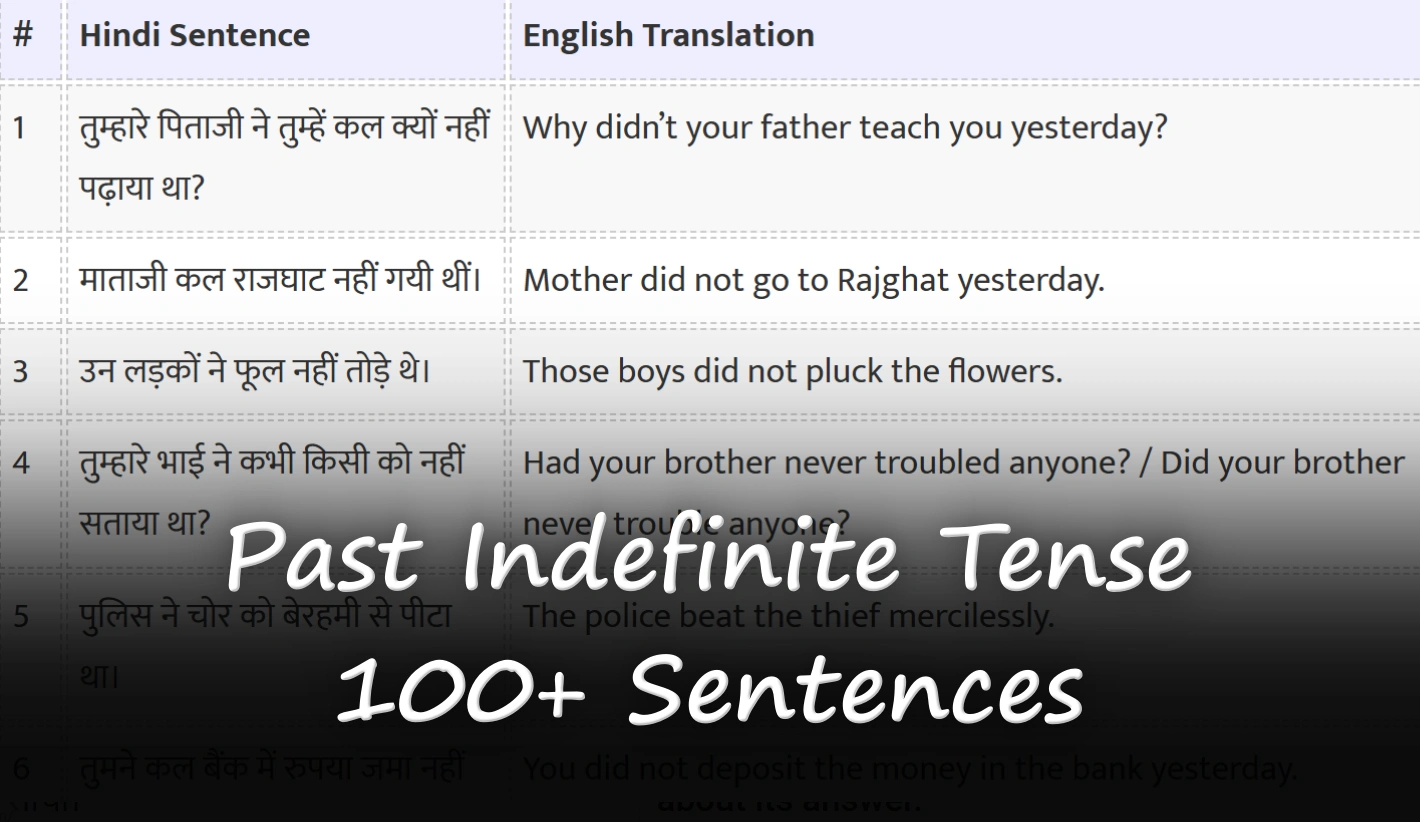
Past Indefinite Tense (Simple Past) in Hindi: Rules, Examples and Exercises
Past Indefinite Tense के वाक्यों से ज्ञात होता है कि कार्य भूतकाल में हुआ था। इसका प्रयोग निम्न रीति से होता है-
(A) भूतकाल में कार्य के होने को प्रकट करने के लिए; जैसे-
वह कल यहाँ आया था।
He came here yesterday.
(B) भूतक्ताल में कार्य के होता रहना प्रकट करने के लिए; जैसे-
जब हम गा रहे थे, वे नाच रहे थे।
While we sang, they danced. (OR) While we were singing, they were dancing.
(C) भूतकाल में Habitual Action (स्वाभाविक कार्य) का होना प्रकट करने के लिए; जैसे-
वह प्रतिदिन दस घण्टे काम किया करता था।
He worked ten hours everyday. (OR) He used to work ten hours everyday.
वह प्रतिदिन सुबह के समय चाय पिया करती थी।
She had tea every morning. (OR) She drank tea every morning. (OR) She used to have tea every morning.
नोट-चाय पीने के लिए सामान्य रूप से drank tea का प्रयोग किया जाता है किन्तु Modern English में had tea का प्रयोग अधिक अच्छा माना जाता है।
Past Indefinite Tense के वाक्यों के अन्त में ता था, ती थे, ते थे, आ, ई, ये आदि शब्दों का प्रयोग होता है। इन वाक्यों में था, थी, थे के लिए Was, Were का प्रयोग नहीं किया जाता है। Was, Were के प्रयोग को “Use of Be” अध्याय में स्पष्ट किया जा चुका है।
नीचे दी गई टेबल को ध्यानपूर्वक पढ़िए:
| Person (पुरुष) |
Singular (एकवचन) |
Plural (बहुवचन) |
|---|---|---|
| I Person | I went. मैं गया। मैं गया था। मैं जाता था। |
We went. हम गये। हम गये थे। हम जाते थे। |
| II Person | You went. तुम गये। (एक व्यक्ति) |
You went. आप गये। (बहुत-से व्यक्ति) |
| III Person | He (She. It) went. वह गया। | They went. वे गये थे। |
Rules (तियम):
- प्रत्येक कर्ता के साथ Verb की Second Form का प्रयोग होता है।
- नोट- ‘कल’ के लिए Yesterday का प्रयोग किया जाता है।
(A) Affirmative (Positive) Sentences
1. मैं कल कानपुर गया था।
I went to Kanpur yesterday.
2. हम आज आगरा से आये थे।
We came from Agra today.
3. तुमने कल क्रिकेट मैच खेला था।
You played a cricket match yesterday.
4. उन्होंने तुम्हारी सहायता की थी।
They helped you.
5. माताजी ने गंगाजी में स्नान किया था।
Mother bathed in the Ganga.
6. पिताजी आज दफ्तर गये थे।
Father went to office today.
7. इन लड़कों ने अपना कार्य किया था।
These boys did their work.
8. उन लड़कों ने पुस्तकालय में शोर मचाया था।
Those boys made a noise in the library.
9. आज जोर से बारिश हुई थी।
It rained heavily today.
10. राम के भाई ने मेरी पुस्तक चुराई थी।
Rama’s brother stole my book.
11. माताजी पिछले वर्ष हमें कहानियाँ सुनाया करती थीं।
Mother used to tell us stories last year. (OR) Mother would tell us stories last year.
12. पिताजी सुबह के समय प्रतिदिन टहलते थे। (या टहला करते थे।)
Father walked every morning.
(B) Negative Sentences
13. तुम कल आगरा नहीं गये थे।
You did not go to Agra yesterday.
14. हम आज स्टेशन नहीं गये थे।
We did not go to station today.
15. आज सूर्य नहीं निकला था।
The sun did not rise today.
16. उन्होंने किसी को गाली नहीं दी थी।
They did not abuse anyone.
17. मैंने कभी कोई वस्तु नहीं चुरायी।
I never stole anything.
18. उस लड़की ने सफेद हाथी कभी नहीं देखा।
That girl never saw a white elephant.
(C) Interrogative Sentences (Question Form)
First Type (‘क्या’ से आरम्भ होने वाले वाक्य):
19. क्या यह लड़का यहाँ सोया था?
Did this boy sleep here?
20. क्या तुम्हारे भाई कल मथुरा गये थे?
Did your brother go to Mathura yesterday?
21. क्या उन्होंने तुम्हें नहीं पीटा था?
Did they not beat you?
22. क्या कल इस लड़की ने अपना पाठ याद नहीं किया था?
Did this girl not learn her lesson yesterday?
23. क्या तुमने कभी कोई वस्तु नहीं चुरायी?
Did you never steal anything?
Second Type (Wh-Type Questions):
24. तुम आज कहाँ गये थे?
Where did you go today?
25. इस लड़के ने अपना पाठ क्यों नहीं याद किया?
‘Why’ did this boy not learn his lesson?
26. वह यहाँ कब आया था?
When did he come here?
27. राम ने आज क्या खाया था?
What did Rama eat today?
28. वह इस साल किस प्रकार पास हुआ?
How did he pass this year?
29. तुम्हें कल किसने बुलाया था?
Who called you yesterday?
30. उन्होंने किसकी सहायता की?
Whom did they help?
31. तुम्हारे भाई ने ‘किसकी पुस्तक चुरायी थी?
Whose book did your brother steal?
32. इस वर्ष कितने विद्यार्थी परीक्षा में सम्मिलित हुए?
How many boys appeared at the examination this year?
33. इस बच्चे ने आज कितना दूध पिया था?
How much milk did this child drink today?
34. पर्वत ने गिलहरी से क्या कहा था?
What did the mountain say to the squirrel?
35. तुमने कौन-सी पुस्तक छाँटी थी?
Which book did you select?
36. किस-किसने किस-किसको क्या-क्या दिया?
Who gave what to whom?
37. गिलहरी ने पर्वत को क्या उत्तर दिया?
What reply did the squirrel give to the mountain?
38. तुमसे ऐसा किसने कहा था?
Who told you so?
पहिचान और अनुवाद के नियम
पहिचान-
- इस Tense के वाक्यों के अन्त में प्रायः आ, ए, ई, था, थे, थी, ते थे, ती थी आदि शब्द आते हैं।
- इस Tense के वाक्यों से कार्य के जारी रहने या अपूर्ण होने के विषय में कुछ भी ज्ञात नहीं होता है।
- इस Tense के वाक्यों में कार्य के पूर्ण होने की अवधि नहीं दी होती है।
अनुवाद के नियम-
(A) Positive Sentences:
- प्रत्येक कर्ता के साथ क्रिया (Verb) की Second Form का प्रयोग होता है।
- ‘कल’ के लिए Yesterday आता है।
- था, थे, थी के लिए Was, Were का प्रयोग नहीं होता है। वह आया था। वह आया। वह आता था। इन सबकी अंग्रेजी He came ही होगी।
नोट– इस Tense का प्रयोग आदत प्रकट करने के लिए भी होता है। अग्रलिखित वाक्य को ध्यानपूर्वक पढ़िए-
माताजी पिछले वर्ष हमें कहानियाँ सुनाया करती थीं।
Mother used to tell us stories last year. (OR) Mother would tell us stories last year.
इसका ‘भाव है कि माता जी पिछले वर्ष कहानियाँ सुनाती थीं, अब नहीं सुनाती हैं। Modern English में used to tell के स्थान पर would tell का भी प्रयोग होने लगा है। अग्रलिखित वाक्य को ध्यानपूर्वक पढ़िए-
माताजी हमें कहानियाँ सुनाती थीं।
Mother told us stories.
इस वाक्य से Habitual Action प्रकट हो रहा है।
पिताजी सुबह के समय टहलते थे।
Father walked in the morning. (यह सामान्य कथन है।)
(B) Negative Sentences:
- निषेधात्मक वाक्यों में ‘नहीं’ के लिए Did not के साथ मुख्य क्रिया (Main Verb) की First Form का प्रयोग होता है।
- ऐसे वाक्यों में did-सहायक क्रिया (Helping Verb) की तरह आती है।
- ‘कभी मत’ के लिए Never का प्रयोग होता है। Never के पश्चात Verb की Second Form आती है।
- ऐसे वाक्यों में सहायक क्रिया (Helping Verb) नहीं होती है बल्कि मुख्य क्रिया की Second Form का ही प्रयोग होता है।
(C) Interrogative Sentences:
- यदि प्रश्नवाचक वाक्य ‘क्या’ शब्द से आरम्भ हुआ है (First Type) तो ‘क्या’ का अनुवाद What से नहीं किया जाता है। ऐसे वाक्यों में कर्ता (Subject) से पहले Did का प्रयोग होता है और कर्ता (Subject) के पश्चात क्रिया की प्रथम अवस्था (Basic Form अर्थात First Form) का प्रयोग होता है।
- यदि ऐसा वाक्य निषेधात्मक भी है तो ‘नहीं’ के लिए Did not का प्रयोग करके मुख्य क्रिया की First Form का प्रयोग किया जाता है।
- प्रश्नवाचक वाक्यों में ‘कभी नहीं’ के लिए Did और Never का प्रयोग होता है। ऐसे वाक्यों में Did के होने के कारण Never के पश्चात भी Verb की First Form का ही प्रयोग होता है।
- वाक्य में Never के पश्चात Verb की II Form का प्रयोग हुआ है और दूसरे वाक्य में Never के पश्चात Verb की First Form का प्रयोग हुआ है। यह अन्तर Did का प्रयोग होने के कारण है।
- यदि प्रश्नवाचक वाक्य में प्रश्नसूचक शब्द (जैसे-कहाँ, कब, क्या, कैसे, किस प्रकार, क्यों) वानय के बीच में हो (Second Type) तो सर्वप्रथम उस शब्द की अंग्रेजी के साथ सहायक क्रिया (Helping Verb) Did का प्रयोग होता है। इसके पश्चात कर्ता और फिर Verb की First Form का प्रयोग होता है।
- ‘यदि ऐसा प्रश्नवाचक वाक्य निषेधात्मक (Negative) भी है तो मुख्य क्रिया से पहले ‘नहीं’ के लिए Not लगाया जाता है।
- प्रश्नवाचक वाक्यों के अन्त में प्रश्नवाचक चिन्ह (?) लगाया जाता है।
नोट- Past Tense में ‘फल’ के लिए Yesterday और Future Tense में ‘कल’ के Tomorrow का प्रयोग होता है।
EXERCISE 1. (Positive Sentences) Translate the following sentences into English:
| # | Hindi Sentence | English Translation |
|---|---|---|
| 1 | मैं कल अपने गाँव से पैदल आया था। | I came from my village on foot yesterday. |
| 2 | हमने आज चिड़ियाघर देखा था। | We visited the zoo today. |
| 3 | तुमने कल शाम के 6 बजे अजायबघर देखा था। | You saw the museum at 6 o’clock yesterday evening. |
| 4 | उन्होंने कल एक ड्रामा में भाग लिया था। | They took part in a drama yesterday. |
| 5 | माताजी आज शाम के 7 बजे बहिन जी से मिलने स्टेशन गयी थी। | Mother went to the station at 7 p.m. today to meet Sister. |
| 6 | पिताजी आज कानपुर से दोपहर लौटे थे। | Father returned from Kanpur this afternoon. |
| 7 | राम के भाइयों ने कल स्टेशन पर मुझसे मुलाकात की थी। | Ram’s brothers met me at the station yesterday. |
| 8 | बाबर ने राणा सांगा को 1527 में कानवा के युद्ध में हराया था। | Babur defeated Rana Sanga in the Battle of Khanwa in 1527. |
| 9 | महेश पिछले साल कई घण्टे तक पढ़ा करता था। | Mahesh used to study for many hours last year. |
| 10 | एक बूढ़ा व्यक्ति उस बरगद के नीचे पिछले वर्ष बैठा करता था। | An old man used to sit under that banyan tree last year. |
Difficult words:मैदल on foot; चिड़ियाघर = zoo; अजायबघर museum; ड्रामा drama; लौटना = to come back (या to return), हराना to defeat; पढ़ा करता था used to study: बरगद = banyan.
EXERCISE 2. (Negative Sentences) Translate the following sentences into English:
| # | Hindi Sentence | English Translation |
|---|---|---|
| 1 | मैं कल प्लेटफार्म पर नहीं सोया था। | I did not sleep on the platform yesterday. |
| 2 | रीता ने कल अपने बड़े भाई को पत्र नहीं लिखा था। | Rita did not write a letter to her elder brother yesterday. |
| 3 | हमने तुम्हारी पुस्तकें नहीं चुराई थीं। | We did not steal your books. |
| 4 | मास्टर साहब ने कल कक्षा में व्याकरण नहीं पढ़ाया था। | The teacher did not teach grammar in the class yesterday. |
| 5 | माताजी ने कल मेहमानों के लिए खाना नहीं बनाया था। | Mother did not cook food for the guests yesterday. |
| 6 | पिताजी ने कल मुझे पाँच रुपये नहीं दिए थे। | Father did not give me five rupees yesterday. |
| 7 | किसान ने आज बारिश के कारण अपना खेत नहीं जोता था। | The farmer did not plough his field today because of the rain. |
| 8 | शिकारी ने हिरन का पीछा नहीं किया था। | The hunter did not chase the deer. |
| 9 | अंशु ने कल कुछ नहीं खाया था। | Anshu did not eat anything yesterday. |
| 10 | डॉक्टर साहब ने रोगी के लिए दवाइयाँ नहीं लिखी थीं। | The doctor did not prescribe medicines for the patient. |
Difficult words:प्लेटफार्म platform; अपने बड़े भाई को to her elder brother; व्याकरण = grammar, मेहमानों = guest; बारिश के कारण = on account of raining (या due to rain); पीछा करना = to chase (या to follow); रोगी= patient; दवाइयों medicines.
EXERCISE 3. (Interrogative Sentences) Translate the following sentences into English:
| # | Hindi Sentence | English Translation |
|---|---|---|
| 1 | क्या कल रात मोहन यहाँ सोया था? | Did Mohan sleep here last night? |
| 2 | क्या इस लड़की ने कल अपना कार्य पूरा कर लिया था? | Did this girl complete her work yesterday? |
| 3 | क्या इन लड़कियों ने सुबह के समय गंगाजी में स्नान नहीं किया था? | Did these girls not bathe in the Ganga in the morning? |
| 4 | क्या तुम कल क्रिकेट खेलना चाहते थे? | Did you want to play cricket yesterday? |
| 5 | क्या शिकारी ने पाँच खरगोश नहीं पकड़े थे? | Did the hunter not catch five rabbits? |
| 6 | क्या गंगाराम को भेड़िए पकड़ने के लिए राजा ने नहीं भेजा था? | Did the king not send Gangaram to catch the wolves? |
| 7 | क्या कल शाम बारिश नहीं हुई? | Did it not rain yesterday evening? |
| 8 | क्या सर्प ने बूढ़े माली को नहीं काटा था? | Did the snake not bite the old gardener? |
| 9 | क्या मास्टर साहब ने हमारी अभ्यास पुस्तिका शुद्ध नहीं की थी? | Did the teacher not correct our exercise book? |
| 10 | क्या यह नाई अपनी वीरता की डींग मारा करता था? | Did this barber use to boast of his bravery? |
Difficult words: शिकारी = hunter, मरगोश = hare; भेड़िये = wolves; सर्प = snake; अभ्यास-पुस्तिका = exercise book; शुद्ध करना to correct; यह नाई this barber; वीरता bravery; डीग मारना = to boast.
EXERCISE 27. (Miscellaneous) Translate the following sentences into English:
| # | Hindi Sentence | English Translation |
|---|---|---|
| 1 | तुम्हारे पिताजी ने तुम्हें कल क्यों नहीं पढ़ाया था? | Why didn’t your father teach you yesterday? |
| 2 | माताजी कल राजघाट नहीं गयी थीं। | Mother did not go to Rajghat yesterday. |
| 3 | उन लड़कों ने फूल नहीं तोड़े थे। | Those boys did not pluck the flowers. |
| 4 | तुम्हारे भाई ने कभी किसी को नहीं सताया था? | Had your brother never troubled anyone? / Did your brother never trouble anyone? |
| 5 | पुलिस ने चोर को बेरहमी से पीटा था। | The police beat the thief mercilessly. |
| 6 | तुमने कल बैंक में रुपया जमा नहीं किया। | You did not deposit the money in the bank yesterday. |
| 7 | यह लड़की गंगाजी में नहीं नहायी थी। | This girl did not bathe in the Ganga. |
| 8 | क्या हमने तुम्हें इतिहास नहीं पढ़ाया था? | Did we not teach you history? |
| 9 | राम ने कल किसकी पुस्तक गंदी कर दी थी? | Whose book did Ram make dirty yesterday? |
| 10 | मेरे बड़े भाई ने कभी झूठ नहीं बोला। | My elder brother never told a lie. |
| 11 | क्या तुमने कभी अपने मित्रों की सहायता नहीं की? | Did you never help your friends? |
| 12 | उसने ऐसा मीठा पानी कभी नहीं पिया। | He never drank such sweet water. |
| 13 | क्या तुमने इतने खट्टे अंगूर पहले कभी खाए थे? | Had you ever eaten such sour grapes before? / Did you ever eat such sour grapes before? |
| 14 | इस बच्चे ने कितने आम खाए थे? | How many mangoes had this child eaten? |
| 15 | उसने कौन-सा उपन्यास पढ़ा? | Which novel did he read? |
| 16 | मेरा दूध किसने पिया? | Who drank my milk? |
| 17 | आज चाय किस-किस बच्चे ने नहीं पी? | Which children did not drink tea today? |
| 18 | मास्टर साहब ने किसको कप्तान बनाया था? | Whom did the teacher make the captain? |
| 19 | डाकखाने से यह पार्सल कौन लाया था? | Who brought this parcel from the post office? |
| 20 | हम प्रतिदिन टहलने जाया करते थे। | We used to go for a walk every day. |
| 21 | क्या तुम पिछले वर्ष टहलने जाया करते थे? | Did you use to go for a walk last year? |
Difficult words: ऐसा such; मीठा sweet; इतने such; खट्टे = sour, पहले before: किस-किस बच्चे ने = which of the boys: फिसको = whom; कप्तान = captain; पार्सल = parcel: डाकखाने = post-office; जाया करते थे = used to go, would go.
Other Tenses & their rules, examples and exercises: