

Active and Passive Voice: Definition
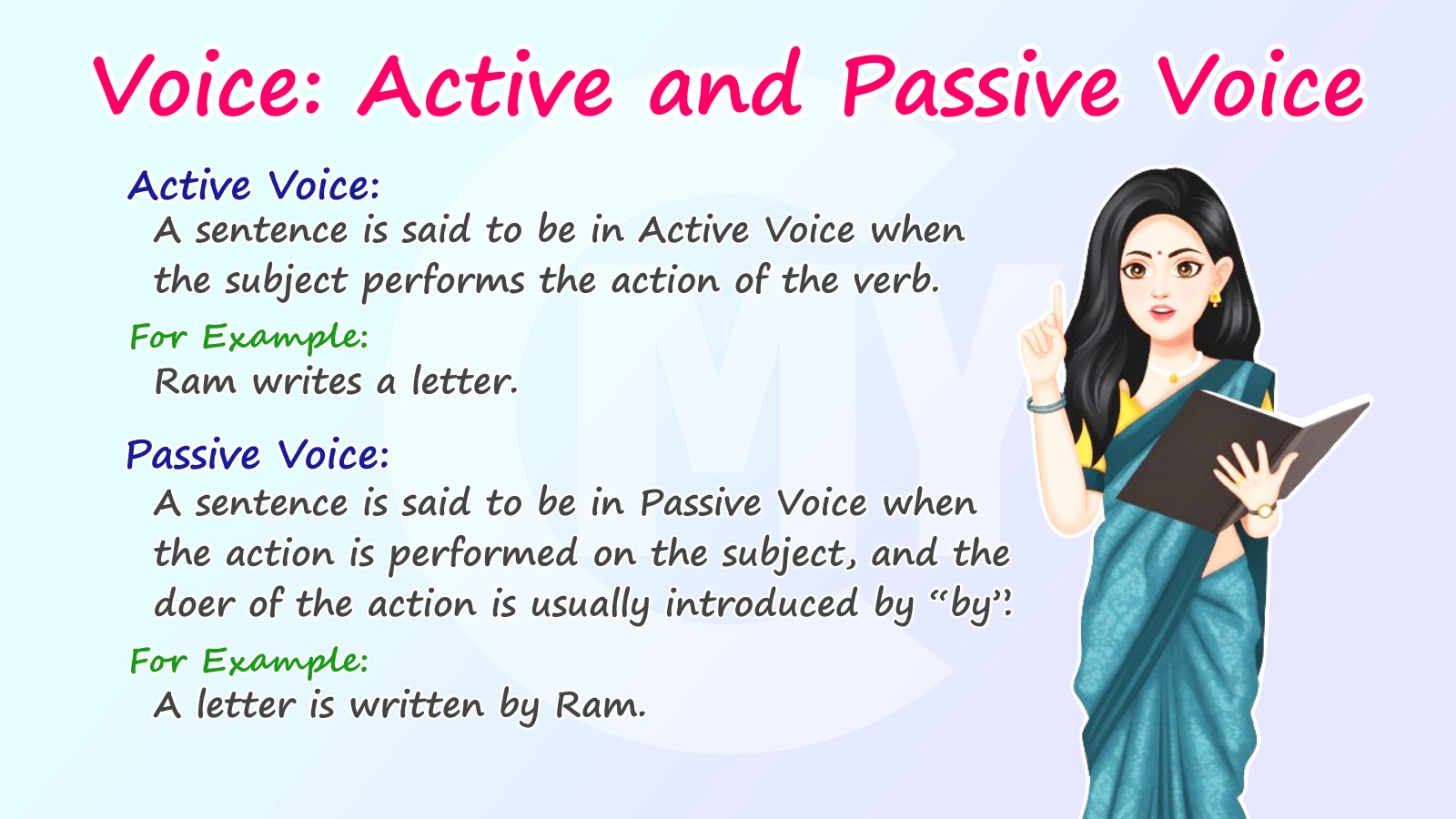
Active Voice: A sentence is said to be in Active Voice when the subject performs the action of the verb.
Example: Ram writes a letter.
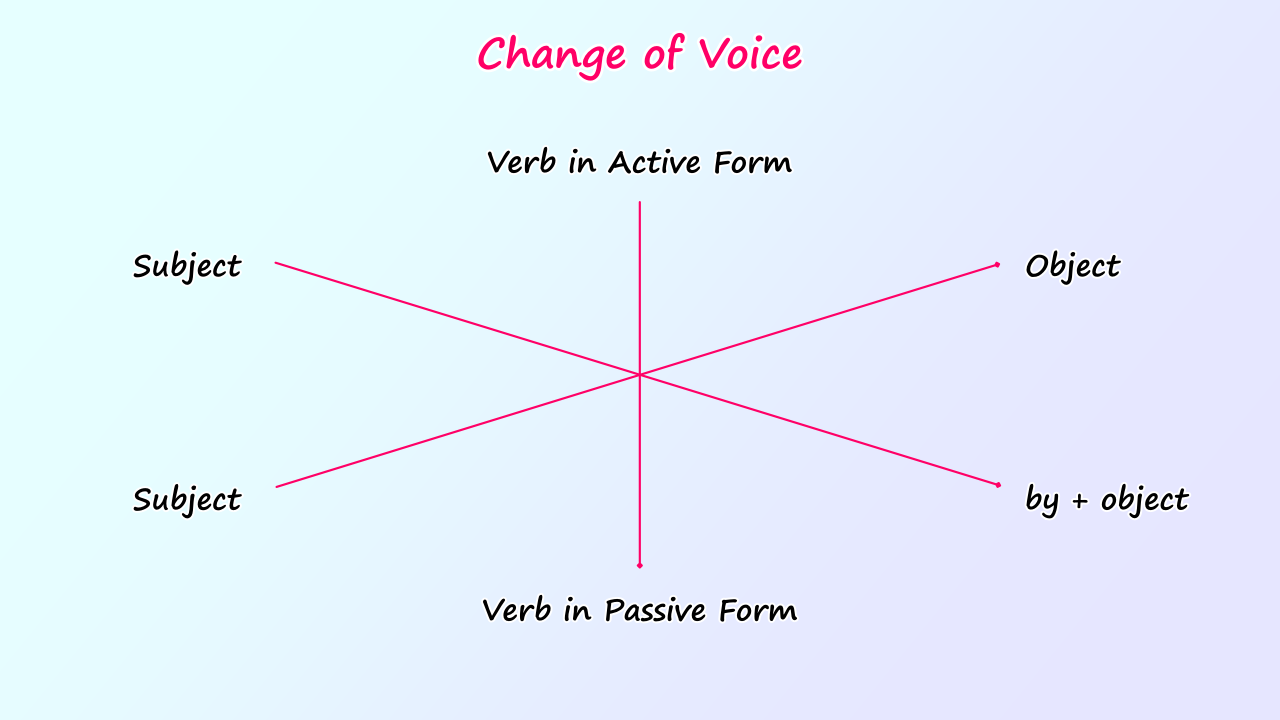
- Active Voice: Subject + Verb + Object
Passive Voice: A sentence is said to be in Passive Voice when the action is performed on the subject, and the doer of the action is usually introduced by “by”.
Example: A letter is written by Ram.
- Passive Voice: Object + Verb + by + Subject
Rules of Voice: Active and Passive Voice
Voice निम्नलिखित दो प्रकार की होती हैं- Active Voice, तथा Passive Voice.
For Examples:
| Active Voice | Passive Voice |
|---|---|
| 1. Gopal teaches Mohan. | Mohan is taught by Gopal. |
| 2. I write a letter. | A letter is written by me. |
| 3. Rama killed Ravan. | Ravan was killed by Rama. |
| 4. He will read this book. | This book will be read by him. |
उपर्युक्त वाक्यों से ज्ञात होता है कि Active Voice में कर्ता (Subject) स्वयं कार्य करता है। जबकि Passive Voice में क्रिया (Verb) द्वारा कर्म (Object) को प्रधानता दी जाती है।
- Active Voice में क्रिया (Verb) द्वारा कर्ता (Subject) को प्रधानता दी जाती है।
- Passive Voice में क्रिया (Verb) द्वारा कर्म (Object) को प्रधानता दी जाती है।
नोट: Active Voice में 12 Tenses होते हैं लेकिन Passive Voice केवल 8 Tenses के वाक्यों की ही बनायी जा सकती है। निम्नलिखित 4 Tenses के वाक्यों की Passive Voice नहीं बनती है।
- Present Perfect Continuous,
- Past Perfect Continuous.
- Future Continuous तथा,
- Future Perfect Continuous.
नोट: जिन वाक्यों में Intransitive Verb (अकर्मक क्रिया) का प्रयोग होता है, उनकी Passive Voice नहीं बना करती है।
Subject (कर्ता) यदि Pronoun (सर्वनाम) है, तो वह वाक्य के अन्त में आता है और इसके पूर्व प्रायः by का प्रयोग होता है।
| Subject (Active Voice) | Object (Passive Voice) |
|---|---|
| I | me |
| We | us |
| You | you |
| They | them |
| He | him |
| She | her |
| It | it |
| Who | whom |
(I) ACTIVE VOICE के वाक्यों की PASSIVE VOICE बनाना
Active Voice में Passive Voice बनाने के मुख्य नियम निम्नलिखित हैं-
- Subject को Object तथा Object को Subject बनाना।
- नये Object से पहले by लगाना।
- Tense के अनुसार सहायक क्रिया (Helping Verb) लिखना।
- Active Voice के वाक्य की मुख्य क्रिया की Third Form (अर्थात Past Participle Form) लिखना।
Active Voice से Passive Voice बनाने की विधि-Active Voice से Passive Voice बनाने की विधियाँ विभिन्न Tenses के अनुसार नीचे दी जा रही है, इन्हें ध्यानपूर्वक पढ़िए।
1. Present Indefinite (Simple Present) Tense
- इस Tense Tense में कर्ता केअनुसार Is, Am, Are सहायक क्रियाओं (Helping Verbs) के साथ मुख्य क्रिया की Third Form का प्रयोग होता है।
- I के साथ Am; He/She/It तथा Singular Nouns (एकवचन की संज्ञाओं) के साथ Is का प्रयोग होता है।
- We, You, They तथा Plural Nouns (बहुवचन की संज्ञाओं) के साथ Are का प्रयोग होता है।
निम्नलिखित उदाहरणों को ध्यानपूर्वक पढ़िए-
- Active: We read our books.
Passive: Our books are read by us. - Active: He plays cricket.
Passive: Cricket is played by him. - Active: You do not learn your lesson.
Passive: Your lesson is not learnt by you.
Change the following sentences into Passive Voice:
| # | Active Voice | Passive Voice |
|---|---|---|
| 1 | I buy books from the market. | Books are bought by me from the market. |
| 2 | She washes her dirty clothes. | Her dirty clothes are washed by her. |
| 3 | I do not hate my neighbour. | My neighbour is not hated by me. |
| 4 | Do you not love her? | Is she not loved by you? |
| 5 | She does not like me. | I am not liked by her. |
| 6 | Mohan reads a letter. | A letter is read by Mohan. |
| 7 | Sohan does not abuse his servants. | His servants are not abused by Sohan. |
| 8 | Does Meera not sing songs now? | Are songs not sung by Meera now? |
| 9 | Which fruit do you not like to eat? | Which fruit is not liked by you to eat? |
| 10 | Who teaches you History these days? | By whom are you taught History these days? |
2. Present Continuous (Present Progressive) Tense
- इस Tense में Subject (कर्ता) के अनुसार Is being, Are being तथा Am being के साथ मुख्य क्रिया की Third Form लिखी जाती है।
- I के साथ Am being; He, She, It तथा Singular Nouns के साथ Is being må You, We, They तथा Plural Nouns के साथ Are being का प्रयोग किया जाता है।
निम्नलिखित उदाहरणों को ध्यानपूर्वक पढ़िए-
- Active: I am reading a book.
Passive: A book is being read by me. - Active: You are not playing cricket.
Passive: Cricket is not being played by you. - Active: Are the boys writing an essay?
Passive: Is an essay being written by the boys?, - Active: Why is she helping you?
Passive: Why are you being helped by her?
Change the following into Passive Voice:
| # | Active Voice | Passive Voice |
|---|---|---|
| 1 | I am writing letters to my friends. | Letters are being written by me to my friends. |
| 2 | You are buying books. | Books are being bought by you. |
| 3 | She is not selling her ornaments. | Her ornaments are not being sold by her. |
| 4 | My brother is not playing cricket. | Cricket is not being played by my brother. |
| 5 | Are the farmers doing their work? | Is their work being done by the farmers? |
| 6 | Is the washerman not washing clothes today? | Are clothes not being washed by the washerman today? |
| 7 | Why is Anshu not eating her food today? | Why is her food not being eaten by Anshu today? |
| 8 | Where is the teacher correcting our answer books? | Where are our answer books being corrected by the teacher? |
| 9 | Who is calling me at the gate? | By whom am I being called at the gate? |
| 10 | Who is not doing homework today? | By whom is homework not being done today? |
3. Present Perfect Tense
- इस Tense में कर्ता (Subject) के अनुसार Helping Verb (सहायक क्रिया) Have been तथा Has been का प्रयोग करके मुख्य क्रिया (Main Verb) की Third Form (अर्थात Past Participle Form) का प्रयोग होता है।
- I, We, You, They तथा Plural Nouns के साथ Have been का प्रयोग होता है।
- He, She, It तथा Singular Nouns के साथ Has been का प्रयोग होता है।
निम्नलिखित उदाहरणों को ध्यानपूर्वक पढ़िए-
- Active: I have written the essay.
Passive: The essay has been written by me. - Active: You have not finished the work.
Passive: The work has not been finished by you. - Active: Has the hunter killed the fox?
Passive: Has the fox been killed by the hunter? - Active: Why has she not eaten the ripe mangoes?
Passive: Why have the ripe mangoes not been eaten by her.
Change the following from Active to Passive Voice:
| # | Active Voice | Passive Voice |
|---|---|---|
| 1 | Father has taught me English today. | I have been taught English today by my father. |
| 2 | Razia has not eaten these apples. | These apples have not been eaten by Razia. |
| 3 | You have beaten the thief. | The thief has been beaten by you. |
| 4 | The policeman has not caught the robbers. | The robbers have not been caught by the policeman. |
| 5 | They have not written the essay yet. | The essay has not been written by them yet. |
| 6 | Who has broken the jug? | By whom has the jug been broken? |
| 7 | Why has he not played football? | Why has football not been played by him? |
| 8 | When will he teach you English? | When will you be taught English by him? |
| 9 | Has the wood-cutter not cut down the trees? | Have the trees not been cut down by the wood-cutter? |
| 10 | How has your younger brother solved these questions? | How have these questions been solved by your younger brother? |
4. Past Indefinite Tense (Simple Past)
- इस Tense में सहायक क्रिया (Helping Verb) Was तथा Were का प्रयोग वाक्य के कर्ता (Subject) के साथ किया जाता है।
- I. He, She, It तया Singular Nouns के साथ सहायक क्रिया Was लगाकर मुख्य क्रिया की Third Form का प्रयोग किया जाता है।
- You, We, They तथा Plural Nouns के साथ सहायक क्रिया Were लगाकर मुख्य क्रिया की Third Form का प्रयोग किया जाता है।
निम्नलिखित उदाहरणों को ध्यानपूर्वक पढ़िए-
- Active: He helped me today.
Passive: I was helped today by him. - Active: You did not help me yesterday.
Passive: I was not helped yesterday by you. - Active: Did you call Hari last Sunday?
Passive: Was Hari called last Sunday by you? - Active: Why did she not sing any song in the function?
Passive: Why was any song not sung in the function by her? - Active: Who taught you Urdu?
Passive: By whom were you taught Urdu? (OR) By whom was Urdu taught to you?
नोट-
She did not sing a song. (Active)
A song was not sung by her. (Passive)
Sing का प्रयोग Transitive Verb की तरह है।
She did not sing Yesterday. (Active)
इस वाक्य की Passive नहीं बनेगी। (कारण-क्रिया Sing का प्रयोग Intransitive Verb की तरह है।)
Change the following into Passive Voice:
| # | Active Voice | Passive Voice |
|---|---|---|
| 1 | Mother cooked the food. | The food was cooked by mother. |
| 2 | Father read the paper in his office. | The paper was read by father in his office. |
| 3 | They said their prayer in the church. | Their prayer was said by them in the church. |
| 4 | The farmer did not take his food in the morning. | His food was not taken by the farmer in the morning. |
| 5 | Who taught you English? | By whom were you taught English? |
| 6 | Why did he not teach you yesterday? | Why were you not taught by him yesterday? |
| 7 | Did the postman give you my letter? | Was my letter given to you by the postman? |
| 8 | Why did Sachin not play in the match? | Why was the match not played by Sachin? |
| 9 | Did the postman not go to the post-office yesterday? | Was the post-office not gone to by the postman yesterday? |
| 10 | Why did you discuss the matter with the manager? | Why was the matter discussed by you with the manager? |
5. Past Continuous Tense (Past Progressive or Imperfect)
- इस Tense के वाक्यों में सहायक क्रिया (Helping Verb) Was being तथा Were being का प्रयोग वाक्य के Subject के अनुसार किया जाता है।
- I, He, She, It तथा Singular Nouns के साथ Was being तथा We, You, They एवं Plural Nouns के साथ Were being का प्रयोग करके मुख्य क्रिया की Third Form लिखी जाती है।
निम्नलिखित उदाहरणों को ध्यानपूर्वक पढ़िए-
- Active: He was reading a novel.
Passive: A novel was being read by him. - Active: You were calling the servant.
Passive: The servant was being called by you. - Active: The gardener was not doing his work.
Passive: His work was not being done by the gardener. - Active: Who was breaking the furniture?
Passive: By whom was the furniture being broken?
Turn the following sentences from the Active Voice to the Passive Voice:
| No. | Active Voice | Passive Voice |
|---|---|---|
| 1 | I was writing a letter. | A letter was being written by me. |
| 2 | Ramesh was eating ripe mangoes in the morning. | Ripe mangoes were being eaten by Ramesh in the morning. |
| 3 | Your brother was washing dirty clothes in the river. | Dirty clothes were being washed by your brother in the river. |
| 4 | The postman was not doing his work properly yesterday. | His work was not being done properly by the postman yesterday. |
| 5 | Why were you abusing the poor old man? | Why was the poor old man being abused by you? |
| 6 | What were you eating in the kitchen? | What was being eaten by you in the kitchen? |
| 7 | Why was Tom laughing at Rogers Ben? | Why was Rogers Ben being laughed at by Tom? |
| 8 | Where was he doing his work today? | Where was his work being done by him today? |
| 9 | When were you reciting the poem? | When was the poem being recited by you? |
| 10 | Who was calling you yesterday? | By whom were you being called yesterday? |
6. Past Perfect Tense
- Past Perfect Tense में प्रत्येक कर्ता (Subject) के साथ Had been सहायक क्रिया का प्रयोग किया जाता है तथा मुख्य क्रिया की Third Form लिखी जाती है।
निम्नलिखित उदाहरणों को ध्यानपूर्वक पढ़िए-
- Active: Ruchi had done the work.
Passive: The work had been done by Ruchi. - Active: I had written the letter before noon.
Passive: The letter had been written before noon by me. - Active: Had they called you before leaving Delhi.
Passive: Had you been called before leaving Delhi by them? - Active: Why had you beaten the old servant before going out?
Passive: Why had the old servant been beaten before going out by you?
Change the following sentences into their Passive Form:
| # | Active Voice | Passive Voice |
|---|---|---|
| 1 | The farmers had ploughed their field before sunset. | Their field had been ploughed by the farmers before sunset. |
| 2 | The boys had won the match before noon. | The match had been won by the boys before noon. |
| 3 | Shila had washed her dirty clothes before lunch. | Her dirty clothes had been washed by Shila before lunch. |
| 4 | They had not finished their homework before it was night. | Their homework had not been finished by them before it was night. |
| 5 | Had the police caught the thieves before morning? | Had the thieves been caught by the police before morning? |
| 6 | Why did you not write the essay after the teacher had gone? | Why was the essay not written by you after the teacher had gone? |
| 7 | The military had taken position before curfew. | Position had been taken by the military before curfew. |
| 8 | Had he not told the truth before the end of the case? | Had the truth not been told by him before the end of the case? |
| 9 | Who had broken the jug before noon? | By whom had the jug been broken before noon? |
| 10 | Where had the thief hidden himself before he was arrested? | Where had he been hidden by the thief before he was arrested? |
नोट– Before he was arrested = before his arrest.
7. Future Indefinite Tense (Simple Future)
- Future Indefinite Tense (Simple Future) में Will be तथा Shall be सहायक क्रियाओं का प्रयोग वाक्य के Subject के अनुसार होता है।
- I, We के साथ Shall be तथा अन्य सभी Subjects के साथ सहायक क्रिया Will be के पश्चात मुख्य क्रिया की Third Form का प्रयोग होता है।
निम्नलिखित उदाहरणों को ध्यानपूर्वक पढ़िए-
- Active: He will do it again.
Passive: It will be done by him again. - Active: I shall not write a letter to him.
Passive: A letter will not be written to him by me. - Active: Will you help us today?
Passive: Shall we be helped today by you? - Active: Who will ring the bell?
Passive: By whom will the bell be rung?
Rewrite the following sentences so that the Verbs are in the Passive Voice:
| # | Active Voice | Passive Voice |
|---|---|---|
| 1 | The woodcutter will cut the trees today. | The trees will be cut by the woodcutter today. |
| 2 | I shall complete the work tomorrow. | The work will be completed by me tomorrow. |
| 3 | They sell radios here. | Radios are sold here. |
| 4 | Hurry will gain nothing. | Nothing will be gained by hurry. |
| 5 | The servant will not drive the car. | The car will not be driven by the servant. |
| 6 | He shall never help you again. | You will never be helped by him again. |
| 7 | They will not follow your instruction. | Your instruction will not be followed by them. |
| 8 | The Times will never print your letter in the morning edition. | Your letter will never be printed by The Times in the morning edition. |
| 9 | Will they accompany us to Delhi? | Will we be accompanied by them to Delhi? |
| 10 | Who will forget your kindness? | By whom will your kindness be forgotten? |
8. Future Perfect Tense
- इस Tense में I, We के साथ सहायक क्रिया Shall have been तथा अन्य सभी कर्ताओं (Subjects) के साथ सहायक क्रिया Will have been का प्रयोग करके मुख्य क्रिया (Main Verb) की Third Form लिखी जाती है।
निम्नलिखित उदाहरणों को ध्यानपूर्वक पढ़िए-
- Active: We shall have done it.
Passive: It will have been done by us. - Active: Seema will have helped Meera.
Passive: Meera will have been helped by Seema. - Active: Ruchi will not have washed her dirty clothes.
Passive: Her dirty clothes will not have been washed by Ruchi. - Active: Will they have shut the door?
Passive: Will the door have been shut by them?
Change the following sentences so that the Verbs are in the Passive Voice:
| # | Active Voice | Passive Voice |
|---|---|---|
| 1 | I shall have solved the question paper. | The question paper will have been solved by me. |
| 2 | You will have also done the same. | The same will have also been done by you. |
| 3 | The teacher will have corrected the exercise books. | The exercise books will have been corrected by the teacher. |
| 4 | She will not have bathed in the Ganga. | The Ganga will not have been bathed in by her. |
| 5 | Will you not have finished the work by tomorrow? | Will the work not have been finished by you by tomorrow? |
| 6 | How will you have completed the course in such a short time? | How will the course have been completed by you in such a short time? |
| 7 | Who will have punished these naughty boys? | By whom will these naughty boys have been punished? |
| 8 | Will the carpenter not have repaired the broken furniture in two hours? | Will the broken furniture not have been repaired by the carpenter in two hours? |
| 9 | When will you have revised your course? | When will your course have been revised by you? |
| 10 | Father will not have bathed before mother cooks the food. | Father will not have been bathed before the food is cooked by mother. |
Imperative Sentences
Imperative Sentences से आज्ञा, निवेदन, प्रार्थना, सुझाव आदि प्रकट होते हैं। ऐसे वाक्यों में कर्ता (Subject) छिपा रहता है। यह कर्ता You होता है. Imperative Sentence के Positive (Affirmative) वाक्य Verb की First Form से आरम्भहोते हैं।
Passive Voice of Imperative Sentences
- Imperative Sentences की Passive बनाते समय Let के पश्चात कर्म (Object) लिखकर सहायक क्रिया be का प्रयोग करके मुख्य क्रिया की Third Form लिखी जाती है।
- Negative sentences (निषेधात्मक या नकारात्मक वाक्यों) की Passive voice बनाते समय be से पहले not लिखा जाता है।
- Active Voice के Negative वाक्य प्रायः Do not (Don’t) से आरम्भ होते हैं।
- Never वाले वाक्यों को Should + never + be + Verb की III Form के structure (रचना) से Passive voice में बदलिए।
- प्रार्थनासूचक Positive Sentences की Passive बनाते समय Please को हटा देते हैं। Please के स्थान पर You are requested to लिखकर वाक्य के शेष भाग को ज्यों का त्यों लिख देते हैं।
- प्रार्थनासूचक Negative Sentences में You are requested not to लिखकर वाक्य के शेष भाग को ज्यों का त्यों लिख देते हैं।
निम्नलिखित उदाहरणों को ध्यानपूर्वक पढ़िए-
- Active: Shut the door.
Passive: Let the door be shut by you. - Active: Cat down the trees.
Passive: Let the trees be cut down.. - Active: Do not beat the child.
Passive: Let the child not be beaten by you. - Active: Don’t hate the old people.
Passive: Let the old people be not hated by you. - Active: Please help me.
Passive: You are requested to help me. - Active: Don’t insult the poor, please.
Passive: You are requested not to insult the poor. - Active: Never do it.
Passive: It should never be done by you.
Passive: Let it never be done. - Active: Always beat him.
Passive: He should always be beaten.
Passive: Let him always be beaten.
Turn the following sentences into their Passive Form:
| # | Active Voice (Imperative) | Passive Voice |
|---|---|---|
| 1 | Call the peon. | Let the peon be called. |
| 2 | Open the door. | Let the door be opened. |
| 3 | Don’t make a noise. | Let no noise be made. |
| 4 | Do not hate your poor relatives. | Let your poor relatives not be hated. |
| 5 | Please ask him to go. | You are requested to ask him to go. |
| 6 | Please don’t allow him to go. | You are requested not to allow him to go. |
| 7 | Tell him to work hard. | Let him be told to work hard. |
| 8 | Never tell a lie. | Let a lie never be told. |
| 9 | Don’t disturb me now. | Let me not be disturbed now. |
| 10 | Please walk to the left. | You are requested to walk to the left. |
| 11 | Don’t walk to the right, please. | You are requested not to walk to the right. |
Change the following sentences into Passive Voice:
| # | Active Voice | Passive Voice |
|---|---|---|
| 1 | We compelled the enemy to surrender. | The enemy was compelled to surrender by us. |
| 2 | The young man made a disturbance at the meeting. | A disturbance was made by the young man at the meeting. |
| 3 | I see a dark cloud. | A dark cloud is seen by me. |
| 4 | The dog chased the sheep and goats. | The sheep and goats were chased by the dog. |
| 5 | The naughty child drank all the milk. | All the milk was drunk by the naughty child. |
| 6 | The servant feeds the horse every day. | The horse is fed by the servant every day. |
| 7 | Kapil Dev threw the ball. | The ball was thrown by Kapil Dev. |
| 8 | Your behaviour vexes me. | I am vexed by your behaviour. |
| 9 | Now we expect good news. | Good news is expected by us now. |
| 10 | The farmer gathers the harvest. | The harvest is gathered by the farmer. |
| 11 | His own brother swindled him yesterday. | He was swindled by his own brother yesterday. |
| 12 | He handed her a chair. | She was handed a chair by him. |
Examples of Some More Types of Sentences
निम्नलिखित उदाहरणों को ध्यानपूर्वक पढ़िए-
- Active: We propose to hold a meeting.
Passive: To hold a meeting was proposed by us. - Active: All his friends laughed at him.
Passive: He was laughed at by all his friends. - Active: They made him king.
Passive: He was made king by them. - Active: You must listen to my words.
Passive: My words must be listened to by you. - Active: All desire wealth.
Passive: Wealth is desired by all. - Active: They proposed to stage a drama.
Passive: It is proposed to stage a drama. (by them) - Active: The University conferred a degree upon him.
Passive: A degree was conferred upon him. (by the university) - Active: Hurry will gain nothing.
Passive: Nothing will be gained by hurry. - Active: One should keep one’s promises.
Passive: Promises should be kept. - Active: Circumstances will oblige me to go.
Passive: I shall be obliged to go.
Change the following sentences into Passive Voice:
| # | Active Voice | Passive Voice |
|---|---|---|
| 1 | We admire the brave. | The brave are admired by us. |
| 2 | I bought the baby a couple of dolls. | The baby was bought a couple of dolls by me. |
| 3 | Nature teaches beasts to know their friends. | Beasts are taught by nature to know their friends. |
| 4 | He made his wife do the work. | His wife was made to do the work by him. |
| 5 | Did you not read the book long ago? | Was the book not read by you long ago? |
| 6 | The Mughals expected to conquer Udaipur. | Udaipur was expected to be conquered by the Mughals. |
| 7 | The boy is climbing the cliff. | The cliff is being climbed by the boy. |
| 8 | Maulana Jaffri taught me to read Urdu and Persian. | I was taught to read Urdu and Persian by Maulana Jaffri. |
| 9 | One expects better behaviour from a college student. | Better behaviour is expected from a college student. |
| 10 | Do you not understand my meaning? | Is my meaning not understood by you? |
| 11 | The captain encouraged his team in the field. | His team was encouraged by the captain in the field. |
| 12 | Shall we hear his voice no more? | Shall his voice be heard by us no more? |
| 13 | They propose to build a dam for irrigation. | A dam is proposed to be built for irrigation. |
| 14 | The manager of the zoo showed us some wild beasts. | Some wild beasts were shown to us by the manager of the zoo. |
| 15 | Salim hoped to succeed Akbar, the Grand Moghal. | Akbar, the Grand Moghal, was hoped to be succeeded by Salim. |
Change the following sentences into Passive Voice:
| # | Active Voice | Passive Voice |
|---|---|---|
| 1 | My captors were taking me to prison. | I was being taken to prison by my captors. |
| 2 | Your behaviour vexes me sometimes. | I am sometimes vexed by your behaviour. |
| 3 | The judge found him guilty of murder. | He was found guilty of murder by the judge. |
| 4 | He pretended to be a mill owner. | A mill owner was pretended to be by him. |
| 5 | The minister ordered the police to pursue the thief. | The police were ordered by the minister to pursue the thief. |
| 6 | Subject him to a severe examination. | Let him be subjected to a severe examination. |
| 7 | Somebody has put out the light. | The light has been put out. |
| 8 | Aunt Polly saw Tom opening the safe. | Tom was seen opening the safe by Aunt Polly. |
| 9 | Some ministers accused the Chief Minister of various offences. | The Chief Minister was accused of various offences by some ministers. |
| 10 | Avoid the narrow lane. | Let the narrow lane be avoided. |
| 11 | Shun the broad path. | Let the broad path be shunned. |
| 12 | Did you never hear the name of Baji Rao Peshwa? | Was the name of Baji Rao Peshwa never heard by you? |
| 13 | My friends will never blame me. | I shall never be blamed by my friends. |
| 14 | The master appointed him the manager of his factory. | He was appointed the manager of his factory by the master. |
| 15 | The Sikhs surrendered the fort to the English. | The fort was surrendered to the English by the Sikhs. |
Passive Voice without the Agent
जब हम कार्य को अधिक प्रमुखता देते हैं, तब Passive Voice में By के साथ कर्ता (Agent) का प्रयोग नहीं करते हैं। ऐसे वाक्यों में Agent को नहीं लिखा जाता है।
Examples:
- The building was destroyed. (इमारत नष्ट कर दी गयी।)
- The Prime Minister was sent to jail. (प्रधानमंत्री जेल भेज दिये गये।)
- Taxes must be paid in time. (कर समय पर जमा कर दिये जाने चाहिए।)
- The child was murdered. (बच्चे की हत्या कर दी गयी।)
निम्नलिखित उदाहरणों को ध्यानपूर्वक पढ़िए-
- Active: Summon the fire brigade.
Passive: Let the fire brigade be summoned. - Active: Give the order.
Passive: Let the order be given. - Active: It is time to shut up the shop.
Passive: It is time for the shop to be shut up. - Active: The audience loudly cheered the Prime Minister’s speech.
Passive: The Prime Minister’s speech was loudly cheered. - Active: Pay that bill today.
Passive: Let that bill be paid today. - Active: They have pulled down the old house.
Passive: The old house has been pulled down by them. - Active: Should we send the book by post?
Passive: Should the book be sent by post by us. - Active: Where did you find the pen?
Passive: Where was the pen found? - Active: They paid him his salary.
Passive: His salary was paid to him. - Active: People speak Hindi all over U.P.
Passive: Hindi is spoken all over U.P.
Change the following sentences into Passive Voice:
| No. | Active Voice | Passive Voice |
|---|---|---|
| 1 | He shot the tiger. | The tiger was shot by him. |
| 2 | The villagers caught the thieves. | The thieves were caught by the villagers. |
| 3 | They were buying balloons. | Balloons were being bought by them. |
| 4 | They have won the match. | The match has been won by them. |
| 5 | He is writing a letter. | A letter is being written by him. |
| 6 | Ravi will post the letter. | The letter will be posted by Ravi. |
| 7 | They have found out the truth. | The truth has been found out by them. |
| 8 | We had locked all the doors before sunset. | All the doors had been locked by us before sunset. |
| 9 | We did not import food grains last year. | Food grains were not imported by us last year. |
| 10 | Who has painted that picture? | By whom has that picture been painted? |
| 11 | My servant can post your letter. | Your letter can be posted by my servant. |
| 12 | Shakespeare wrote a number of plays. | A number of plays were written by Shakespeare. |
| 13 | A little boy greeted her on the road. | She was greeted on the road by a little boy. |
| 14 | Gopal could drive the car easily. | The car could be driven easily by Gopal. |
| 15 | Our boys must win the match. | The match must be won by our boys. |
| 16 | You must listen to his words. | His words must be listened to by you. |
| 17 | The boys elected Mohan captain. | Mohan was elected captain by the boys. |
| 18 | The white ants have eaten the carpet. | The carpet has been eaten by the white ants. |
| 19 | Rama wrote a letter to his father. | A letter was written by Rama to his father. |
| 20 | The driver drove the car fast. | The car was driven fast by the driver. |
| 21 | He hurt his leg in an accident. | His leg was hurt by him in an accident. |
| 22 | The judge found the prisoner guilty. | The prisoner was found guilty by the judge. |
| 23 | Did you finish your work in time? | Was your work finished by you in time? |
| 24 | Please go there. | You are requested to go there. |
| 25 | The cat is drinking the milk. | The milk is being drunk by the cat. |
(II) PASSIVE VOICE से ACTIVE VOICE बनाना
Passive से Active बनाने के लिए Active से Passive बनाने के नियमों का उल्टा प्रयोग किया जाता है अर्थात Passive बनाते समय जिन शब्दों को बढ़ाया जाता है, Active बनाते समय उन्हें हटा दिया जाता है। Passive Voice से Active Voice बनाने के मुख्य नियम निम्नलिखित हैं-
- Subject को Object और Object को Subject बना दिया जाता है।
- By को हटा कर By के बाद वाले Noun को Active Voice का Subject बना दिया जाता है।
- यदि By के बाद में Objective Case का Pronoun हो तो Subject बनाते समय उसका Nominative Case लिखा जाता है अर्थात me को I, us को we, them को they, him को he तथा her को she में परिवर्तित कर दिया जाता है।
निम्नलिखित उदाहरणों को ध्यानपूर्वक पढ़िए-
- Passive: Meera is loved by Mohan.
Active: Mohan loves Meera. - Passive: The wall is being constructed by the mason
Active: The mason is constructing the wall. - Passive: The shop was closed by the shopkeeper.
Active: The shopkeeper closed the shop. - Passive: The wounded soldier was being carried by some boys.
Active: Some boys were carrying the wounded soldier. - Passive: The work will not be finished in two days by him.
Active: He will not finish the work in two days. - Passive: Why could the work not be done by you?
Active: Why could you not do the work? - Passive: A pass will be given to you tomorrow by the secretary.
Active: The secretary will give you a pass tomorrow. - Passive: He was praised by everyone.
Active: Everyone praised him. - Passive: You are advised to walk to the left.
Active: Walk to the left. - Passive: You are warned not to walk to the right.
Active: Don’t walk to the right.
Change the following from Passive to Active Voice:
| # | Passive Voice | Active Voice |
|---|---|---|
| 1 | One thousand trees were planted in our college last year. | We planted one thousand trees in our college last year. |
| 2 | Why was Mohan punished in the class by the teacher? | Why did the teacher punish Mohan in the class? |
| 3 | Was he seen by you yesterday? | Did you see him yesterday? |
| 4 | The tree was uprooted by the wind. | The wind uprooted the tree. |
| 5 | Portuguese is spoken in Brazil. | People speak Portuguese in Brazil. |
| 6 | That door has not been used for twenty years. | No one has used that door for twenty years. |
| 7 | Books in the reference library must not be taken away. | Students must not take away books from the reference library. |
| 8 | Cotton goods are made in Kanpur. | People make cotton goods in Kanpur. |
| 9 | Has the hen not been fed yet? | Has no one fed the hen yet? |
| 10 | The report was read by the Principal on College Day. | The Principal read the report on College Day. |
| 11 | A well was dug to provide water to the villagers by the Panchayat. | The Panchayat dug a well to provide water to the villagers. |
| 12 | A bridge was built across the river. | They built a bridge across the river. |
| 13 | Monthly dues should be paid before the 15th of the month by students. | Students should pay monthly dues before the 15th of the month. |
| 14 | Rice is grown in many parts of the world. | People grow rice in many parts of the world. |
| 15 | The new books were placed on a separate shelf. | Someone placed the new books on a separate shelf. |
Change the following sentences into Active Voice:
| # | Passive Voice | Active Voice |
|---|---|---|
| 1 | By whom was the Ramayana written? | Who wrote the Ramayana? |
| 2 | The meeting was not attended by some members. | Some members did not attend the meeting. |
| 3 | English is not taught in the lower classes of Rajasthan. | Teachers do not teach English in the lower classes of Rajasthan. |
| 4 | The bill will not be passed by the Assembly. | The Assembly will not pass the bill. |
| 5 | These letters should be typed before 4 o’clock. | Someone should type these letters before 4 o’clock. |
| 6 | The child was given an injection. | The doctor (or nurse) gave the child an injection. |
| 7 | The agent was left a cripple by the accident. | The accident left the agent a cripple. |
| 8 | The mad man was laughed at by the boys. | The boys laughed at the mad man. |
| 9 | The scientist was surprised at the discovery. | The discovery surprised the scientist. |
| 10 | His command was promptly obeyed. | They promptly obeyed his command. |
| 11 | The telegraph wires have been cut. | Someone has cut the telegraph wires. |
| 12 | Why should I be praised by you? | Why should you praise me? |
| 13 | She was refused admittance. | They refused her admittance. |
| 14 | The dog was teased by the boys. | The boys teased the dog. |
| 15 | Some of the cargo had been destroyed by the sea water. | Sea water had destroyed some of the cargo. |
Change the following sentences into Active Voice:
| No. | Passive Voice | Active Voice |
|---|---|---|
| 1 | My books have been taken. | Someone has taken my books. |
| 2 | The leader was welcomed by the people. | The people welcomed the leader. |
| 3 | She was dismissed by her mistress. | Her mistress dismissed her. |
| 4 | The thief has been caught by him. | He has caught the thief. |
| 5 | He was not crowned King by them. | They did not crown him King. |
| 6 | The good fight has been fought by them. | They have fought the good fight. |
| 7 | The thief was arrested by the police. | The police arrested the thief. |
| 8 | A messenger was sent by the king. | The king sent a messenger. |
| 9 | By whom was this novel written? | Who wrote this novel? |
| 10 | The play has been written by my brother. | My brother has written the play. |
| 11 | She was given a prize by the Principal. | The Principal gave her a prize. |
| 12 | The letter will be posted by Pramod. | Pramod will post the letter. |
| 13 | The cake may be eaten by dogs. | Dogs may eat the cake. |
| 14 | Your work has been done. | Someone has done your work. |
| 15 | You could not be helped by your friends. | Your friends could not help you. |
| 16 | Your name must not be written in the answer book. | You must not write your name in the answer book. |
| 17 | The answer must be written in ink in your answer book. | You must write the answer in ink in your answer book. |
| 18 | While answering the question red ink must not be used. | While answering the question, you must not use red ink. |
| 19 | Was football being played by Shiam? | Was Shiam playing football? |
Interchange the Voice:
निम्नलिखित वाक्यों में Voice का परिवर्तन कीजिए। अर्थात जो वाक्य Active Voice के है उनकी Passive बनाइये और जो वाक्य Passive के है उनकी Active Voice बनाइये।
For examples:
- Sher Shah defeated Humayun.
Humayun was defeated by Sher Shah. - Post this letter today.
Let the letter be posted today.
| # | Sentence | Changed Voice |
|---|---|---|
| 1 | A dog has bitten the child. | The child has been bitten by a dog. |
| 2 | A cruel boy killed the pretty bird. | The pretty bird was killed by a cruel boy. |
| 3 | He is loved by all. | All love him. |
| 4 | Kanitkar scored twenty runs. | Twenty runs were scored by Kanitkar. |
| 5 | My father will write a letter. | A letter will be written by my father. |
| 6 | The lion was shot dead by an Englishman. | An Englishman shot the lion dead. |
| 7 | He did not keep me waiting yesterday. | I was not kept waiting by him yesterday. |
| 8 | The teacher asked my name. | My name was asked by the teacher. |
| 9 | Why did your brother not help you? | Why were you not helped by your brother? |
| 10 | My scooter has been stolen today. | Someone has stolen my scooter today. |
| 11 | We must execute your order. | Your order must be executed by us. |
| 12 | He made a very remarkable discovery. | A very remarkable discovery was made by him. |
| 13 | His Principal praised him. | He was praised by his Principal. |
| 14 | My cousin has drawn the picture. | The picture has been drawn by my cousin. |
| 15 | Someone has stolen my shoes. | My shoes have been stolen. |
Change the following sentences into Passive Voice:
| # | Active Sentence | Passive Voice |
|---|---|---|
| 1 | Ram killed a bird with his gun. | A bird was killed by Ram with his gun. |
| 2 | They have solved all the sums in the class. | All the sums have been solved by them in the class. |
| 3 | He has made a mistake. | A mistake has been made by him. |
| 4 | His teacher praised him. | He was praised by his teacher. |
| 5 | He reads one new book. | One new book is read by him. |
| 6 | He has answered all the questions. | All the questions have been answered by him. |
| 7 | They threw him out. | He was thrown out by them. |
| 8 | Everyone loves him. | He is loved by everyone. |
| 9 | Sita ate a ripe mango. | A ripe mango was eaten by Sita. |
| 10 | He will have finished his homework. | His homework will have been finished by him. |
| 11 | My brother wrote that long letter. | That long letter was written by my brother. |
| 12 | We did not import the sugar last year. | The sugar was not imported by us last year. |
| 13 | The police caught the thieves. | The thieves were caught by the police. |
| 14 | He does not use sugar in his diet. | Sugar is not used by him in his diet. |
| 15 | He earned a lot of wealth without unfair means. | A lot of wealth was earned by him without unfair means. |
Change the following sentences into Active Voice:
| No. | Passive Voice | Active Voice |
|---|---|---|
| 1 | This song was sung by Lata. | Lata sang this song. |
| 2 | A book was written by him. | He wrote a book. |
| 3 | Your letter can be posted by my servant. | My servant can post your letter. |
| 4 | You will be given a ticket by the manager. | The manager will give you a ticket. |
| 5 | A number of books were read by him. | He read a number of books. |
| 6 | All the problems were solved by him. | He solved all the problems. |
| 7 | All the doors were locked by them. | They locked all the doors. |
| 8 | He was taken to the hospital by his friends. | His friends took him to the hospital. |
| 9 | The dog will be beaten by his master. | His master will beat the dog. |
| 10 | My book has been stolen by someone. | Someone has stolen my book. |
| 11 | A number of plays were written by Shakespeare. | Shakespeare wrote a number of plays. |
| 12 | A number of letters were written by him to his father. | He wrote a number of letters to his father. |
| 13 | The naughty boy was punished by the teacher. | The teacher punished the naughty boy. |
| 14 | Those thieves were caught by the villagers. | The villagers caught those thieves. |
| 15 | English was being read by those boys yesterday. | Those boys were reading English yesterday. |
| 16 | Let a song be sung by Ram in the company of his friends. | Let Ram sing a song in the company of his friends. |
| 17 | The Ramayana was written by Tulsidas in Hindi. | Tulsidas wrote the Ramayana in Hindi. |
FAQs
What is the difference between Active and Passive Voice?
Active voice is when the subject of the sentence does the action.
Passive voice is when the object of the sentence becomes the subject and the focus is on the action, not the doer.
Example: The teacher teaches English (Active). → English is taught by the teacher (Passive).
How do you change a sentence from Active to Passive Voice?
To convert an active sentence to passive:
- Identify subject, verb, object.
- Swap object as the new subject.
- Use the correct form of be + past participle (V3) according to the tense.
- Add “by + subject” (optional).
Example: They write a letter. → A letter is written by them.
When is Passive Voice used in English?
Passive voice is used:
- When the doer is unknown or not important.
- When we want to emphasize the action or the object rather than the subject.
Example: The window was broken. (We don’t know who did it.)