

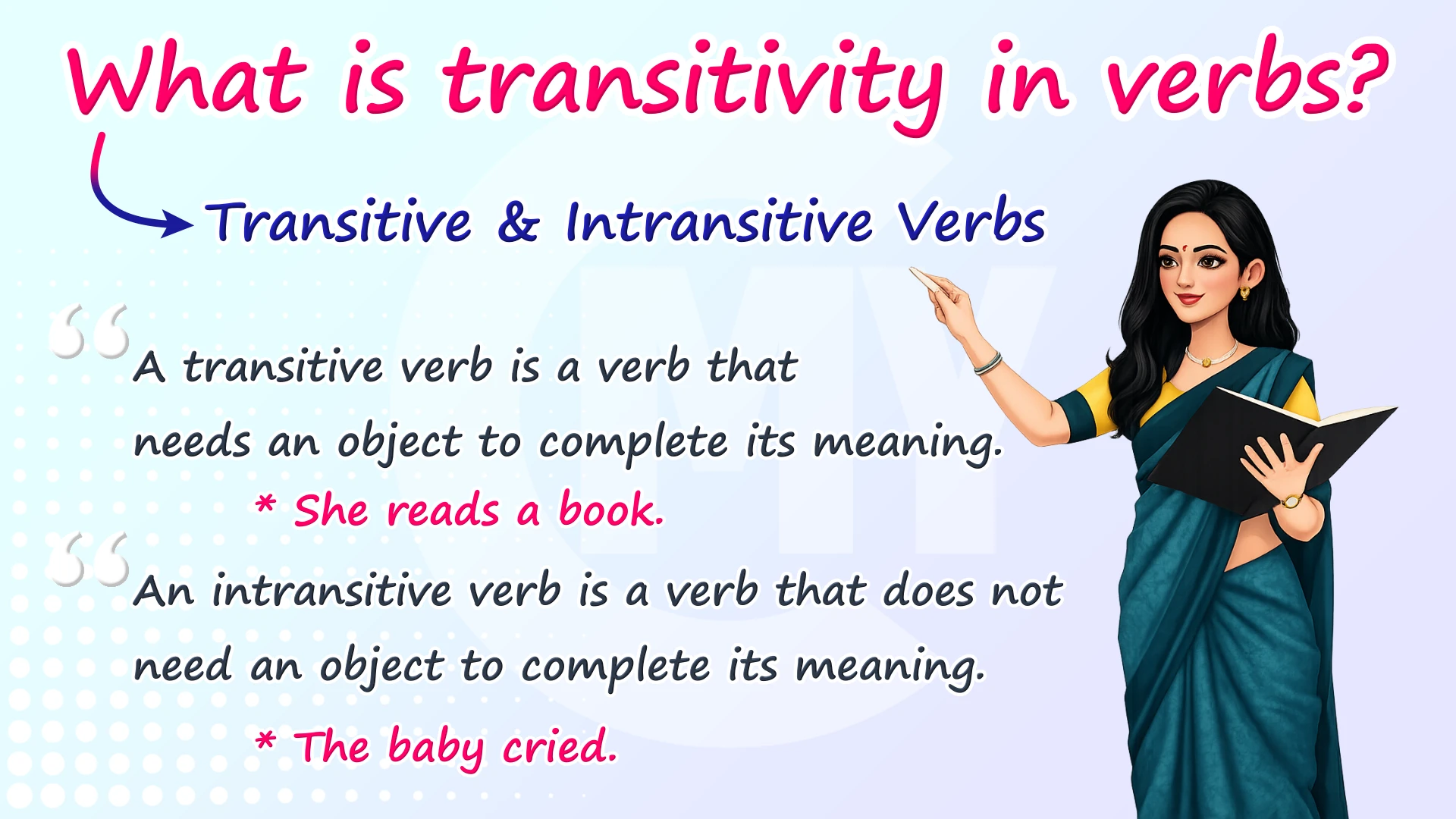
What is Verb? A verb is a word that shows an action, state, or possession. (Verb वह शब्द है जो काम, अवस्था या होने का भाव बताए।)
Verb Types by Transitivity : Transitivity in Verbs
Transitivity means whether a verb takes an object or not. (Transitivity का अर्थ है कि क्रिया को कर्म (object) की आवश्यकता है या नहीं।) On the basis of transitivity, verbs are of two types.
- Transitive Verbs: These require a direct object (the person or thing receiving the action). Without an object, the sentence feels incomplete (e.g., “She wrote a letter”).
- Intransitive Verbs: These do not take a direct object. The action starts and ends with the subject (e.g., “The baby smiled” or “The plane arrived“).
Some other types according to Oxford dictionary:
- Ambitransitive Verbs: These can function as both transitive or intransitive depending on the context. For example, “I am reading” (intransitive) vs. “I am reading a book” (transitive).
- Ditransitive Verbs: These take two objects: a direct object and an indirect object. The indirect object usually identifies who or what receives the direct object (e.g., “He gave me (indirect) the keys (direct)”).
1. Transitive Verb (सकर्मक क्रिया)
A transitive verb is a verb that needs an object to complete its meaning. (Transitive Verb वह क्रिया है जिसे अपना अर्थ पूरा करने के लिए कर्म (object) की आवश्यकता होती है।)
It answers the question what? or whom? (यह क्या? या किसे? का उत्तर देता है।)
Structure: Subject + Verb + Object
For Examples-
- She reads a book. (वह एक किताब पढ़ती है।)
- He killed the snake. (उसने साँप को मारा।)
- I wrote a letter. (मैंने एक पत्र लिखा।)
- The boy kicked the ball. (लड़के ने गेंद को मारा।)
Without an object, the sentence is incomplete. (कर्म के बिना वाक्य अधूरा रहता है।)
Common Transitive Verbs with Examples:
| Verb | Hindi Meaning | Example Sentence |
| eat | खाना | She eats an apple. (वह सेब खाती है।) |
| read | पढ़ना | He reads a book. (वह किताब पढ़ता है।) |
| write | लिखना | I wrote a letter. (मैंने एक पत्र लिखा।) |
| buy | खरीदना | They bought a car. (उन्होंने एक कार खरीदी।) |
| sell | बेचना | He sold his house. (उसने अपना घर बेचा।) |
| make | बनाना | She made a cake. (उसने केक बनाया।) |
| open | खोलना | He opened the door. (उसने दरवाज़ा खोला।) |
| close | बंद करना | She closed the window. (उसने खिड़की बंद की।) |
| break | तोड़ना | The boy broke the glass. (लड़के ने शीशा तोड़ा।) |
| catch | पकड़ना | He caught the ball. (उसने गेंद पकड़ी।) |
| see | देखना | I saw a movie. (मैंने फ़िल्म देखी।) |
| watch | देखना | She watches TV. (वह टीवी देखती है।) |
| help | मदद करना | She helped me. (उसने मेरी मदद की।) |
| teach | पढ़ाना | The teacher taught us English. (शिक्षक ने हमें अंग्रेज़ी पढ़ाई।) |
| tell | बताना | He told me the truth. (उसने मुझे सच बताया।) |
| kill | मारना | The hunter killed the lion. (शिकारी ने शेर को मारा।) |
| call | बुलाना | She called her friend. (उसने अपने दोस्त को बुलाया।) |
| invite | आमंत्रित करना | They invited us. (उन्होंने हमें बुलाया।) |
| meet | मिलना | I met my teacher. (मैं अपने शिक्षक से मिला।) |
| like | पसंद करना | She likes music. (उसे संगीत पसंद है।) |
| love | प्यार करना | He loves his mother. (वह अपनी माँ से प्यार करता है।) |
| hate | नफरत करना | She hates lies. (उसे झूठ से नफरत है।) |
| need | आवश्यकता होना | I need help. (मुझे मदद चाहिए।) |
| find | ढूँढना | She found her keys. (उसने अपनी चाबियाँ ढूँढ लीं।) |
| lose | खो देना | He lost his wallet. (उसने अपना बटुआ खो दिया।) |
| take | लेना | He took the book. (उसने किताब ली।) |
| give | देना | She gave me a gift. (उसने मुझे उपहार दिया।) |
| send | भेजना | He sent a letter. (उसने एक पत्र भेजा।) |
| bring | लाना | She brought water. (वह पानी लाई।) |
| build | बनाना | They built a house. (उन्होंने घर बनाया।) |
| choose | चुनना | He chose a pen. (उसने एक पेन चुना।) |
| clean | साफ़ करना | She cleaned the room. (उसने कमरा साफ़ किया।) |
2. Intransitive Verb (अकर्मक क्रिया)
An intransitive verb is a verb that does not need an object to complete its meaning. (Intransitive Verb वह क्रिया है जिसे अपना अर्थ पूरा करने के लिए कर्म की आवश्यकता नहीं होती।)
It does not answer what? or whom? (यह क्या? या किसे? का उत्तर नहीं देता।)
Structure: Subject + Verb
For Examples-
- The baby cried. (बच्चा रोया।)
- He slept. (वह सोया।)
- The sun rose. (सूरज उगा।)
- She laughed loudly. (वह ज़ोर से हँसी।)
Adding an object makes the sentence wrong. (कर्म जोड़ने से वाक्य गलत हो जाता है।)
Common Intransitive Verbs with Examples:
| Verb | Hindi Meaning | Example Sentence |
|---|---|---|
| sleep | सोना | He sleeps well. (वह अच्छी तरह सोता है।) |
| laugh | हँसना | She laughed loudly. (वह ज़ोर से हँसी।) |
| cry | रोना | The baby cried. (बच्चा रोया।) |
| run | दौड़ना | He runs fast. (वह तेज़ दौड़ता है।) |
| walk | चलना | She walks daily. (वह रोज़ चलती है।) |
| come | आना | He came late. (वह देर से आया।) |
| go | जाना | They went home. (वे घर गए।) |
| arrive | पहुँचना | The train arrived late. (ट्रेन देर से पहुँची।) |
| die | मरना | The old man died. (बूढ़ा आदमी मर गया।) |
| live | जीना | He lives here. (वह यहाँ रहता है।) |
| sit | बैठना | Please sit down. (कृपया बैठ जाइए।) |
| stand | खड़ा होना | He stood quietly. (वह चुपचाप खड़ा रहा।) |
| swim | तैरना | She swims well. (वह अच्छी तरह तैरती है।) |
| fly | उड़ना | Birds fly high. (पक्षी ऊँचा उड़ते हैं।) |
| fall | गिरना | The leaves fell. (पत्ते गिर गए।) |
| rise | उगना / उठना | The sun rises in the east. (सूरज पूर्व में उगता है।) |
| grow | बढ़ना | Plants grow fast. (पौधे तेज़ी से बढ़ते हैं।) |
| wait | इंतज़ार करना | I waited outside. (मैं बाहर इंतज़ार करता रहा।) |
| rest | आराम करना | She rested for an hour. (उसने एक घंटे आराम किया।) |
| shout | चिल्लाना | He shouted loudly. (वह ज़ोर से चिल्लाया।) |
| dance | नाचना | She danced happily. (वह खुशी से नाची।) |
| sing | गाना | The girl sang sweetly. (लड़की मधुर स्वर में गाई।) |
| jump | कूदना | The child jumped high. (बच्चा ऊँचा कूदा।) |
| smile | मुस्कुराना | She smiled gently. (वह धीरे से मुस्कुराई।) |
| work | काम करना | He works hard. (वह मेहनत करता है।) |
| fail | असफल होना | He failed again. (वह फिर असफल हुआ।) |
| succeed | सफल होना | She succeeded finally. (वह अंततः सफल हुई।) |
| appear | प्रकट होना | The moon appeared. (चाँद दिखाई दिया।) |
| disappear | गायब होना | The thief disappeared. (चोर गायब हो गया।) |
| happen | होना | What happened yesterday? (कल क्या हुआ?) |
Difference Between Transitive & Intransitive Verbs
| Transitive Verb | Intransitive Verb |
|---|---|
| Needs an object | Does not need an object |
| Has object | No object |
| She eats an apple. (वह सेब खाती है।) | She eats. (वह खाती है।) |
Ambitransitive Verb: Verbs Used as Both Transitive & Intransitive
An ambitransitive verb is a verb that can be used both as a transitive verb and as an intransitive verb, without any change in its form. (Ambitransitive Verb वह क्रिया है जो बिना रूप बदले कभी Transitive और कभी Intransitive के रूप में प्रयोग की जा सकती है।)
1. Ambitransitive Verb Used as Transitive:
When the verb takes an object, it is transitive. (जब क्रिया के साथ कर्म (object) हो, तब वह Transitive होती है।)
For Examples-
- She opened the door. (उसने दरवाज़ा खोला।)
- He stopped the car. (उसने कार रोकी।)
- The boy rang the bell. (लड़के ने घंटी बजाई।)
2. Ambitransitive Verb Used as Intransitive:
When the same verb is used without an object, it is intransitive. (जब वही क्रिया बिना कर्म के प्रयोग हो, तब वह Intransitive होती है।)
For Examples-
- The door opened. (दरवाज़ा खुल गया।)
- The car stopped. (कार रुक गई।)
- The bell rang. (घंटी बजी।)
Common Ambitransitive Verbs:
| Verb | Example (Transitive) | Example (Intransitive) |
|---|---|---|
| open | He opened the box. (उसने डिब्बा खोला।) | The box opened. (डिब्बा खुल गया।) |
| close | She closed the door. (उसने दरवाज़ा बंद किया।) | The door closed. (दरवाज़ा बंद हो गया।) |
| break | He broke the glass. (उसने शीशा तोड़ा।) | The glass broke. (शीशा टूट गया।) |
| stop | He stopped the bus. (उसने बस रोकी।) | The bus stopped. (बस रुक गई।) |
| boil | She boiled the milk. (उसने दूध उबाला।) | The milk boiled. (दूध उबल गया।) |
Difference Between Transitive, Intransitive & Ambitransitive
- Ambitransitive verbs do not change their form. (Ambitransitive verbs अपना रूप नहीं बदलतीं।)
- Meaning changes according to presence or absence of object. (अर्थ कर्म की उपस्थिति या अनुपस्थिति पर निर्भर करता है।)
| Type | Object | Example |
|---|---|---|
| Transitive | Required | He reads a book. (वह किताब पढ़ता है।) |
| Intransitive | Not required | He sleeps. (वह सोता है।) |
| Ambitransitive | Optional | She opened the door. / The door opened. |
Ditransitive Verbs
Ditransitive verbs are a type of transitive verb. Only verbs related to giving, sending, teaching, showing, etc. are usually ditransitive. (Ditransitive verbs, transitive verbs का ही एक प्रकार हैं। देना, भेजना, सिखाना, दिखाना से जुड़ी क्रियाएँ सामान्यतः ditransitive होती हैं।)
A ditransitive verb is a verb that takes two objects:
- Indirect Object (person who receives something)
- Direct Object (thing that is given)
Ditransitive Verb वह क्रिया है जिसके साथ दो कर्म (objects) आते हैं- एक अप्रत्यक्ष कर्म (Indirect Object) और एक प्रत्यक्ष कर्म (Direct Object)।
Structure:
→ Subject + Verb + Indirect Object + Direct Object
→ Subject + Verb + Direct Object + to/for + Indirect Object
Examples with Hindi Meaning:
- She gave me a gift. (उसने मुझे एक उपहार दिया।)
me → Indirect Object
a gift → Direct Object - The teacher taught us English. (शिक्षक ने हमें अंग्रेज़ी पढ़ाई।)
- He sent her a letter. (उसने उसे एक पत्र भेजा।)
- My father bought me a bicycle. (मेरे पिता ने मुझे एक साइकिल खरीदी।)
Alternative Form (Using Preposition):
- She gave a gift to me. (उसने मुझे एक उपहार दिया।)
- He sent a letter to her. (उसने उसे एक पत्र भेजा।)
- My father bought a bicycle for me. (मेरे पिता ने मेरे लिए साइकिल खरीदी।)
Common Ditransitive Verbs:
| Verb | Hindi Meaning |
|---|---|
| give | देना |
| send | भेजना |
| tell | बताना |
| teach | सिखाना |
| offer | प्रस्ताव देना |
| buy | खरीदना |
| lend | उधार देना |
| show | दिखाना |