

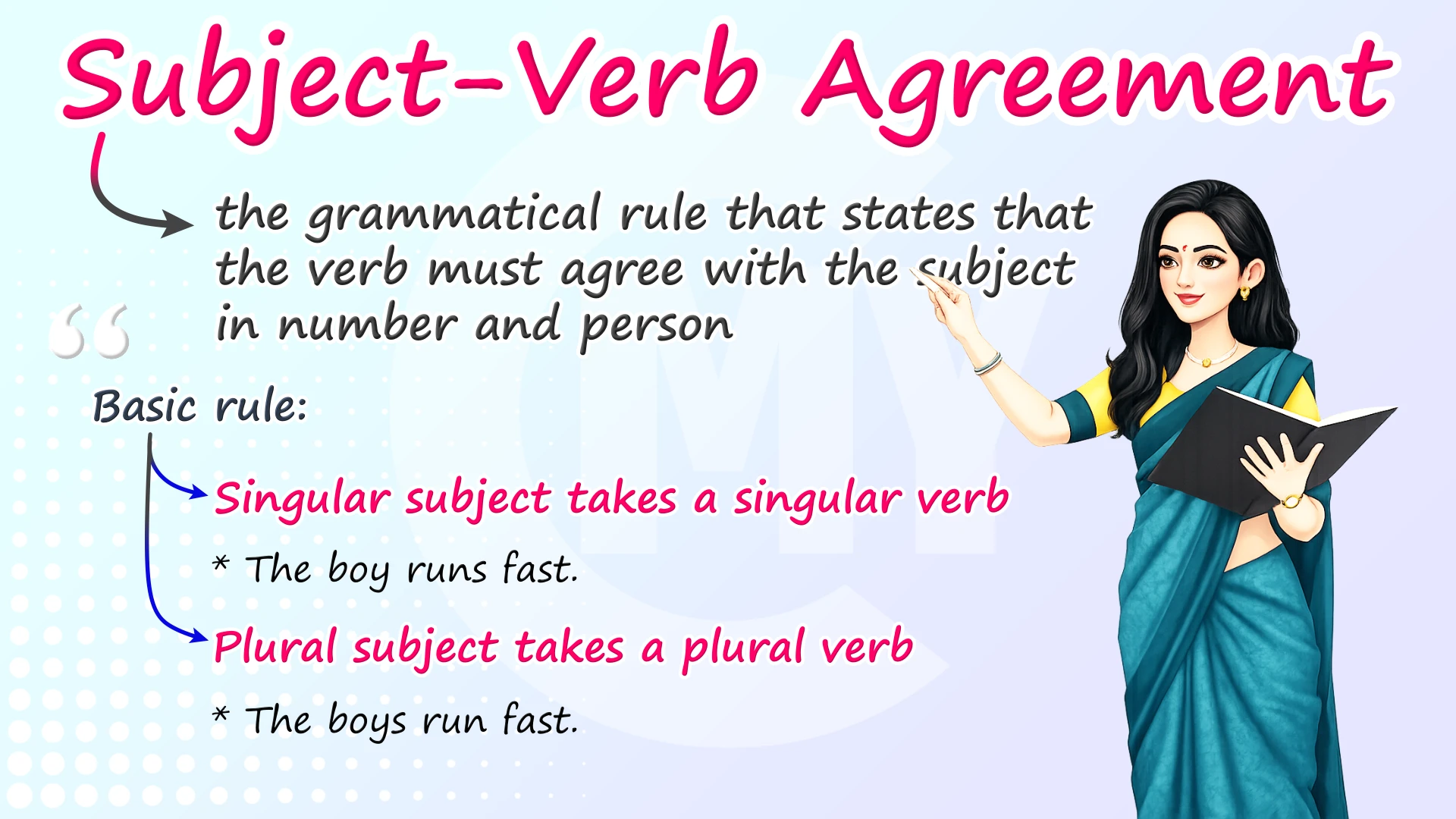
Subject-Verb Agreement is an essential rule of English grammar that ensures harmony between the subject and the verb in a sentence. According to this rule, the verb must agree with its subject in number and person. Proper use of subject–verb agreement makes sentences grammatically correct, clear, and meaningful. It plays a vital role in both spoken and written communication and is especially important for students in academic writing and examinations.
Basic rule of Subject-Verb Agreement (मूल नियम)
The basic rule of Subject-Verb Agreement states that a singular subject takes a singular verb, while a plural subject takes a plural verb. (Subject-Verb Agreement का मूल नियम यह है कि एकवचन कर्ता के साथ एकवचन क्रिया और बहुवचन कर्ता के साथ बहुवचन क्रिया का प्रयोग किया जाता है।)
Examples (उदाहरण):
- The boy runs fast. (लड़का तेज़ दौड़ता है।)
- The boys run fast. (लड़के तेज़ दौड़ते हैं।)
In the present tense, singular subjects usually take verbs ending in –s or –es, whereas plural subjects take the base form of the verb. (Present tense में एकवचन कर्ता के साथ क्रिया में –s या –es जुड़ता है, जबकि बहुवचन कर्ता के साथ क्रिया का मूल रूप प्रयोग होता है।)
Rules of Subject-Verb Agreement
Rule 1. Singular and Plural Nouns
एकवचन संज्ञा के साथ एकवचन क्रिया और बहुवचन संज्ञा के साथ बहुवचन क्रिया का प्रयोग किया जाता है। (A singular noun takes a singular verb, while a plural noun takes a plural verb.)
Examples (उदाहरण):
- The child plays in the park. (बच्चा पार्क में खेलता है।)
- The children play in the park. (बच्चे पार्क में खेलते हैं।)
Rule 2. Two or More Subjects Joined by “and”
When two or more subjects are joined by and, they usually take a plural verb. (जब दो या अधिक कर्ता ‘and’ से जुड़े हों, तो उनके साथ बहुवचन क्रिया का प्रयोग होता है।)
For Example:
- Ram and Shyam are friends. (राम और श्याम मित्र हैं।)
Exception (अपवाद):
यदि दोनों कर्ता मिलकर एक ही व्यक्ति या वस्तु को दर्शाते हों, तो एकवचन क्रिया का प्रयोग होता है। (If the subjects refer to one person, thing, or idea, a singular verb is used.)
- Bread and butter is my breakfast. (ब्रेड और मक्खन मेरा नाश्ता है।)
Rule 3. Subjects Joined by “or / nor”
क्रिया उस कर्ता के अनुसार होती है जो उसके सबसे पास होता है। (The verb agrees with the subject nearest to it.)
For Example:
- Either the teacher or the students are responsible. (या तो शिक्षक या विद्यार्थी जिम्मेदार हैं।)
Rule 4. Collective Nouns
जब समूह एक इकाई के रूप में कार्य करता है तो एकवचन क्रिया, और जब सदस्य अलग-अलग कार्य करते हैं तो बहुवचन क्रिया का प्रयोग होता है। (A collective noun takes a singular verb when the group acts as a unit, and a plural verb when the members act separately.)
Examples:
- The team is winning the match. (टीम मैच जीत रही है।)
- The team are arguing among themselves. (टीम के सदस्य आपस में बहस कर रहे हैं।)
Rule 5. Indefinite Pronouns (अनिश्चित सर्वनाम)
Each, everyone, someone, nobody जैसे शब्दों के साथ एकवचन क्रिया का प्रयोग होता है। (Indefinite pronouns like each, everyone, someone, nobody take a singular verb.)
For Example:
- Everyone is happy. (हर कोई खुश है।)
Pronouns like many, few, several take a plural verb. (many, few, several जैसे शब्दों के साथ बहुवचन क्रिया का प्रयोग होता है।)
Rule 6. Use of Each and Every
Each और Every से शुरू होने वाले कर्ता के साथ हमेशा एकवचन क्रिया आती है। (Subjects beginning with each or every always take a singular verb.)
For Example:
- Each student has a book. (प्रत्येक छात्र के पास एक किताब है।)
Rule 7. Uncountable Nouns
अगणनीय संज्ञा के साथ हमेशा एकवचन क्रिया का प्रयोग होता है। (Uncountable nouns always take a singular verb.)
For Example:
- Information is useful. (जानकारी उपयोगी है।)
Rule 8. Titles, Names, and Subjects
पुस्तकों, फिल्मों और विषयों के नाम के साथ एकवचन क्रिया आती है। (Titles of books, movies, and subjects take a singular verb.)
For Example:
- Mathematics is my favorite subject. (गणित मेरा पसंदीदा विषय है।)
Common Errors to Avoid (सामान्य गलतियाँ जिनसे बचना चाहिए)
Subject-Verb Agreement का प्रयोग करते समय विद्यार्थी कुछ सामान्य गलतियाँ कर देते हैं। इनसे बचने से वाक्य शुद्ध और प्रभावी बनते हैं। (While using Subject-Verb Agreement, learners often make certain common mistakes. Avoiding these errors helps in writing correct and effective sentences.)
1. Confusion Between Singular and Plural Subjects (एकवचन और बहुवचन कर्ता में भ्रम)
एकवचन कर्ता के साथ बहुवचन क्रिया या बहुवचन कर्ता के साथ एकवचन क्रिया का प्रयोग एक सामान्य गलती है। (Using a plural verb with a singular subject or a singular verb with a plural subject is a common error.)
- Wrong: The boy run fast.
Correct: The boy runs fast.
2. Ignoring the Main Subject (मुख्य कर्ता को नज़रअंदाज़ करना)
कभी-कभी कर्ता और क्रिया के बीच आने वाले शब्द भ्रम पैदा करते हैं, पर क्रिया हमेशा मुख्य कर्ता के अनुसार होती है। (Sometimes words placed between the subject and the verb confuse the learner, but the verb must agree with the main subject.)
For Example:
- The bouquet of flowers is beautiful. (फूलों का गुलदस्ता सुंदर है।)
3. Errors with Collective Nouns (समूहवाचक संज्ञा से संबंधित गलतियाँ)
विद्यार्थी समूहवाचक संज्ञा के साथ गलत क्रिया का प्रयोग कर देते हैं। (Learners often misuse singular or plural verbs with collective nouns.)
For Example:
- The team is ready. (सही)
- The team are playing well. (सदस्य अलग-अलग कार्य कर रहे हैं)
4. Incorrect Use of Indefinite Pronouns (अनिश्चित सर्वनाम का गलत प्रयोग)
एकवचन अनिश्चित सर्वनाम के साथ बहुवचन क्रिया का प्रयोग करना भी एक आम गलती है। (Using plural verbs with singular indefinite pronouns is another common mistake.)
- Wrong: Everyone are happy.
Correct: Everyone is happy.
5. Mistakes with “Each” and “Every”
Each और Every के साथ बहुवचन क्रिया का प्रयोग करना गलत है। (Learners often use plural verbs with each and every, which is incorrect.)
- Correct: Each student has a pen. (प्रत्येक छात्र के पास एक पेन है।)
Importance of Subject-Verb Agreement
Subject-Verb Agreement is essential for forming grammatically correct and meaningful sentences. It helps convey ideas clearly and avoids confusion in communication.
(Subject-Verb Agreement व्याकरण की शुद्धता के लिए अत्यंत आवश्यक है। यह विचारों को स्पष्ट रूप से व्यक्त करने में सहायता करता है और भ्रम से बचाता है।)
It improves the quality of both spoken and written English and is especially important in academic writing, examinations, and professional communication.
(यह बोलचाल और लिखित अंग्रेज़ी दोनों की गुणवत्ता को बेहतर बनाता है तथा शैक्षणिक लेखन, परीक्षाओं और व्यावसायिक संप्रेषण में बहुत उपयोगी है।)
Correct use of subject–verb agreement reflects a good command over the English language.
(Subject–Verb Agreement का सही प्रयोग अंग्रेज़ी भाषा पर अच्छी पकड़ को दर्शाता है।)
In conclusion, Subject-Verb Agreement is a fundamental rule of English grammar that must be followed to construct correct sentences. Understanding and applying its rules helps in improving accuracy and fluency in language.