

To use many verb tenses in English, we must know the past forms of verbs. Every verb has a base form or infinitive, such as look, make, and play. Most verbs are called Regular verbs. They form their past simple and past participle by adding –ed. Some verbs do not follow this rule. These are called Irregular verbs. Regular and irregular verbs are learned step by step, which makes them easy to understand and remember.
Overview of English Verb Forms
Every English verb can have five forms:
- Base form (Plural form)
- Singular form
- –ing form
- Past simple form
- Past participle form
Use of Base Form:
- They live in Rome. (Present simple tense)
- I want to learn English. (Infinitive (to + verb))
Use Singular Verbs:
- The boy plays cricket.
- She reads a book.
Use of –ing Form:
- He is working. (Continuous tenses)
- Swimming is good for you. (Gerund)
Use of Past Simple:
- She visited Delhi last year.
- He woke up, brushed his teeth, and went to school.
Use of Past Participle:
- I have finished. (Perfect tenses)
- It was made in Japan. (Passive voice)
- The chair is broken. (Adjectives)
To use English tenses correctly, we must learn regular and irregular verbs and their forms.
Regular & Irregular Verbs
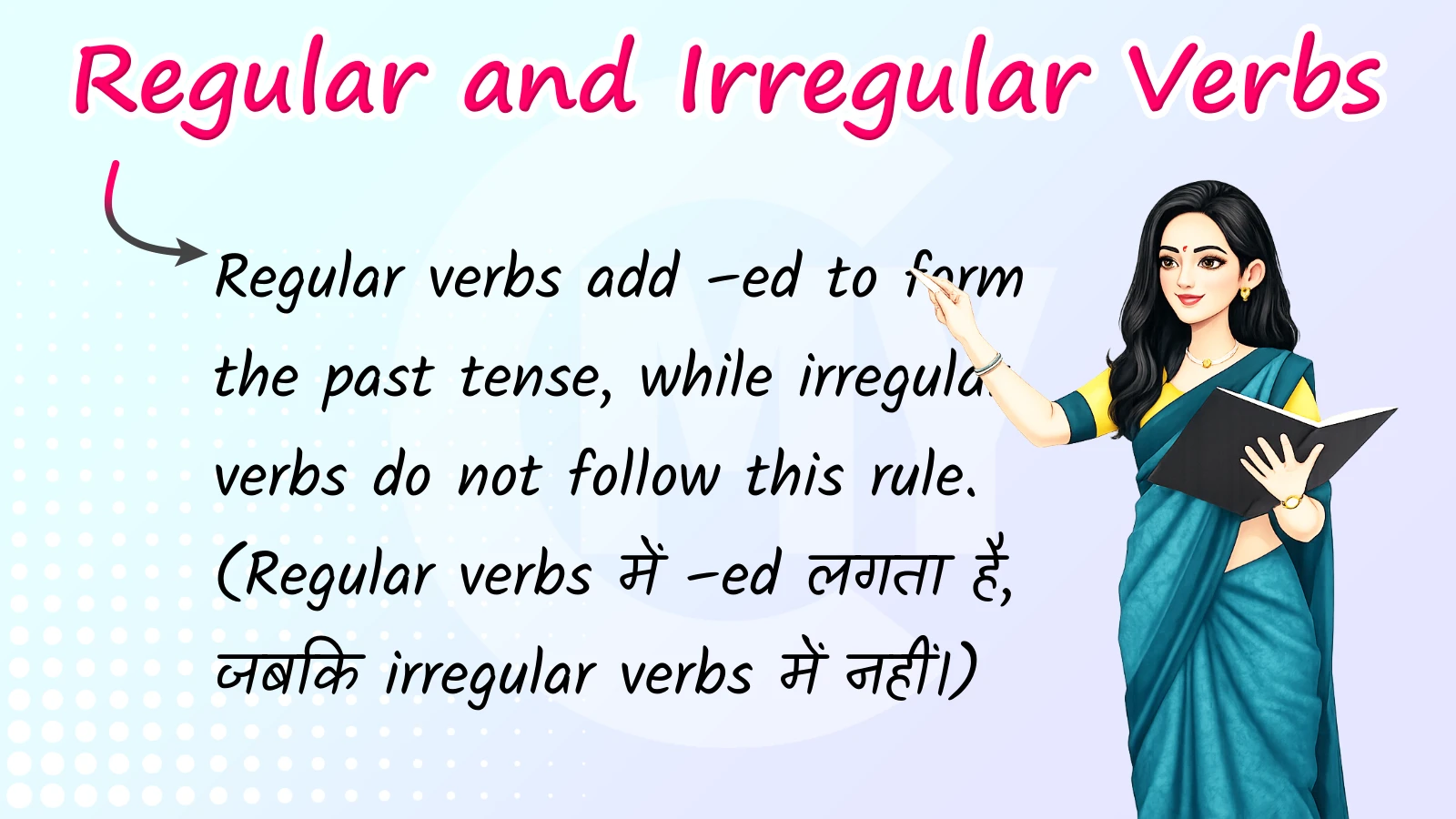
Regular verbs add –ed to form the past tense, while irregular verbs do not follow this rule. (Regular verbs में –ed लगता है, जबकि irregular verbs में नहीं।)
1. Regular Verbs
Regular verbs are verbs that form their past tense and past participle by adding –ed to the base form. (Regular verbs वे क्रियाएँ हैं जिनका भूतकाल –ed जोड़कर बनाया जाता है।)
| Base Form | Past | Past Participle | Meaning |
|---|---|---|---|
| play | played | played | play (खेलना) |
| work | worked | worked | work (काम करना) |
| clean | cleaned | cleaned | clean (साफ़ करना) |
| watch | watched | watched | watch (देखना) |
| help | helped | helped | help (मदद करना) |
Sentences
- She played cricket. (उसने क्रिकेट खेला।)
- He worked hard. (उसने मेहनत की।)
If the verb ends in a consonant + y, change y to i and add –ed. (यदि क्रिया व्यंजन + y पर समाप्त होती है, तो y को i में बदलकर –ed जोड़ते हैं।)
| Base Form | Past | Past Participle | Meaning |
|---|---|---|---|
| cry | cried | cried | cry (रोना) |
| try | tried | tried | try (कोशिश करना) |
| carry | carried | carried | carry (ले जाना) |
| study | studied | studied | study (पढ़ाई करना) |
| copy | copied | copied | copy (नकल करना) |
| hurry | hurried | hurried | hurry (जल्दी करना) |
| marry | married | married | marry (शादी करना) |
| worry | worried | worried | worry (चिंता करना) |
| reply | replied | replied | reply (उत्तर देना) |
| apply | applied | applied | apply (आवेदन करना) |
If a verb ends in –e, we simply add –d. (यदि क्रिया –e पर समाप्त होती है, तो केवल –d जोड़ते हैं।)
| Base Form | Past | Past Participle | Meaning |
|---|---|---|---|
| live | lived | lived | live (रहना) |
| like | liked | liked | like (पसंद करना) |
| love | loved | loved | love (प्रेम करना) |
| move | moved | moved | move (हिलना / चलना) |
| close | closed | closed | close (बंद करना) |
| dance | danced | danced | dance (नृत्य करना) |
| hope | hoped | hoped | hope (आशा करना) |
2. Irregular Verbs
Irregular verbs are verbs that do not form their past tense by adding –ed and follow no fixed rule. (Irregular verbs वे क्रियाएँ हैं जिनका भूतकाल –ed से नहीं बनता।)
- There are about 200 irregular verbs in English.
- These verbs do not follow any fixed rule to form their past tense. (ये क्रियाएँ भूतकाल बनाने के किसी निश्चित नियम का पालन नहीं करतीं।)
Irregular verbs are divided into four types based on the similarity or difference in their forms:
- Verbs which have the same base form, past simple and past participle (जिन क्रियाओं का मूल रूप, भूतकाल और past participle तीनों एक जैसे होते हैं।)
- Verbs which have the same past simple and past participle (जिन क्रियाओं का भूतकाल और past participle समान होता है।)
- Verbs which have the same base form and past participle (जिन क्रियाओं का मूल रूप और past participle समान होता है।)
- Verbs which have a different base form, past simple and past participle (जिन क्रियाओं का मूल रूप, भूतकाल और past participle तीनों अलग-अलग होते हैं।)
1. Same Base Form, Past & Past Participle (मूल रूप, भूतकाल और past participle तीनों समान)
| Base Form | Past | Past Participle | Meaning |
|---|---|---|---|
| cut | cut | cut | cut (काटना) |
| put | put | put | put (रखना) |
| hit | hit | hit | hit (मारना) |
| shut | shut | shut | shut (बंद करना) |
| let | let | let | let (अनुमति देना) |
| set | set | set | set (स्थापित करना) |
| hurt | hurt | hurt | hurt (चोट पहुँचाना) |
2. Same Past & Past Participle (भूतकाल और past participle समान)
| Base Form | Past | Past Participle | Meaning |
|---|---|---|---|
| bring | brought | brought | bring (लाना) |
| buy | bought | bought | buy (खरीदना) |
| teach | taught | taught | teach (पढ़ाना) |
| catch | caught | caught | catch (पकड़ना) |
| think | thought | thought | think (सोचना) |
| fight | fought | fought | fight (लड़ना) |
| seek | sought | sought | seek (खोजना) |
3. Same Base Form & Past Participle (मूल रूप और past participle समान)
| Base Form | Past | Past Participle | Meaning |
|---|---|---|---|
| come | came | come | come (आना) |
| become | became | become | become (बनना) |
| run | ran | run | run (दौड़ना) |
| overcome | overcame | overcome | overcome (काबू पाना) |
नोट: इस प्रकार में verbs कम होते हैं, इसलिए इन्हें याद रखना आसान है।
4. Different Base, Past & Past Participle (तीनों रूप अलग-अलग)
| Base Form | Past | Past Participle | Meaning |
|---|---|---|---|
| go | went | gone | go (जाना) |
| eat | ate | eaten | eat (खाना) |
| write | wrote | written | write (लिखना) |
| see | saw | seen | see (देखना) |
| take | took | taken | take (लेना) |
| give | gave | given | give (देना) |
| speak | spoke | spoken | speak (बोलना) |
Sentences
- She went home. (वह घर गई।)
- He has written a letter. (उसने एक पत्र लिखा है।)
Difference Between Regular and Irregular Verbs
| Regular Verbs | Irregular Verbs |
|---|---|
| Follow a fixed rule to form past tense. (भूतकाल बनाने का निश्चित नियम होता है।) |
Do not follow a fixed rule. (कोई निश्चित नियम नहीं होता।) |
| Past tense is formed by adding –ed. (–ed जोड़कर भूतकाल बनता है।) |
Past tense is not formed by adding –ed. (–ed से नहीं बनता।) |
| Easy to learn and remember. (सीखना और याद करना आसान है।) |
Must be memorized. (याद करने पड़ते हैं।) |
| Same past and past participle form. (Past और past participle समान होते हैं।) |
Past and past participle may be different. (Past और past participle अलग हो सकते हैं।) |
| Example: play → played (खेलना → खेला) |
Example: go → went (जाना → गया) |
| Mostly regular in use. (अधिकतर नियमित होते हैं।) |
Limited but commonly used. (संख्या कम पर प्रयोग अधिक।) |