

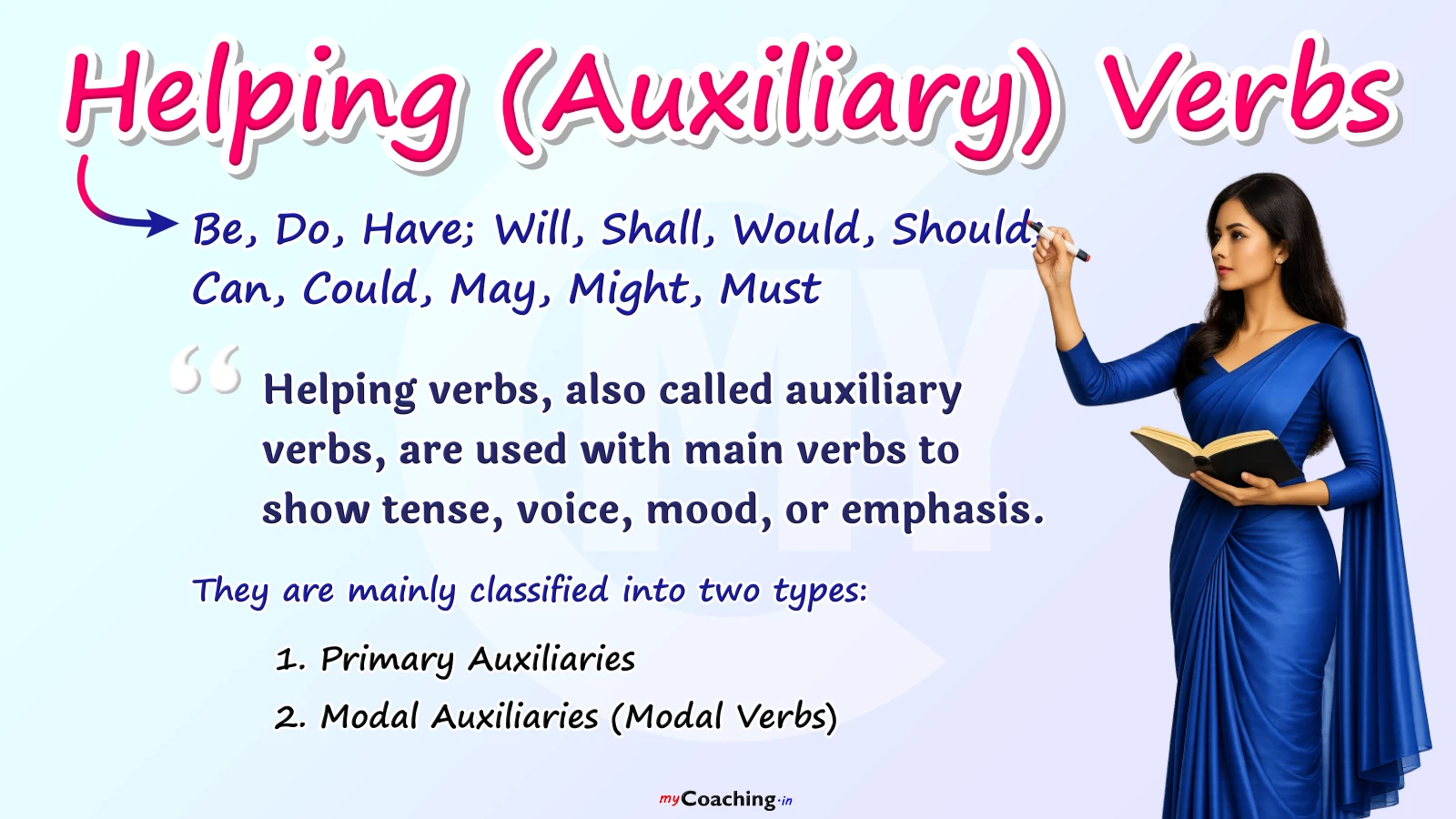
Helping (Auxiliary) Verbs
Be, Do, Have; Will, Shall, Would, Should; Can, Could, May, Might, Must
Helping verbs (also called auxiliary verbs) are used with main verbs to show tense, voice, mood, or emphasis.
They are mainly classified into two types:
- Primary Auxiliaries
- Modal Auxiliaries (Modal Verbs)
Primary Auxiliaries (Helping Verbs)
Primary auxiliaries are be, have, and do. They help the main verb in forming tenses, voice, and emphasis and can also function as main verbs.
प्राथमिक सहायक क्रियाएँ be, have और do होती हैं। ये क्रियाएँ मुख्य क्रिया (Main Verb) की सहायता करके काल (Tense), वाच्य (Voice) और बल/ज़ोर (Emphasis) व्यक्त करती हैं। इसके अतिरिक्त, ये क्रियाएँ स्वयं भी मुख्य क्रिया के रूप में कार्य करती हैं।
- Primary auxiliaries can act as helping verbs and main verbs
- They are limited to three: be, have, do
- They help in forming tense, voice, and emphasis
| Primary Auxiliary | Main Uses | Example |
|---|---|---|
| Be | Continuous, Passive, Linking | She is singing |
| Have | Perfect tenses | They have finished |
| Do | Questions, Negatives, Emphasis | Do you agree? |
Primary auxiliaries are helping verbs that assist the main verb in forming tenses, voice, and emphasis, and can also function as main (lexical) verbs on their own.
There are three primary auxiliaries:
- Be → am, is, are, was, were, been, being
- Have → has, have, had
- Do → do, does, did
1. Auxiliary BE – Forms of Be
- am, is, are (present)
- was, were (past)
- been (past participle)
- being (present participle)
Uses of Be
To form continuous tenses:
- She is reading. (वह पढ़ रही है।)
- They were playing. (वे खेल रहे थे।)
To form the passive voice:
- The work was done. (काम किया गया था।)
- The letter is written. (पत्र लिखा गया है।)
As a main (linking) verb:
- She is happy. (वह खुश है।)
- He was a teacher. (वह एक शिक्षक था।)
2. Auxiliary HAVE – Forms of Have
- have, has (present)
- had (past)
Uses of Have
To form perfect tenses:
- She has finished her work. (उसने अपना काम पूरा कर लिया है।)
- They had left early. (वे जल्दी निकल चुके थे।)
- He will have completed the task. (वह कार्य पूरा कर चुका होगा।)
As a main verb (possession/experience):
- I have a car. (मेरे पास एक कार है।)
- She has a headache. (उसे सिरदर्द है।)
3. Auxiliary DO – Forms of Do
- do, does (present)
- did (past)
Uses of Do
To form questions
- Do you like tea? (क्या तुम्हें चाय पसंद है?)
- Did he call you? (क्या उसने तुम्हें फोन किया?)
To form negatives
- She does not agree. (वह सहमत नहीं है।)
- They did not come. (वे नहीं आए।)
For emphasis
- I do want to help you. (मैं सच में तुम्हारी मदद करना चाहता हूँ।)
- He did try his best. (उसने सच में पूरी कोशिश की।)
- He did complete the work. (उसने वास्तव में काम पूरा किया।)
As a main verb (action)
- I do my homework daily. (मैं रोज़ अपना गृहकार्य करता हूँ।)
- She did the work. (उसने काम किया।)
Modal Auxiliaries (Modal Verbs)
Modal auxiliaries, also called modal verbs, are helping verbs that express the mood, attitude, or intention of the speaker rather than an action. They show ideas such as ability, permission, possibility, necessity, obligation, advice, request, and prediction.
Modal auxiliaries, जिन्हें modal verbs भी कहा जाता है, सहायक क्रियाएँ होती हैं। ये किसी कार्य को व्यक्त करने के बजाय वक्ता की मनःस्थिति, दृष्टिकोण या इच्छा (mood, attitude, intention) को प्रकट करती हैं।
ये क्रियाएँ योग्यता (ability), अनुमति (permission), संभावना (possibility), आवश्यकता (necessity), बाध्यता (obligation), सलाह (advice), निवेदन (request) तथा भविष्यवाणी (prediction) जैसे भावों को व्यक्त करती हैं।
- Modal auxiliaries are always used with a main verb.
- These only act as helping verbs and do not function as main verbs.
- Need and dare can be modal or main verbs
Modal auxiliaries are helping verbs that:
- express mood (ability, permission, obligation, possibility, advice, intention, etc.)
- do not change form according to subject
- cannot be used as main verbs,
- are followed by the base form of the verb
Modal auxiliaries are helping verbs that express mood such as ability, permission, obligation, possibility, advice, and intention. They are followed by the base form of the verb and cannot function as main verbs.
Common Modal Auxiliaries
- can, could
- may, might
- must
- shall, should
- will, would
- ought to
- need (modal use)
- dare (modal use)
Main Characteristics of Modal Verbs
Modal auxiliaries have special features, like:
They do not change their form (No use of –s, –ed, or –ing)
- He can swim. (
He cans swim)
They are followed by the base form of the verb
- She may go home. (
mayto go)
They cannot be used as main verbs
- I can write. (
I can a pen)
Questions and negatives are formed without “do”
- Can you help me?
- She cannot (can’t) come.
| Modal | Function | Example |
|---|---|---|
| can | ability, permission | She can swim. |
| could | past ability / polite request | He could help you. |
| may | permission, possibility | You may go. |
| might | weak possibility | It might rain. |
| must | obligation, certainty | You must obey rules. |
| shall | suggestion/future | We shall begin. |
| should | advice, duty | You should study. |
| will | future/intention/willingness | I will call you. |
| would | polite request, habit | Would you help me? |
| ought to | moral duty | You ought to help the poor. |
Uses of Modal Auxiliaries
1. CAN – Ability, Polite request, Possibility:
| Use | Example |
|---|---|
| Ability | She can swim. (वह तैर सकती है।) |
| Permission (informal) | You can go now. (तुम अब जा सकते हो।) |
| Possibility | Anyone can make mistakes. (कोई भी व्यक्ति गलती कर सकता है।) |
2. COULD – Past ability, Polite request, Possibility:
| Use | Example |
|---|---|
| Past ability | He could run fast. (वह तेज़ दौड़ सकता था।) |
| Polite request | Could you help me? (क्या आप मेरी मदद कर सकते हैं?) |
| Possibility | It could rain today. (आज बारिश हो सकती है।) |
3. MAY – Permission (formal), Possibility:
| Use | Example |
|---|---|
| Permission (formal) | You may enter. (आप भीतर आ सकते हैं।) May I come in? (क्या मैं अंदर आ सकता हूँ?) |
| Possibility | It may rain today. (आज बारिश हो सकती है।) She may be at home. (वह घर पर हो सकती है।) |
4. MIGHT – Weak possibility, Polite Suggestion/Indirect Statement:
| Use | Example |
|---|---|
| Weak possibility | She might come later. (वह बाद में आ सकती है।) It might rain today. (आज बारिश हो सकती है।) He might be at home. (वह घर पर हो सकता है।) |
| Polite Suggestion / Indirect Statement |
You might try again. (तुम फिर से कोशिश कर सकते हो।) |
5. MUST – Obligation/necessity, Strong certainty:
| Use | Example |
|---|---|
| Obligation / Necessity | You must obey the rules. (तुम्हें नियमों का पालन करना चाहिए।) |
| Strong certainty | She must be tired. (वह ज़रूर थकी हुई होगी।) |
6. SHALL – Suggestion/offer, Future (formal):
| Use | Example |
|---|---|
| Suggestion / Offer | Shall we go out? (क्या हम बाहर चलें?) |
| Future (formal) | We shall overcome this problem. (हम इस समस्या पर विजय प्राप्त करेंगे।) |
7. SHOULD – Advice, Moral duty
| Use | Example |
|---|---|
| Advice | You should study harder. (तुम्हें और मेहनत से पढ़ाई करनी चाहिए।) |
| Moral duty | We should help the poor. (हमें गरीबों की मदद करनी चाहिए।) |
8. WILL – Future action, Willingness, Habit:
| Use | Example |
|---|---|
| Future action | I will call you. (मैं तुम्हें फोन करूँगा।) |
| Willingness | She will help you. (वह तुम्हारी मदद करेगी।) |
| Habit | He will talk for hours. (वह घंटों बात करता रहेगा।) |
9. WOULD – Polite request, Past habit:
| Use | Example |
|---|---|
| Polite request | Would you open the door? (क्या आप दरवाज़ा खोलेंगे?) |
| Past habit | He would play there daily. (वह वहाँ रोज़ खेला करता था।) |
10. OUGHT TO – Moral duty/advice:
| Use | Example |
|---|---|
| Moral duty / Advice | You ought to respect elders. (तुम्हें बड़ों का सम्मान करना चाहिए।) |
11. NEED (Modal) – Necessity (mainly in negatives/questions):
| Use | Example |
|---|---|
| Necessity (negative) | You need not worry. (तुम्हें चिंता करने की आवश्यकता नहीं है।) |
| Necessity (question) | Need I go now? (क्या मुझे अब जाने की ज़रूरत है।) |
12. DARE (Modal) – Courage (mostly negative/interrogative)
| Use | Example |
|---|---|
| Courage (negative) | He dare not speak. (वह बोलने की हिम्मत नहीं करता।) |
| Courage (question) | Dare you ask him? (क्या तुम उससे पूछने की हिम्मत करते हो?) |
Modal Auxiliaries and Tense
Modal verbs do not show tense directly. Time is understood from context or the main verb.
- She will go tomorrow. (future)
- She must have gone already. (past inference)
Difference Between Primary and Modal Auxiliaries
Primary auxiliaries are be, have, and do. Modal auxiliaries express mood such as ability, permission, obligation, and possibility.
| Primary Auxiliaries | Modal Auxiliaries |
|---|---|
| be, have, do | can, may, must, will, etc. |
| Can be main verbs | Cannot be main verbs |
| Show tense/voice | Show mood/attitude |
Verbs of Future Tenses
| Verb Form | Verb Type | Tense |
|---|---|---|
| will | Modal auxiliary verb | Simple future |
| will be | Modal auxiliary + helping verb | Future continuous |
| will have | Modal auxiliary + helping verb | Future perfect |
| will have been | Modal auxiliary + helping verbs | Future perfect continuous |
FAQs
Helping (Auxiliary) Verbs क्या होते हैं?
Helping verbs के कितने प्रकार होते हैं?
Primary Auxiliaries – be, have, do
Modal Auxiliaries (Modal Verbs) – can, may, must, will, should आदि।
क्या helping verbs स्वयं main verb हो सकते हैं?
Example: I have a pen.
Modal auxiliaries main verb नहीं बन सकते।
Example:
Are Modal Auxiliary Verbs and Modal Verbs the same?
Modal verbs and modal auxiliary verbs are the same thing.
They are called modal auxiliary verbs because they:
are auxiliaries (helping verbs), and
express mood (ability, permission, obligation, possibility, etc.).
Common Modal (Auxiliary) Verbs:
can, could, may, might, must, shall, should, will, would, ought to, need (modal), dare (modal)
Are Primary Auxiliary Verbs and Helping Verbs the same?
Primary auxiliary verbs are a type of helping verbs, but not all helping verbs are primary auxiliaries.
Are Auxiliary Verbs and Helping Verbs the same?
They are two names for the same grammatical concept.
Both terms refer to verbs that help the main verb to express:
tense (काल),
voice (वाच्य),
mood (भाव),
questions, negatives, emphasis.
Examples:
be, have, do, can, may, must, will, should आदि.