

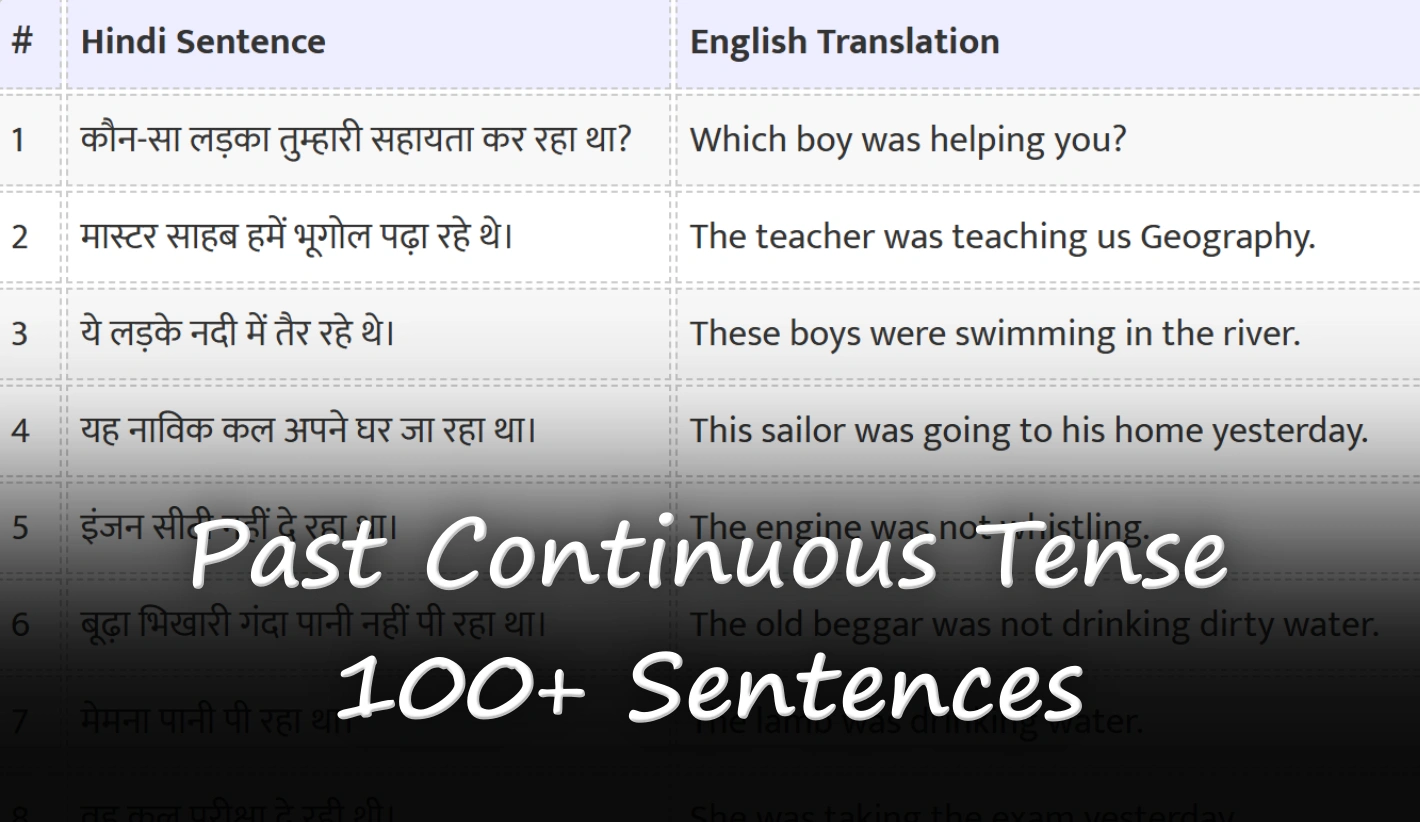
Past Continuous Tense in Hindi: Rules, Examples and Exercises
इस Tense के वाक्यों से ज्ञात होता है कि कार्य भूतकाल (बीते हुए समय) में जारी था और अभी तक पूरा नहीं हुआ था। इस काल के वाक्यों के अन्त में “रहा था, रही थी, रहे थे” आदि शब्द-समूह आते है, किन्तु कार्य के जारी रहने की अवधि नहीं दी हुई होती है।
नीचे दी गई टेबल को ध्यानपूर्वक पढ़िए:
| Person (पुरुष) |
Singular (एकवचन) |
Plural (बहुवचन) |
|---|---|---|
| I Person | I was swimming. मैं तैर रहा था। |
We were swimming. हम तैर रहे थे। |
| II Person | You were swimming. तुम तैर रहे थे। (एक व्यक्ति) |
You were swimming. आप तैर रहे थे। (बहुत-से व्यक्ति) |
| III Person | He (She, It) was swimming. वह तैर रहा था। |
They were swimming. वे तैर रहे थे। |
Rules (नियम):
- यदि कर्ता I, He, She, It या Singular Noun है तो सहायक क्रिया Was लगाकर Verb की First Form में -ing जोड़ दिया जाता है।
- यदि कर्ता We, You, They तथा Plural Noun है तो सहायक क्रिया Were का प्रयोग करके Verb की First Form के अन्त में -ing जोड़ दिया जाता है।
नोट-
- इस Tense में Was, Were सहायक क्रियाओं का प्रयोग होता है।
- मुख्य क्रिया के अन्त में -ing जोड़ा जाता है।
- कल (बीते हुए विन) के लिए Yesterday का प्रयोग होता है।
(A) Affirmative (Positive) Sentences
1. मैं कल एक पुस्तक पढ़ रहा था।
I was reading a book yesterday.
2. हम पुस्तकालय में समाचार-पत्र पढ़ रहे थे।
We were reading newspaper in the library.
3. तुम कल क्रिकेट खेल रहे थे।
You were playing cricket yesterday.
4. यह लड़की कल रो रही थी।
This girl was weeping yesterday.
5. वह लड़का पहले घण्टे में हँस रहा था।
That boy was laughing in the first period.
6. वे लड़के बूढ़े व्यक्ति का मजाक बना रहे थे।
Those boys were laughing at the old man.
7. राम का भाई टिकट खरीद रहा था।
Rama’s brother was buying a ticket.
(B) Negative Sentences
8. मैं कल पत्र नहीं लिख रहा था।
I was not writing a letter yesterday.
9. तुम कक्षा में शोर नहीं मचा रहे थे।
You were not making a noise in the class.
10. वे अपने खेतों को नहीं जोत रहे थे।
They were not ploughing their fields.
11. ये लड़कियाँ ईश्वर की प्रार्थना नहीं कर रही थी।
These girls were not praying to God.
(C) Interrogative Sentences (Question Form)
First Type (‘क्या’ से आरम्भ होने वाले वाक्य):
12. क्या तुम नागपुर जा रहे थे?
Were you going to Nagpur?
13. क्या गवाह झूठ बोल रहा था?
Was the witness telling a lie?
14. क्या जज साहब मुकदमे की सुनवाई नहीं कर रहे थे?
Was the judge not hearing the case?
15. क्या राम का भाई अपनी छोटी बहिन को नहीं पीट रहा था?
Was Rama’s brother not beating his younger sister?
16. क्या बिल्ली चूहे के पीछे नहीं दौड़ रही थी?
Was the cat not running after the rat?
17. क्या वे समाचार-पत्र नहीं पढ़ रहे थे?
Were they not reading newspaper?
Second Type (Wh-Type Questions):
18. वह कल क्या खा रहा था?
What was he eating yesterday?
19 तुम कल कहाँ जा रहे थे?
Where were you going yesterday?
20. वह यहाँ कब सो रहा था?
When was he sleeping here?
22. सुरेश को कल कौन बुला रहा था?
Why were they not doing their work?
21. वे अपना कार्य क्यों नहीं कर रहे थे?
Who was calling Suresh yesterday?
23. तुम कल किसे पढ़ा रहे थे?
Whom were you teaching yesterday?
24. वह किसकी पुस्तक पढ़ रहा था?
Whose book was he reading?
25. तुम किस कक्षा में पढ़ रहे थे?
In which (what) class were you reading?
26. इस कमरे में कितने बच्चे सो रहे थे?
How many children were sleeping in this room?
27. वह कितना दूध पी रहा था?
How much milk was he drinking?
28. तुम यहाँ कब से ठहर रहे थे?
How long were you staying here?
29. पर्वत गिलहरी से क्या कह रहा था?
What was the mountain saying to the squirrel
30. वे अपना समय क्यों नष्ट कर रहे थे?
Why were they wasting their time?
पहिचान और अनुवाद के नियम
पहिचान-
- इस काल (Tense) के वाक्य “रहा था, रही थी, रहे थे आदि शब्द-समूह पर समाप्त होते हैं।
- इस Tense के वाक्यों में कार्य का लगातार होना पाया जाता है किन्तु कार्य के जारी रहने का समय (Time) नहीं दिया होता है।
- इस Tense को Past Imperfect या Past Progressive भी कहते हैं।
अनुवाद के नियम-
(A) Positive Sentences:
- I, We, You, They तथा बहुवचन की संज्ञाओं (Plural Nouns) के लिए Were के साथ मुख्य क्रिया की -ing Form का प्रयोग किया जाता है।
- I, He, She, It तथा एकवचन की संज्ञाओं (Singular Nouns) के लिए Was के साथ मुख्य क्रिया की -ing Form का प्रयोग किया जाता है।
- इस Tense में Was/Were का प्रयोग सहायक क्रिया (Helping Verb) की तरह होता है। मुख्य क्रिया (Main Verb) के अन्त में -ing लगाते हैं।
(B) Negative Sentences:
- Was या Were और मुख्य क्रिया के बीच में ‘नहीं’ के लिए Not लगता है।
(C) Interrogative Sentences:
- ‘क्या’ शब्द से आरम्भ होने वाले वाक्य (First Type) में कर्ता के अनुसार कर्ता से पहले Was, Were का प्रयोग होता है तथा कर्ता के बाद में मुख्य क्रिया के अन्त में -ing जोड़ा जाता है।
- यदि वाक्य निषेधात्मक (Negative) भी है तो मुख्य क्रिया से पहले ‘नहीं’ के लिए Not लिखा जाता है।
- यदि प्रश्नसूचक शब्द (जैसे- क्या, कब, क्यों, कहाँ, कैसे) वाक्य के बीच में आया हो (Second Type) तो वाक्य में उस शब्द की अंग्रेजी सबसे पहले आती है और फिर कर्ता के अनुसारं सहायक क्रिया Was/Were का प्रयोग होता है।
- यदि ऐसे वाक्य निषेधात्मक (Negative) भी हैं तो कर्ता और मुख्य क्रिया के बीच में ‘नहीं’ के लिए Not का प्रयोग होता है।
- ‘कौन’ वाले वाक्यों में Who का प्रयोग होता है। Who के तुरन्त बाद सहायक Was/Were तथा मुख्य क्रिया (First Form+ing) का प्रयोग किया जाता है।
- ‘किसकी’, ‘किस’, ‘कितने’, ‘कितना’ के साथ इनसे सम्बन्धित Nouns लिखकर सहायक क्रिया का प्रयोग किया जाता है।
- ‘कब से’ के लिए How long का प्रयोग होता है।
- प्रश्नवाचक वाक्यों के अन्त में प्रश्नवाचक चिन्ह (?) लगाया जाता है।
Present Continuous और Past Continuous में अन्तर
- Present Continuous के अन्त में ‘रहा है’, ‘रही है’, ‘रहे हैं’ आदि शब्द आते हैं जबकि Past Continuous के अन्त में ‘रहा था’, ‘रही थे’, ‘रहे थे’ आदि शब्द आते हैं।
- Present Continuous में Is/Am/Are सहायक क्रियाओं के साथ मुख्य क्रिया की First Form + -ing का प्रयोग होता है जबकि Past Continuous में Was/Were सहायक क्रियाओं के साथ मुख्य क्रिया की First Form + -ing का प्रयोग होता है।
- Yesterday का प्रयोग Present Continuous में नहीं हो सकता, Yesterday का प्रयोग Past Continuous में होता है।
Examples:
- राम अपने गाँव जा रहा है। Rama is going to his village. (Present Continuous)
- राम अपने गाँव जा रहा था। Rama was going to his village. (Past Continuous)
EXERCISE 28. (Positive Sentences) Translate the following sentences into English:
| # | Hindi Sentence | English Translation |
|---|---|---|
| 1 | हमारे मास्टर साहब कल अलीगढ़ जा रहे थे। | Our teacher was going to Aligarh yesterday. |
| 2 | हमारा धोबी आज सुबह के समय तालाब में गंदे कपड़े धो रहा था। | Our washerman was washing dirty clothes in the pond this morning. |
| 3 | हम पार्क में अपने मित्रों के साथ मटरगश्ती कर रहे थे। | We were roaming around in the park with our friends. |
| 4 | पिताजी माताजी और भाई साहब के साथ आगरा से लौट रहे थे। | Father was returning from Agra with mother and elder brother. |
| 5 | हिमानी झूठ बोल रही थी। | Himani was telling a lie. |
| 6 | अंशु अपना कार्य ध्यानपूर्वक कर रही थी। | Anshu was doing her work carefully. |
| 7 | पिताजी सुबह के समय विश्वनाथ मंदिर को जा रहे थे। | Father was going to the Vishwanath temple in the morning. |
| 8 | कल ये लड़के पतंगें उड़ा रहे थे। | These boys were flying kites yesterday. |
| 9 | वायुयान इंजन में यांत्रिक खराबी के कारण धीरे-धीरे उतर रहा था। | The airplane was landing slowly because of a mechanical defect in the engine. |
| 10 | सूर्य आकाश में तेजी से चमक रहा था। | The sun was shining brightly in the sky. |
Difficult words: तालाब = pond (या pool); ग्रंदे = dirty; मटरगश्ती करना = to loiter; लौटना = to return; ध्यानपूर्वक = carefully (या attentively); पतंगें = kites; इंजन = engine; यांत्रिक खराबी के कारण = due to mechanical defect; उतरना = to climb down; तेजी से चमकना brilliantly,
EXERCISE 2. (Negative Sentences) Translate the following sentences into English:
| # | Hindi Sentence | English Translation |
|---|---|---|
| 1 | मैं कल इस समय कार्य नहीं कर रहा था। | I was not working at this time yesterday. |
| 2 | भावना चाय नहीं बना रही थी। | Bhavana was not making tea. |
| 3 | महेश आज सुबह कॉफी नहीं पी रहा था। | Mahesh was not drinking coffee this morning. |
| 4 | अंशु चोट के कारण स्कूल नहीं जा रही थी। | Anshu was not going to school because of her injury. |
| 5 | हिमानी अपने कपड़े नहीं धो रही थी। | Himani was not washing her clothes. |
| 6 | मुकेश सामान खरीदने गाजियाबाद नहीं जा रहा था। | Mukesh was not going to Ghaziabad to buy goods. |
| 7 | रुचि अपने भाइयों से मिलने कासिमपुर नहीं जा रही थी। | Ruchi was not going to Kasimpur to meet her brothers. |
| 8 | बच्चों की परीक्षा के कारण लक्ष्मी दिल्ली नहीं आ रही थी। | Lakshmi was not coming to Delhi because of her children’s exams. |
| 9 | धन की कमी के कारण विनोद नया स्कूटर नहीं खरीद रहा था। | Vinod was not buying a new scooter due to lack of money. |
| 10 | रमेश अपने बच्चों से मिलने के कारण ऑफिस में कार्य नहीं कर रहा था। | Ramesh was not working in the office because he was meeting his children. |
| 11 | छुट्टियाँ होने पर भी महेश कालकाजी नहीं जा रहा था। | Mahesh was not going to Kalkaji even though it was vacation time. |
Difficult words: चोट के कारण = on account of being injured; परीक्षा के कारण due to examination; धन की कमी के कारण = on account of being short of money; छुट्टी होने पर भी = in spite of holidays.
EXERCISE 3. (Interrogative Sentences) Translate the following sentences into English:
First Type:
| # | Hindi Sentence | English Translation |
|---|---|---|
| 1 | क्या वह अपना स्कूटर बेच रहा था? | Was he selling his scooter? |
| 2 | क्या एक लड़की कुएँ पर बैठी रो रही थी? | Was a girl sitting by the well and crying? |
| 3 | क्या तुम्हारे भाई कमरे में सो रहे थे? | Were your brothers sleeping in the room? |
| 4 | क्या पिताजी समाचार पत्र नहीं पढ़ रहे थे? | Was father not reading the newspaper? |
| 5 | क्या माताजी कल कॉफी नहीं पी रही थी? | Was mother not drinking coffee yesterday? |
Second Type:
| # | Hindi Sentence | English Translation |
|---|---|---|
| 6 | हमीद कल क्या खा रहा था? | What was Hameed eating yesterday? |
| 7 | तुम आज सुबह किसे पीट रहे थे? | Whom were you beating this morning? |
| 8 | वे भिखारी को क्यों फटकार रहे थे? | Why were they scolding the beggar? |
| 9 | माताजी कल कहाँ जा रही थीं? | Where was mother going yesterday? |
| 10 | पिताजी कल इस समय दफ्तर में क्या काम कर रहे थे? | What work was father doing in the office at this time yesterday? |
| 11 | तुम कितनी चीनी खरीद रहे थे? | How much sugar were you buying? |
| 12 | इस कक्षा में पाँचवें घण्टे में कितने लड़के पढ़ रहे थे? | How many boys were studying in this class during the fifth period? |
| 13 | कल कौन-से अध्यापक तुम्हें नहीं पढ़ा रहे थे? | Which teacher was not teaching you yesterday? |
| 14 | कल यह धोबी कितने ग्राहकों से पेशगी ले रहा था? | From how many customers was this washerman taking an advance yesterday? |
| 15 | वे कब से तुम्हारी प्रतीक्षा कर रहे थे? | Since when were they waiting for you? |
Difficult words: स्कूटर = scooter; कुएं = well; कॉफी = coffee; फटकारना = to scold (या to abuse): दफ्तर = office; क्या काम = what work; कितनी चीनी = how much sugar, पांचवें घण्टे में = in the fifth period; कौन-से अध्यापक = which teachers; ग्राहकों = customers; पेशगी = advance.
EXERCISE 4. (Miscellaneous) Translate the following sentences into English:
| # | Hindi Sentence | English Translation |
|---|---|---|
| 1 | कौन-सा लड़का तुम्हारी सहायता कर रहा था? | Which boy was helping you? |
| 2 | मास्टर साहब हमें भूगोल पढ़ा रहे थे। | The teacher was teaching us Geography. |
| 3 | ये लड़के नदी में तैर रहे थे। | These boys were swimming in the river. |
| 4 | यह नाविक कल अपने घर जा रहा था। | This sailor was going to his home yesterday. |
| 5 | इंजन सीटी नहीं दे रहा था। | The engine was not whistling. |
| 6 | बूढ़ा भिखारी गंदा पानी नहीं पी रहा था। | The old beggar was not drinking dirty water. |
| 7 | मेमना पानी पी रहा था। | The lamb was drinking water. |
| 8 | वह कल परीक्षा दे रही थी। | She was taking the exam yesterday. |
| 9 | डॉक्टर साहब रोगी को दवा नहीं दे रहे थे। | The doctor was not giving medicine to the patient. |
| 10 | तुम कल कहाँ जा रहे थे? | Where were you going yesterday? |
| 11 | वह तुम्हें नहीं पुकार रहा था। | He was not calling you. |
| 12 | कमरा कौन साफ कर रहा था? | Who was cleaning the room? |
Difficult words: कौन-सा लड़की = which boy: भूगोल = Geography: इंजन =.engine; सीटी देना = to whistle; भिखारी = beggar; गंदा पानी dirty water; मेमना = lamb; परीक्षा = examination; रोगी = patient: दवाई medicine.
Learn other English Grammar in Hindi Translation: