

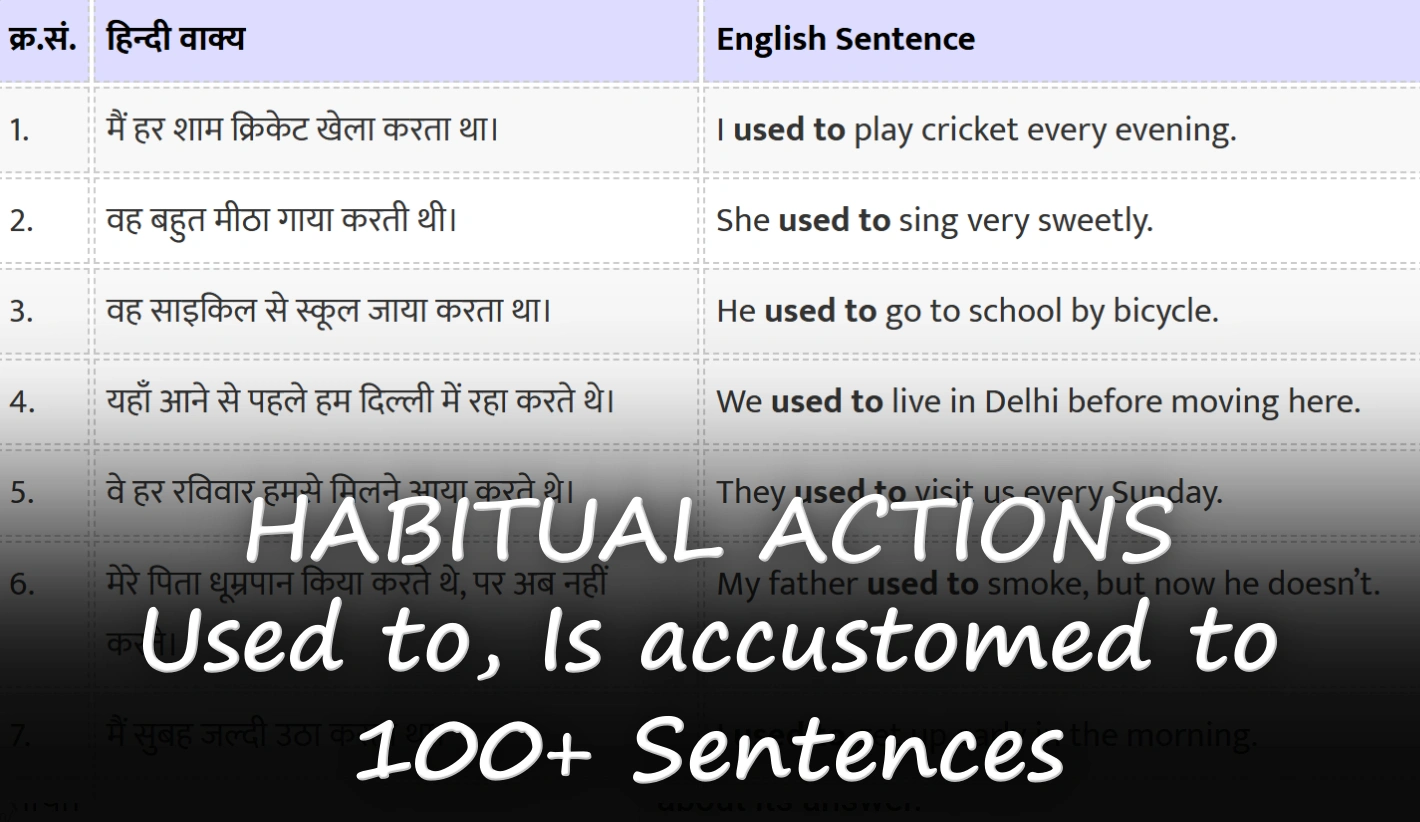
HABITUAL ACTIONS
Habitual Action का अर्थ है- “स्वाभाविक कार्य” या “आदतन क्रियाएँ” या “नियमित रूप से होने वाली क्रियाएँ”। अतः Habitual actions वे क्रियाएँ होती हैं जो कोई व्यक्ति नियमित रूप से, आदतवश या बार-बार करता है। ऐसे कार्य उसकी आदत (habit) को दर्शाते हैं।
स्वाभाविक कार्य से संबंधित वाक्यों का अनुवाद करने के प्रमुख नियम (rules) निम्न है-
- बहुवचन के Common Noun से पहले Article-“The” का प्रयोग न करने से Habitual Action (स्वभाव से प्रकट होने वाला कार्य अर्थात स्वाभाविक कार्य) प्रकट होती है; जैसे-
- The boys play.
लडके खेलते हैं। - Boys play.
लड़के खेला करते हैं। (स्वाभाविक कार्य)
- The boys play.
- यदि Proper Noun की आदत प्रकट करनी है तो-
- Past Tense में आदत प्रकट करने के लिए “Used to + V1” का प्रयोग होता है। ये वाक्य “Would + V1“के प्रयोग से भी बनाये जा सकते हैं। Negative वाक्यों में “Did not use to + V1” का प्रयोग किया जाता है।
- Present Tense में “is accustomed + V-ing / is used to + V-ing” का प्रयोग किया जाता है।
Examples:
1 पक्षी आकाश में उड़ा करते हैं।
Birds fly in the air.
2. कुत्ते भौका करते हैं।
Dogs bark.
3. हरी दिन में सोया करता है।
Hari is accustomed to sleeping in the day.
(OR) Hari is used to sleeping in the day.
4. ये लड़कियाँ गीत गाया करती थीं।
These girls used to sing songs.
(OR) These girls would sing.
5. वह दिन में शतरंज खेला करता था।
He used to play chess in the day.
(OR) He would play chess in the day.
6. एक बूढ़ा व्यक्ति अपने खोये हुए बच्चे के लिए रोया करता था।
An old man used to weep for his, lost child.
7 . एक निर्धन व्यक्ति उस बरगद के पेड़ के नीचे बैठ जाया करता था।
A poor man would sit under that banyan tree.
8. शिवाजी की माता उनको बचपन में वीरता की कहानियाँ सुनाया करती थीं।
Shivaji’s mother used to tell him tales of bravery in childhood.
9. वह प्रतिदिन यहाँ नहीं आया करती थी।
She did not use to come here daily.
10. इतनी अधिक बारिश नहीं हुआ करती थी।
It did not use to rain so often.
EXERCISE 1. Translate the following sentences into English:
| # | हिन्दी वाक्य | English Translation |
|---|---|---|
| 1. | तोते आकाश में उड़ा करते हैं। | Parrots fly in the sky. |
| 2. | बैल घास खाया करते हैं। | Bulls eat grass. |
| 3. | मनुष्य दिन में काम किया करते हैं। | Men work during the day. |
| 4. | मुसलमान मुहर्रम में रोज़ा रखा करते हैं। | Muslims keep fasts during Muharram. |
| 5. | हिन्दू मन्दिर में पूजा किया करते हैं। | Hindus worship in the temple. |
| 6. | ईसाई रविवार को चर्च जाया करते हैं। | Christians go to church on Sundays. |
| 7. | पिताजी ठीक समय पर प्रतिदिन अपने दफ़्तर जाया करते हैं। | Father goes to his office daily on time. |
| 8. | कुत्ते अपरिचित व्यक्तियों को देखकर भौंका करते हैं। | Dogs bark when they see strangers. |
| 9. | पिछले वर्ष मैं प्रतिदिन शतरंज खेला करता था। | Last year, I used to play chess every day. |
| 10. | पिछले वर्ष यह मोटा आदमी प्रतिदिन जुआ खेला करता था। | Last year, this fat man used to gamble every day. |
| 11. | माताजी प्रतिदिन गत वर्ष मन्दिर में पूजा करने जाया करती थीं। | Mother used to go to the temple for worship every day last year. |
| 12. | पिताजी कुछ वर्षों से हमें इंग्लिश ग्रामर पढ़ाया करते थे। | Father used to teach us English grammar for several years. |
| 13. | हमारे बड़े भाई साहब दिन में सोया करते थे। | Our elder brother used to sleep during the day. |
| 14. | तुम्हारे चाचाजी दिन में कार्य नहीं किया करते थे। | Your uncle did not use to work during the day. |
| 15. | यह दुकानदार सूर्यास्त होने से पहले अपनी दुकान बंद कर दिया करता था। | This shopkeeper used to close his shop before sunset. |
Difficult words: तोते = parrots; बैल = bullocks, oxen; मुहर्रम = Muharram; रोजा रखना = to keep fast; ईसाई = Christians; चर्च church; शतरंज chess; बन्द करना = to close: अपरिचित व्यक्ति = strangers.
EXERCISE 2. Translate the following sentences into English:
| # | हिन्दी वाक्य | English Sentence |
| 1. | मैं हर शाम क्रिकेट खेला करता था। | I used to play cricket every evening. |
| 2. | वह बहुत मीठा गाया करती थी। | She used to sing very sweetly. |
| 3. | वह साइकिल से स्कूल जाया करता था। | He used to go to school by bicycle. |
| 4. | यहाँ आने से पहले हम दिल्ली में रहा करते थे। | We used to live in Delhi before moving here. |
| 5. | वे हर रविवार हमसे मिलने आया करते थे। | They used to visit us every Sunday. |
| 6. | मेरे पिता धूम्रपान किया करते थे, पर अब नहीं करते। | My father used to smoke, but now he doesn’t. |
| 7. | मैं सुबह जल्दी उठा करता था। | I used to get up early in the morning. |
| 8. | वह बहुत सारी किताबें पढ़ा करता था। | He used to read a lot of books. |
| 9. | वह चश्मा लगाया करती थी। | She used to wear glasses. |
| 10. | हम रात के खाने के बाद टहलने जाया करते थे। | We used to go for a walk after dinner. |
| 11. | मुझे पहले कॉफी पसंद नहीं थी। | I did not use to like coffee before. |
| 12. | वह ज़्यादा टीवी नहीं देखा करता था। | He did not use to watch TV much. |
| 13. | वे यहाँ अक्सर नहीं आया करते थे। | They did not use to come here often. |
| 14. | वह अंग्रेज़ी नहीं बोला करती थी। | She did not use to speak English. |
| 15. | मैं पहले शतरंज नहीं खेला करता था। | I did not use to play chess before. |
| 16. | हम जंक फूड नहीं खाया करते थे। | We did not use to eat junk food. |
| 17. | वह पहले गंभीरता से पढ़ाई नहीं किया करता था। | He did not use to study seriously. |
| 18. | मेरी बहन खाना नहीं बनाया करती थी। | My sister did not use to cook food. |
| 19. | वे सुबह जल्दी नहीं उठा करते थे। | They did not use to get up early. |
| 20. | मैं औपचारिक कपड़े नहीं पहना करता था। | I did not use to wear formal clothes. |
| 21. | मैं हर सप्ताहांत मछली पकड़ने जाया करता था। | I would go fishing every weekend. |
| 22. | वह हमेशा गरीबों की मदद किया करता था। | He would always help poor people. |
| 23. | मेरी माँ हर रविवार स्वादिष्ट खाना बनाया करती थीं। | My mother would cook delicious food every Sunday. |
| 24. | हम पेड़ के नीचे बैठकर घंटों बातें किया करते थे। | We would sit under the tree and talk for hours. |
| 25. | वह अपने दोस्तों को नियमित रूप से पत्र लिखा करती थी। | She would write letters to her friends regularly. |
| 26. | वह अक्सर अपनी किताबें घर पर भूल जाया करता था। | He would often forget his books at home. |
| 27. | वे हर सुबह मंदिर जाया करते थे। | They would go to the temple every morning. |
| 28. | मैं हर गर्मियों में अपने दादा-दादी से मिलने जाया करता था। | I would visit my grandparents every summer. |
| 29. | वह हमें मज़ेदार कहानियाँ सुनाया करता था। | He would tell us funny stories. |
| 30. | हम बारिश में फुटबॉल खेला करते थे। | We would play football in the rain. |
| 31. | मैं जल्दी उठने का आदी हूँ। | I am accustomed to waking up early. |
| 32. | वह दोपहर के खाने के बाद चाय पीने का आदी है। | He is accustomed to drinking tea after lunch. |
| 33. | वह मेहनत करने की आदी है। | She is accustomed to working hard. |
| 34. | वे ठंडे मौसम में रहने के आदी हैं। | They are accustomed to living in cold weather. |
| 35. | हम मसालेदार भोजन खाने के आदी हैं। | We are accustomed to eating spicy food. |
| 36. | मैं लम्बी दूरी चलने का आदी था। | I was accustomed to walking long distances. |
| 37. | वह रात को देर से सोने का आदी था। | He was accustomed to sleeping late at night. |
| 38. | वह पारंपरिक कपड़े पहनने की आदी थी। | She was accustomed to wearing traditional clothes. |
| 39. | वे जल्दी उठने के आदी थे। | They were accustomed to getting up early. |
| 40. | हम अपना सारा काम खुद करने के आदी थे। | We were accustomed to doing all our work ourselves. |
| 41. | जब मैं छोटा था, तब घोड़ा चलाया करता था। | I used to ride a horse when I was young. |
| 42. | वह नियमित रूप से जिम जाया करता था। | He used to go to the gym regularly. |
| 43. | वह कॉलेज के कार्यक्रमों में नाचा करती थी। | She used to dance in college functions. |
| 44. | हम शामें छत पर बिताया करते थे। | We used to spend evenings on the roof. |
| 45. | वे हर रात ताश खेला करते थे। | They used to play cards every night. |
| 46. | मैं पहले फिल्में नहीं देखा करता था। | I did not use to watch movies before. |
| 47. | वह बचपन में दूध नहीं पिया करता था। | He did not use to drink milk in his childhood. |
| 48. | वह जीन्स नहीं पहना करती थी। | She did not use to wear jeans. |
| 49. | हम ट्रेन से यात्रा नहीं किया करते थे। | We did not use to travel by train. |
| 50. | वे कक्षा में ज़्यादा बात नहीं किया करते थे। | They did not use to talk much in class. |
Note:
Present Habitual Actions → Simple Present Tense
Example: He goes to school daily.
(वह रोज़ स्कूल जाता है।)
Past Habitual Actions → “Used to”
Example: He used to play cricket every evening.
(वह हर शाम क्रिकेट खेला करता था।)
नोट: यदि “be” के साथ phrase हो जैसे कि accustomed to / used to / addicted to / fond of / interested in तो verb हमेशा -ing form में आएगा। जैसे-
| Phrase | Examples |
|---|---|
| accustomed to | He is accustomed to waking early. (वह जल्दी उठने का आदी है।) He was accustomed to waking early. (वह जल्दी उठने का आदी था।) He will be accustomed to waking early. (वह जल्दी उठने का आदी हो जाएगा।) |
| be used to | She is used to working late. (वह देर तक काम करने की आदी है।) She was used to working late. (वह देर तक काम करने की आदी थी।) She will be used to working late. (वह देर तक काम करने की आदी हो जाएगी।) |
| addicted to | He is addicted to playing games. (उसे खेल खेलने की लत है।) He was addicted to playing games. (उसे खेल खेलने की लत थी।) He will be addicted to playing games. (उसे खेल खेलने की लत लग जाएगी।) |
| fond of | She is fond of reading books. (उसे किताबें पढ़ने का शौक है।) She was fond of reading books. (उसे किताबें पढ़ने का शौक था।) She will be fond of reading books. (उसे किताबें पढ़ने का शौक हो जाएगा।) |
| interested in | I am interested in learning English. (मुझे अंग्रेज़ी सीखने में रुचि है।) I was interested in learning English. (मुझे अंग्रेज़ी सीखने में रुचि थी।) I will be interested in learning English. (मुझे अंग्रेज़ी सीखने में रुचि हो जाएगी।) |
जबकि Past Habit व्यक्त करने के लिए “Used to + V1” या सिर्फ repeated past action दिखाने के लिए “Would + V1” का भी प्रयोग कर सकते हैं। जैसे-
1. वह दिन में शतरंज खेला करता था।
He used to play chess in the day.
He Would play chess in the day.
2. वह प्रतिदिन यहाँ नहीं आया करती थी।
She did not use to come here daily.
हम “Would + V1” कब use नहीं करते?
- अगर sentence में repeated action का idea नहीं है। Single Past Action (एक बार की घटना)
- Stative Verbs (feel, like, know, love, be)
1. हरी दिल्ली रहा करता था। (Single Time Habit)
Hari used to live in Delhi.
Hari would live in Delhi.
2. जब मैं बच्चा था तब मुझे दूध पसंद हुआ करता था। (Stative Verbs)
I used to like milk when I was a child.
I would like milk when I was a child.
3. वह पहले उत्तर जानती हुआ करती थी।
She used to know the answer.
She would know the answer.