

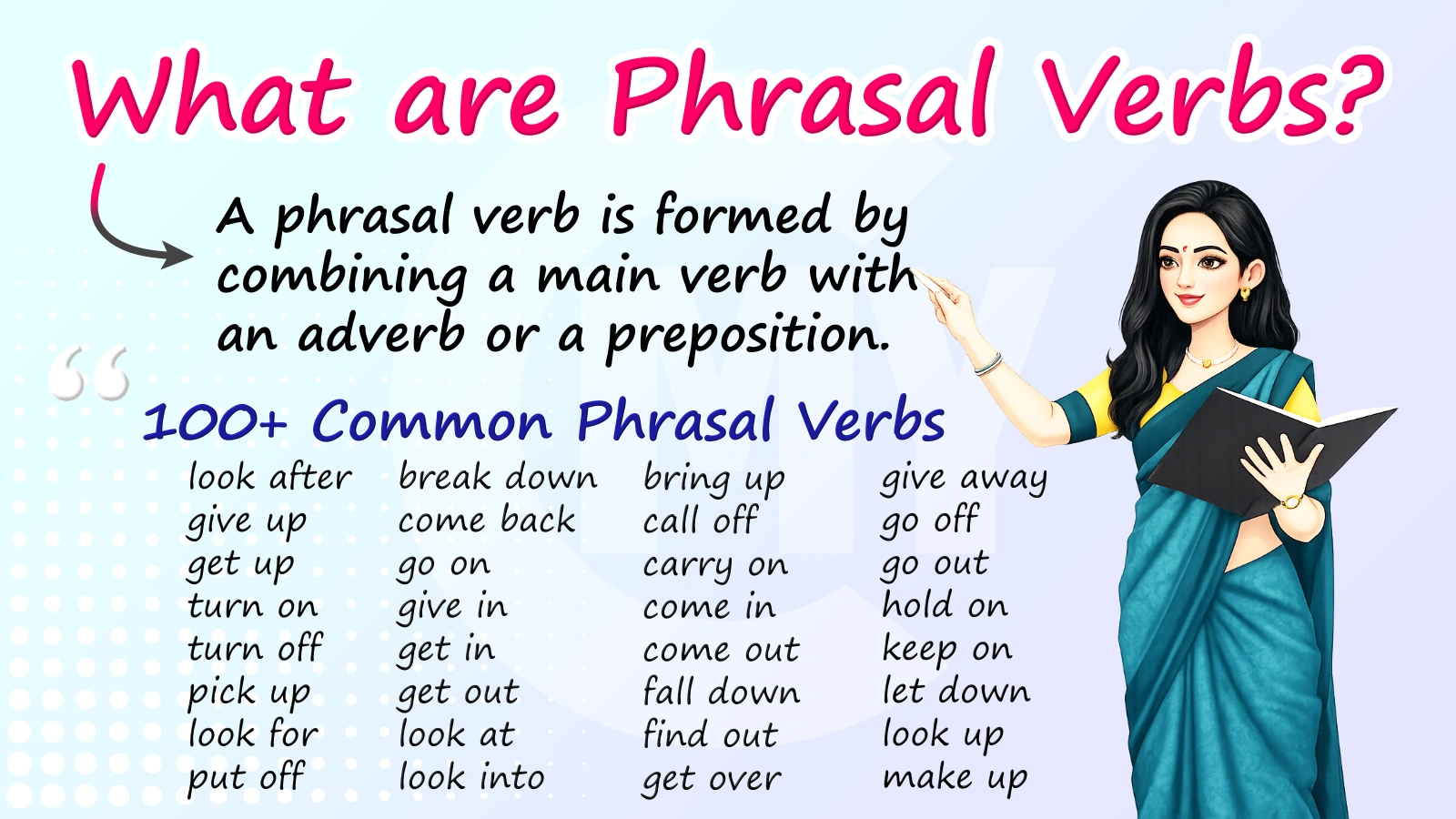
What is a Phrasal Verb?
Phrasal verbs वे क्रियाएँ होती हैं जो main verb और preposition/adverb से मिलकर बनती हैं। इनका अर्थ अक्सर अलग या नया होता है, जो verb के अकेले अर्थ से अलग हो सकता है।
Structure of Phrasal Verbs: Verb + Preposition / Adverb
- look + after → look after (देखभाल करना)
- give + up → give up (छोड़ देना)
चूंकि Phrasal verb का अर्थ अक्सर उसके अलग-अलग शब्दों के अर्थ से अलग होता है। इसलिए phrasal verb को एक नया शब्द मानकर सीखना चाहिए।
A phrasal verb is formed by combining a main verb with an adverb or a preposition. The meaning of a phrasal verb is usually different from the meanings of its individual words. So, a phrasal verb should be learned as a new word.
For Example: “Get over”
- get = प्राप्त करना (to acquire)
- over = ऊपर / पार
But together:
get over = recover from / overcome (किसी दुख, बीमारी या समस्या से उबर जाना)
Using a Phrasal Verb in Different Forms
Phrasal verbs को सामान्य verb की तरह सभी कालों में प्रयोग किया जा सकता है।
Phrasal verbs can be used like normal verbs, in all tenses and forms.
Examples of “get over”:
- I had the flu last week but got over it. (Simple Past)
(मुझे पिछले हफ्ते फ्लू था, लेकिन मैं उससे ठीक हो गया।) - He wrote a song to get over his grandmother’s death. (Infinitive)
(उसने अपनी दादी की मृत्यु से उबरने के लिए एक गीत लिखा।) - Getting over prejudice at work is never easy. (Gerund)
(काम पर भेदभाव से उबरना आसान नहीं होता।) - Having finally gotten over the breakup, they moved on. (Past Participle)
(आखिरकार ब्रेकअप से उबरने के बाद वे आगे बढ़ गए।)
How to Conjugate Phrasal Verbs (Phrasal Verbs का रूप कैसे बदलते हैं?)
Phrasal verb में केवल main verb बदलता है, adverb/preposition वही रहता है।
When a phrasal verb is used as the main verb, only the verb part changes, not the particle.
Example of “get up”:
- I get up early. (मैं जल्दी उठता हूँ।)
- I got up early yesterday. (मैं कल जल्दी उठा।)
- I have gotten up early many times. (मैं कई बार जल्दी उठा हूँ।)
Types of Phrasal Verbs
Phrasal verbs को दो तरीकों से वर्गीकृत किया जाता है: transitive and intransitive, separable and inseparable.
Transitive Phrasal Verbs
These verbs need an object. (इन verbs के साथ object आवश्यक होता है।)
- Charlie couldn’t put up with the noise. (चार्ली शोर सह नहीं सका।)
Intransitive Phrasal Verbs
These verbs do not need an object. (इन verbs को object की आवश्यकता नहीं होती।)
- The team went ahead without the manager. (टीम मैनेजर के बिना आगे बढ़ गई।)
Separable Phrasal Verbs
In these verbs, the object can come between the verb and particle. (इन verbs में object को बीच में रखा जा सकता है।)
- He turned off the light.
- He turned the light off.
Inseparable Phrasal Verbs
These verbs cannot be split. (इन verbs को अलग नहीं किया जा सकता।)
- She looks after her mother.
- Wrong: looks her mother after
Word Order with Phrasal Verbs
- In phrasal verbs, word order depends on whether the verb is separable or inseparable. (Phrasal verbs में शब्दों का क्रम इस बात पर निर्भर करता है कि verb separable है या inseparable।)
- Pronouns must always be placed in the middle of separable phrasal verbs. (Pronoun हमेशा separable phrasal verb के बीच में आता है।)
Intransitive and Inseparable Transitive Phrasal Verbs
Intransitive और inseparable transitive phrasal verbs में verb और particle हमेशा साथ रहते हैं। इन्हें अलग नहीं किया जाता।
- Nothing comes between us. (हमारे बीच कुछ भी नहीं आता।)
Wrong: Nothing comes us between.
Separable Phrasal Verbs
Separable phrasal verbs के नियम अलग होते हैं। ये हमेशा transitive होते हैं और इनके साथ object आता है। Object को verb और particle के बीच रखा जा सकता है।
- Augustus never let Hazel down. (ऑगस्टस ने हेज़ल को कभी निराश नहीं किया।)
Object as a Noun Phrase
अगर object noun phrase हो, तो पूरा phrase verb और particle के बीच आ सकता है।
- You never let any of your friends down.
(तुम अपने किसी भी दोस्त को निराश नहीं करते।)
When Object in the Middle is Required
कुछ separable phrasal verbs में object को बीच में रखना ज़रूरी होता है। जैसे get down:
- The movie gets everyone down. (फ़िल्म सबको उदास कर देती है।)
Wrong: The movie gets down everyone.
When Both Positions Are Correct
कुछ separable phrasal verbs में object बीच में या अंत में, दोनों जगह सही होता है।
- Pick the box up.
- Pick up the box.
Unfortunately, there is no fixed rule to know which phrasal verbs are separable or inseparable. They must be memorized and practiced.
Special Rule for Pronouns
अगर object pronoun हो, तो उसे verb और particle के बीच ही रखना होता है।
- Pick it up. (इसे उठा लो।)
Wrong: Pick up it.
100 Common Phrasal Verbs (with Hindi Meaning & Examples)
| # | Phrasal Verb | Meaning | Example |
|---|---|---|---|
| 1 | look after | देखभाल करना | She looks after her sister. (वह अपनी बहन की देखभाल करती है।) |
| 2 | give up | छोड़ देना | He gave up smoking. (उसने धूम्रपान छोड़ दिया।) |
| 3 | get up | उठना | I get up early. (मैं जल्दी उठता हूँ।) |
| 4 | turn on | चालू करना | Please turn on the fan. (कृपया पंखा चालू करें।) |
| 5 | turn off | बंद करना | Turn off the light. (बत्ती बंद कर दो।) |
| 6 | pick up | उठाना / लेना | She picked up the book. (उसने किताब उठाई।) |
| 7 | look for | ढूँढना | They looked for the keys. (वे चाबियाँ ढूँढ रहे थे।) |
| 8 | put off | टालना | The meeting was put off. (मीटिंग टाल दी गई।) |
| 9 | break down | खराब हो जाना | The car broke down. (कार खराब हो गई।) |
| 10 | come back | वापस आना | He came back late. (वह देर से लौटा।) |
| 11 | go on | जारी रखना | Please go on speaking. (कृपया बोलते रहिए।) |
| 12 | give in | हार मान लेना | He gave in at last. (उसने अंत में हार मान ली।) |
| 13 | get in | अंदर जाना | She got in the car. (वह कार में बैठी।) |
| 14 | get out | बाहर निकलना | Get out of the room. (कमरे से बाहर निकलो।) |
| 15 | look at | देखना | Look at the board. (बोर्ड को देखो।) |
| 16 | look into | जाँच करना | The matter will be looked into. (मामले की जाँच होगी।) |
| 17 | bring up | पालना / विषय उठाना | She brought up the child. (उसने बच्चे को पाला।) |
| 18 | call off | रद्द करना | The match was called off. (मैच रद्द कर दिया गया।) |
| 19 | carry on | जारी रखना | Carry on your work. (अपना काम जारी रखो।) |
| 20 | come in | अंदर आना | Please come in. (कृपया अंदर आइए।) |
| 21 | come out | बाहर आना / प्रकाशित होना | The result came out. (परिणाम आया।) |
| 22 | fall down | गिर जाना | He fell down. (वह गिर गया।) |
| 23 | find out | पता लगाना | Find out the truth. (सच पता करो।) |
| 24 | get over | उबर जाना | She got over her illness. (वह बीमारी से उबर गई।) |
| 25 | give away | दान करना | He gave away clothes. (उसने कपड़े दान किए।) |
| 26 | go off | बंद हो जाना | The light went off. (बत्ती बंद हो गई।) |
| 27 | go out | बाहर जाना | She went out. (वह बाहर गई।) |
| 28 | hold on | प्रतीक्षा करना | Hold on a minute. (एक मिनट रुको।) |
| 29 | keep on | करते रहना | Keep on trying. (कोशिश करते रहो।) |
| 30 | let down | निराश करना | Don’t let me down. (मुझे निराश मत करना।) |
| 31 | look up | ढूँढना (शब्द) | Look up the meaning. (अर्थ देखो।) |
| 32 | make up | बना लेना / सुलह करना | They made up. (उन्होंने सुलह कर ली।) |
| 33 | pass away | मर जाना | His uncle passed away. (उसके चाचा का निधन हो गया।) |
| 34 | put on | पहनना | Put on your coat. (अपना कोट पहन लो।) |
| 35 | put out | बुझाना | Put out the fire. (आग बुझाओ।) |
| 36 | run away | भाग जाना | The thief ran away. (चोर भाग गया।) |
| 37 | set up | स्थापित करना | He set up a shop. (उसने दुकान खोली।) |
| 38 | take off | उतारना / उड़ान भरना | The plane took off. (हवाई जहाज उड़ा।) |
| 39 | take care of | ध्यान रखना | Take care of yourself. (अपना ध्यान रखो।) |
| 40 | turn up | आ जाना | He turned up late. (वह देर से आया।) |
| 41 | wake up | जागना | Wake up early. (जल्दी जागो।) |
| 42 | work out | हल निकालना | Work out the sum. (प्रश्न हल करो।) |
| 43 | write down | लिख लेना | Write down the answer. (उत्तर लिख लो।) |
| 44 | ask for | माँगना | He asked for help. (उसने मदद माँगी।) |
| 45 | blow out | बुझ जाना | The candle blew out. (मोमबत्ती बुझ गई।) |
| 46 | call up | फोन करना | Call me up. (मुझे फोन करो।) |
| 47 | check in | प्रवेश दर्ज करना | We checked in early. (हमने चेक-इन किया।) |
| 48 | check out | जाँच करना / निकलना | Check out this book. (यह किताब देखो।) |
| 49 | cut down | कम करना | Cut down expenses. (खर्च कम करो।) |
| 50 | drop out | छोड़ देना | He dropped out of school. (उसने स्कूल छोड़ दिया।) |
100 Common Phrasal Verbs (51-100)
| # | Phrasal Verb | Meaning | Example |
|---|---|---|---|
| 51 | break out | फैल जाना / शुरू होना | Fire broke out suddenly. (अचानक आग फैल गई।) |
| 52 | bring back | वापस लाना | Bring back my book. (मेरी किताब वापस लाओ।) |
| 53 | carry out | पूरा करना | He carried out the plan. (उसने योजना पूरी की।) |
| 54 | come across | अचानक मिल जाना | I came across an old photo. (मुझे एक पुरानी तस्वीर मिली।) |
| 55 | come down | कम होना | The price came down. (कीमत कम हो गई।) |
| 56 | cut off | काट देना | The power was cut off. (बिजली काट दी गई।) |
| 57 | do away with | समाप्त करना | We must do away with evil. (हमें बुराई खत्म करनी चाहिए।) |
| 58 | fall apart | टूट जाना | The chair fell apart. (कुर्सी टूट गई।) |
| 59 | get along | मेल-जोल रखना | They get along well. (वे अच्छी तरह रहते हैं।) |
| 60 | get back | वापस आना | He got back home. (वह घर वापस आया।) |
| 61 | get through | पार पाना / संपर्क करना | She got through the exam. (वह परीक्षा पास कर गई।) |
| 62 | give back | वापस देना | Give back my pen. (मेरा पेन वापस दो।) |
| 63 | go ahead | आगे बढ़ना | Go ahead with your work. (अपने काम में आगे बढ़ो।) |
| 64 | hand over | सौंप देना | Hand over the keys. (चाबियाँ सौंप दो।) |
| 65 | keep off | दूर रखना | Keep off the grass. (घास से दूर रहो।) |
| 66 | knock out | बेहोश करना | He was knocked out. (वह बेहोश हो गया।) |
| 67 | lay off | नौकरी से निकालना | The company laid off workers. (कंपनी ने कर्मचारियों को निकाला।) |
| 68 | look out | सावधान रहना | Look out! A car is coming. (सावधान! गाड़ी आ रही है।) |
| 69 | make out | समझ पाना | I can’t make out the words. (मैं शब्द समझ नहीं पा रहा।) |
| 70 | move on | आगे बढ़ना | Let’s move on. (आगे बढ़ते हैं।) |
| 71 | pass out | बेहोश हो जाना | He passed out suddenly. (वह अचानक बेहोश हो गया।) |
| 72 | put away | रख देना | Put away your toys. (अपने खिलौने रख दो।) |
| 73 | put up with | सहन करना | I can’t put up with noise. (मैं शोर सहन नहीं कर सकता।) |
| 74 | run into | टकरा जाना / मिल जाना | I ran into my teacher. (मैं अपने शिक्षक से मिला।) |
| 75 | see off | विदा करना | They saw him off. (उन्होंने उसे विदा किया।) |
| 76 | show up | आ जाना | He didn’t show up. (वह आया ही नहीं।) |
| 77 | slow down | धीमा करना | Slow down the car. (गाड़ी धीमी करो।) |
| 78 | sort out | सुलझाना | Sort out the problem. (समस्या सुलझाओ।) |
| 79 | speak out | खुलकर बोलना | Speak out the truth. (सच खुलकर बोलो।) |
| 80 | take away | ले जाना | Take away the plates. (प्लेटें ले जाओ।) |
| 81 | take back | वापस लेना | Take back your words. (अपने शब्द वापस लो।) |
| 82 | take in | समझना / धोखा देना | I was taken in. (मुझे धोखा दिया गया।) |
| 83 | turn down | मना करना | She turned down the offer. (उसने प्रस्ताव ठुकरा दिया।) |
| 84 | turn into | बदल जाना | Water turned into ice. (पानी बर्फ बन गया।) |
| 85 | use up | पूरी तरह इस्तेमाल करना | Use up the ink. (स्याही खत्म करो।) |
| 86 | wait for | प्रतीक्षा करना | Wait for me. (मेरी प्रतीक्षा करो।) |
| 87 | wear out | घिस जाना / थका देना | These shoes are worn out. (ये जूते घिस गए हैं।) |
| 88 | work on | काम करना | He is working on a project. (वह परियोजना पर काम कर रहा है।) |
| 89 | write off | काट देना / भूल जाना | Write off the loss. (नुकसान लिखे में डालो।) |
| 90 | zoom in | पास से देखना | Zoom in the picture. (तस्वीर को पास से देखो।) |
| 91 | back out | पीछे हटना | He backed out of the deal. (वह सौदे से पीछे हट गया।) |
| 92 | blow up | विस्फोट होना | The bomb blew up. (बम फट गया।) |
| 93 | break into | जबरन घुसना | Thieves broke into the house. (चोर घर में घुस गए।) |
| 94 | bring out | प्रकाशित करना | The author brought out a book. (लेखक ने किताब प्रकाशित की।) |
| 95 | clear out | खाली करना | Clear out the room. (कमरा खाली करो।) |
| 96 | fall behind | पीछे रह जाना | He fell behind in studies. (वह पढ़ाई में पीछे रह गया।) |
| 97 | get ahead | आगे बढ़ना | Work hard to get ahead. (आगे बढ़ने के लिए मेहनत करो।) |
| 98 | give off | उत्सर्जित करना | The flower gives off a smell. (फूल खुशबू देता है।) |
| 99 | look down on | नीचा समझना | Don’t look down on others. (दूसरों को नीचा मत समझो।) |
| 100 | pull out | बाहर निकालना / हटना | He pulled out of the race. (वह दौड़ से हट गया।) |
In conclusion, Phrasal verbs are an important part of English that combine a verb with a particle to create a new meaning. By learning their meanings and correct usage, we can improve our fluency and understanding of English.
FAQs
What is a phrasal verb?
A. A verb with a subject
B. A verb with an adjective
C. A verb + preposition/adverb
D. A helping verb
Answer: C
Explanation:
A phrasal verb is formed by verb + preposition/adverb (जैसे: look after, give up).
Choose the correct meaning of “give up”.
A. देना
B. शुरू करना
C. छोड़ देना
D. देखना
Answer: C
Explanation:
“Give up” means to stop or quit (छोड़ देना)।
Which of the following is a phrasal verb?
A. is going
B. has eaten
C. look after
D. will come
Answer: C
Explanation:
“Look after” = verb + particle → phrasal verb।
Which sentence uses a phrasal verb correctly?
A. He looks the book.
B. She looks after her sister.
C. They look the park.
D. I look English.
Answer: B
Explanation:
“Look after” means to take care of।
Which phrasal verb means “postpone”?
A. put on
B. put off
C. put out
D. put up
Answer: B
Explanation:
“Put off” = टालना (postpone)।
In which phrasal verb the object cannot come in the middle?
A. pick up
B. turn off
C. look after
D. bring back
Answer: C
Explanation:
“Look after” is inseparable → object cannot be placed in between।
Choose the correct sentence (pronoun rule):
A. Pick up it.
B. Pick it up.
C. Pick the up it.
D. Pick it the up.
Answer: B
Explanation:
With pronouns, object must come between the phrasal verb.
Which phrasal verb means “return”?
A. come back
B. go out
C. break down
D. give up
Answer: A
Explanation:
“Come back” = वापस आना (return)।
"The car broke down." Here 'broke down' means:
A. तेज़ चला
B. रुक गया
C. खराब हो गया
D. साफ़ हो गया
Answer: C
Explanation:
“Break down” means to stop working।
Which statement is TRUE about phrasal verbs?
A. They always have the same meaning as the main verb
B. They cannot be used in tenses
C. They create a new meaning
D. They are only helping verbs
Answer: C
Explanation:
Phrasal verbs usually have a new meaning, different from the main verb.