

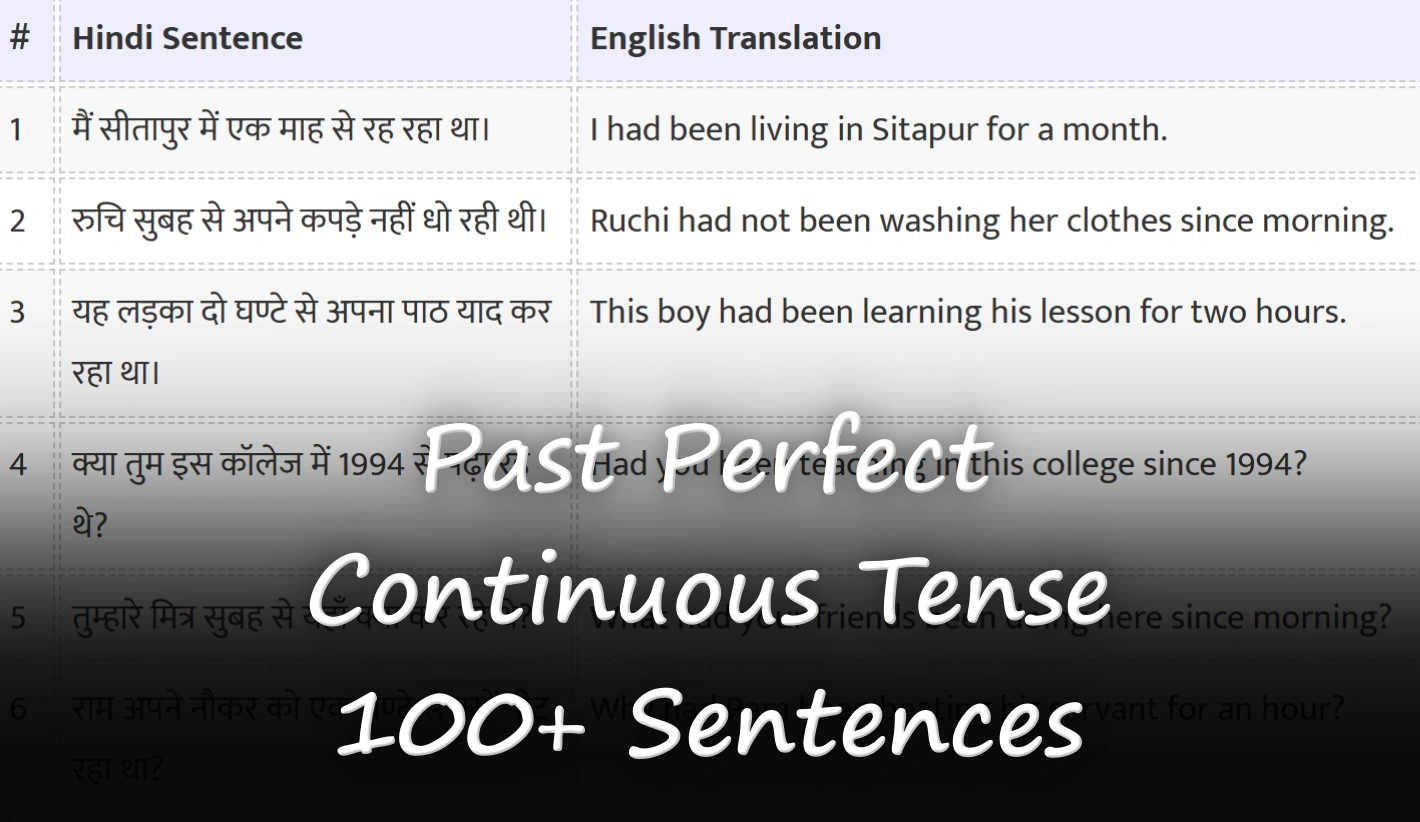
Past Perfect Continuous Tense in Hindi: Rules, Examples and Exercises
Past Perfect Continuous Tense से यह ज्ञात होता है कि काम कुछ समय से भूतकाल में होता आ रहा था और समाप्त नहीं हुआ था। इन वाक्यों का अनुवाद करने के लिए Had been के साथ मुख्य क्रिया की -ing Form का प्रयोग किया जाता है। Negative Sentences में Not को Had और Been के बीच में लिखते हैं। Interrogative Sentences में Had को कर्ता (Subject) से पहले और Been को कर्ता के बाद में रखते हैं।
नीचे दी गई टेबल को ध्यानपूर्वक पढ़िए:
| Person (पुरुष) |
Singular (एकवचन) |
Plural (बहुवचन) |
|---|---|---|
| I Person | I had been sleeping for two hours. मैं दो घण्टे से सो रहा था। |
We had been sleeping for two hours. हम दो घण्टे से सो रहे थे। |
| II Person | You had been sleeping for two hours. तुम दो घण्टे से सो रहे थे। (एक व्यक्ति) |
You had been sleeping for two hours. आप दो घण्टे से सो रहे थे। (बहुत-से व्यक्ति) |
| III Person | He (She, It) had been sleeping for two hours. वह दो घण्टे से सो रहा था। |
They had been sleeping for two hours. वे दो घण्टे से सो रहे थे। |
Rules (नियम):
- प्रत्येक कर्ता (I, We, You, He, She, It, They तथा Singular Noun और Plural Noun के साथ Had been और मुख्य क्रिया की -ing Form का प्रयोग किया जाता है।
- इस Tense में Had been सहायक क्रिया है तथा For/Since का प्रयोग Present Perfect Continuous के समान ही होता है। Since का प्रयोग Point of Time (निश्चित समय) तथा
- For का प्रयोग (Period of Time) के लिए होता है।
- For two hours = दो घण्टे से; Since two o’clock = दो बजे से; Since yesterday = कल से; Since morning = सुबह से: Since 1994 1994 से; For five days = पाँच दिन से।
(A) Affirmative (Positive) Sentences
1. मैं दो बजे से क्रिकेट खेल रहा था।
I had been playing cricket since two o’clock
2. हम आपकी दो घण्टे से प्रतीक्षा कर रहे थे।
We had been waiting for you for two hours.
3. तुम सुबह से अपना पाठ याद कर रहे थे।
You had been learning your lesson since morning.
4. वे इस शहर में दो साल से रह रहे थे।
They had been living in this city for two years.
5. वह तीन वर्ष से इस कक्षा में पढ़ रहा था।
He had been reading in this class for three years.
(B) Negative Sentences
6. राधा सुबह से अपने कपड़े नहीं धो रही थी।
Radha had not been washing her clothes since morning.
7. यह लड़का चार बजे से नहीं खेल रहा था।
This boy had not been playing since four o’clock.
8. मैं दो सप्ताह से हिन्दी नहीं पढ़ रहा था।
I had not been reading Hindi for two weeks.
9. वे इस नगर में 1990 से नहीं रह रहे थे।
They had not been living in this city since 1990.
10. ये लड़कियाँ रविवार से अपना गृहकार्य नहीं कर रही थीं।
These girls had not been doing their homework since Sunday.
(C) Interrogative Sentences
First Type (‘क्या’ से आरम्भ होने वाले वाक्य):
11. क्या बच्चा दस मिनट से चिल्ला रहा था?
Had the child been crying for ten minutes?
12. क्या मुकेश दस वर्ष से फिल्मों में गीत गा रहा था?
Had Mukesh been singing songs in films for ten years?
13. क्या वह चार बजे से तुम्हारी प्रतीक्षा कर रहा था?
Had he been waiting for you since four o’clock?
14. क्या वे देहली में 1989 से नहीं रह रहे थे?
Had they not been living in Delhi since 1989?
Second Type (Wh-Type Questions):
15. तुम सुबह से क्रिकेट क्यों खेल रहे थे?
Why had you been playing cricket since morning?
16. यह लड़का दस मिनट से कौन-सा उपन्यास पढ़ रहा था?
Which novel had this boy been reading for ten minutes?
17. वे कब से देहली में रह रहे थे?
How long had they been living in Delhi?
18. पुलिस चोरों का पीछा एक घण्टे से कहाँ कर रही थी?
Where had the police been chasing the thieves for an hour?
19. तुम्हें एक सप्ताह से कौन पढ़ा रहा था?
Who had been teaching you for a week?
20. दोपहर से यह लड़की क्या कर रही थी?
What had this girl been doing since noon?
21. तुम दो दिन से मुझे क्यों नहीं पढ़ा रहे थे?
Why had you not been teaching me for two days?
पहिचान और अनुवाद के नियम
पहिचान –
- इस काल के वाक्य ‘रहा था’, ‘रही थी’, ‘रहे थे’ आदि शब्द-समूहों परः समाप्त होते हैं तथा कार्य के जारी रहने का समये दिया होता है।
- इस काल के वाक्यों से ज्ञात होता है कि कार्य बीते हुए समय में (Past Timie) में आरम्भ हुआ था और भूतकाल में कुछ समय तक जारी रहो किन्तु पूरा नहीं हुआ।
अनुवाद के नियम –
(A) Positive Sentences :
- प्रत्येक कर्ता (Subject) के लिए Had been के साथ मुख्य क्रिया की -ing Form का प्रयोग किया जाता है।
- निश्चिंत समय (Point of Time) के लिए Since तथा अनिश्चित समय (Period of Time) के लिए For का प्रयोग होता है।
- सुबह से = since morning; दस मिनट से = for ten minutes; एक सप्ताह से = for a week; दोपहर से = since noon: दो दिन से = for two days; 1989 से = since 1989; दो बजे से = since two o’clock; कल से = since yesterday.
(B) Negative Sentences:
- Had के बाद तथा been से पहले Not लगता है।
(C) Interrogative Sentences:
- यदि प्रश्नवाचक वाक्य में सबसे पहले ‘क्या’ शब्द है (First Type) तो ‘क्या’ शब्द का अनुवाद What से नहीं किया जाता है बल्कि प्रत्येक कर्ता (Subject) से पहले Had आता है और फिर कर्ता के बाद been और मुख्य क्रिया की -ing Form लिखी जाती है।
- यदि ऐसा वाक्य निषेधात्मक (Negative) भी है तो been से पहले ‘नहीं’ के लिए Not आता है।
- यदि प्रश्नसूचक शब्द (What, When, Why, How और Where) वाक्य के मध्य में आया हो (Second Type) तो सर्वप्रथम उस शब्द की अंग्रेजी आती है और फिर प्रत्येक कर्ता से पहले Had तथा कर्ता के बाद been तथा मुख्य क्रिया की -ing Form का प्रयोग होता है।
- यदि ऐसा वाक्य निषेधात्मक भी है तो been से पहले ‘नहीं’ के लिए Not का प्रयोग होता है।
- ‘कब से’ के लिए How long का प्रयोग होता है। (उदाहरण 17)
- ‘कौन-सा’ के लिए Which का प्रयोग किया जाता है। ऐसे वाक्यों में Which के साथ उससे सम्बन्धित Noun भी वाक्य में सबसे पहले आता है और तब Had के बाद वाक्य का कर्ता लिखा जाता है।
- ‘कौन’ के लिए Who का प्रयोग होता है। Who के बाद Had been तथा मुख्य क्रिया की -ing Form (अर्थात Present Participle Form) आती है।
- प्रश्नवाचक वाक्यों के अन्त में प्रश्नवाचक चिन्ह (?) लगाया जाता है।
EXERCISE 1. (Positive Sentences) Translate the following sentences into English:
| # | Hindi Sentence | English Translation |
|---|---|---|
| 1 | वह दो घण्टे से अपने पिताजी की प्रतीक्षा स्टेशन पर कर रहा था। | He had been waiting for his father at the station for two hours. |
| 2 | यह बच्चा दूध न मिलने के कारण 7 बजे से चिल्ला रहा था। | This child had been crying since 7 o’clock because he didn’t get milk. |
| 3 | ये लड़के सुबह से क्रिकेट खेल रहे थे। | These boys had been playing cricket since morning. |
| 4 | यह नौकर दो वर्ष से इस दफ्तर में काम कर रहा था। | This servant had been working in this office for two years. |
| 5 | मैं आज पिछले तीन माह से कठोर परिश्रम करता आ रहा था। | I had been working hard for the last three months. |
| 6 | पुलिस डाकुओं की तलाश एक सप्ताह से कर रही थी। | The police had been searching for the robbers for a week. |
| 7 | देश में अनिश्चितता पिछले चार माह से चली आ रही थी। | Uncertainty had been prevailing in the country for the last four months. |
| 8 | कांग्रेस अध्यक्ष सरकार गिराने के प्रयास बहुत दिनों से कर रही थी। | The Congress president had been trying to bring down the government for many days. |
| 9 | लता तीस वर्षों से अधिक समय से गीत गाती आ रही थी। | Lata had been singing songs for more than thirty years. |
| 10 | लक्ष्मी सुबह से उपन्यास पढ़ रही थी। | Laxmi had been reading a novel since morning. |
| 11 | रेखा तीन बजे से गंदे कपड़े धो रही थी। | Rekha had been washing dirty clothes since three o’clock. |
| 12 | राजू 15 जनवरी से कठिन परिश्रम कर रहा था। | Raju had been working hard since 15th January. |
| 13 | आज सुबह से शेर पिंजड़े में दहाड़ रहा था। | The lion had been roaring in the cage since morning. |
| 14 | माली दोपहर से बुखार से पीड़ित था। | The gardener had been suffering from fever since noon. |
| 15 | यह बढ़ई सुबह से रशीद के साथ झगड़ा कर रहा था। | This carpenter had been quarrelling with Rashid since morning. |
Difficult words: प्रतीक्षा करना = to wait for; चिल्लाना = to cry; दूध न मिलने के कारण = on account of not getting milk; तलाश करना = to search; अनिश्चितता = uncertainty; कांग्रेस अध्यक्ष = Congress President: प्रयास = efforts: सरकार गिराना = to let the Government fall (= to oust the Government): दहाड़ना = to roar, पिंजड़ा = cage; बुखार से पीड़ित था = had been suffering from fever, झगड़ा करना = to quarrel.
EXERCISE 2. (Negative Sentences)
| # | Hindi Sentence | English Translation |
|---|---|---|
| 1 | मैं इस कॉलेज में दो वर्ष से नहीं पढ़ रहा था। | I had not been studying in this college for two years. |
| 2 | गुप्ता जी पाँच साल से अंग्रेज़ी व्याकरण नहीं पढ़ा रहे थे। | Mr. Gupta had not been teaching English grammar for five years. |
| 3 | गुड्डी और रेखा दो वर्ष से लक्ष्मी नगर नहीं आ रही थीं। | Guddi and Rekha had not been coming to Laxmi Nagar for two years. |
| 4 | मीता सुबह से अपना पाठ याद नहीं कर रही थी। | Meeta had not been memorizing her lesson since morning. |
| 5 | लक्ष्मी सुबह से मेरी प्रतीक्षा नहीं कर रही थी। | Laxmi had not been waiting for me since morning. |
| 6 | पाँच मिनट से टेलीफोन की घण्टी नहीं बज रही थी। | The telephone bell had not been ringing for five minutes. |
| 7 | पूजा दस मिनट से नहीं रो रही थी। | Pooja had not been crying for ten minutes. |
| 8 | मास्टर साहब एक घण्टे से मुझे इतिहास नहीं पढ़ा रहे थे। | The teacher had not been teaching me history for an hour. |
| 9 | डॉक्टर साहब एक सप्ताह से अपने दवाखाने नहीं आ रहे थे। | The doctor had not been coming to his clinic for a week. |
| 10 | मुकेश 1970 से खैर में नहीं रह रहा था। | Mukesh had not been living in Khair since 1970. |
| 11 | ये लड़के आधे घण्टे से कक्षा में शैतानी नहीं कर रहे थे। | These boys had not been misbehaving in the class for half an hour. |
| 12 | तुम्हारी चाची एक सप्ताह से इस मुहल्ले में नहीं रह रही थीं। | Your aunt had not been living in this locality for a week. |
| 13 | यह व्यक्ति दोपहर से मछलियाँ नहीं पकड़ रहा था। | This man had not been catching fish since afternoon. |
| 14 | तुम्हारी बहन एक सप्ताह से अपना गृहकार्य नहीं कर रही थी। | Your sister had not been doing her homework for a week. |
| 15 | यह यात्री कुछ दिनों से हवाई जहाज से यात्रा नहीं कर रहा था। | This passenger had not been travelling by airplane for a few days. |
Difficult words: गुड्डी Guddie; मेरी प्रतीक्षा करना = to wait for me: मिनट = minute; दवाखाने = dispensary; शैतानी करना to do mischiefs; आध घण्टे से for half an hour. मुहल्ला = locality; यात्रा करना to travel.
EXERCISE 38. (Interrogative Sentences)
(A) First Type :
| # | Hindi Sentence | English Translation |
|---|---|---|
| 1 | क्या वह इस कॉलेज में एक वर्ष से पढ़ रहा था? | Had he been studying in this college for one year? |
| 2 | क्या मेहमान दो दिन से तुम्हारे यहाँ ठहर रहे थे? | Had the guests been staying at your place for two days? |
| 3 | क्या सचिन कुछ दिनों से मैच नहीं खेल रहा था? | Had Sachin not been playing matches for a few days? |
| 4 | क्या तुम आधे घण्टे से इतिहास पढ़ रहे थे? | Had you been studying history for half an hour? |
| 5 | क्या मास्टर साहब आधे घण्टे से भूगोल नहीं पढ़ा रहे थे? | Had the teacher not been teaching geography for half an hour? |
| 6 | क्या प्रधानाचार्य दो दिन से बुखार से पीड़ित थे? | Had the principal been suffering from fever for two days? |
| 7 | क्या मोदी सरकार 13 माह से ठीक प्रकार से कार्य नहीं कर रही थी? | Had the Modi government not been working properly for 13 months? |
| 8 | क्या कांग्रेस अध्यक्ष पिछले कुछ दिनों से वर्तमान शासन से अपनी अप्रसन्नता लगातार व्यक्त नहीं कर रही थी? | Had the Congress president not been continuously expressing her dissatisfaction with the present government for the past few days? |
| 9 | क्या दक्षिण भारत की एक महिला सरकार के मार्ग में बाधा उत्पन्न नहीं करती रही थी? | Had a woman from South India not been creating obstacles in the path of the government? |
(B) Second Type:
| # | Hindi Sentence | English Translation |
|---|---|---|
| 10 | वह सुबह से हॉकी क्यों खेल रहा था? | Why had he been playing hockey since morning? |
| 11 | तुम आधे घण्टे से कौन-सा उपन्यास पढ़ रहे थे? | Which novel had you been reading for half an hour? |
| 12 | महेश कब से दिल्ली रह रहा था? | Since when had Mahesh been living in Delhi? |
| 13 | पूजा को एक महीने से कौन पढ़ा रहा था? | Who had been teaching Pooja for a month? |
| 14 | दोपहर से रुचि क्या कर रही थी? | What had Ruchi been doing since afternoon? |
| 15 | मास्टर साहब हिमानी को दो दिन से क्यों नहीं पढ़ा रहे थे? | Why had the teacher not been teaching Himani for two days? |
| 16 | पुलिस डाकुओं को एक सप्ताह से क्यों नहीं गिरफ्तार कर रही थी? | Why had the police not been arresting the dacoits for a week? |
| 17 | मुकेश दो वर्ष से फिल्मों में काम क्यों नहीं कर रहा था? | Why had Mukesh not been working in films for two years? |
| 18 | टेलीफोन की घण्टी क्यों नहीं बज रही थी? | Why had the telephone bell not been ringing? |
Difficult words:मेहमान = guests; भूगोल = geography; बुखार से पीड़ित थे = had been suffering from fever; ठीक प्रकार से properly; कांग्रेस अध्यक्ष = congress president; बाघा उत्पन्न करना = to put hidrance (to obstruct); कौन-सा = which; कब से = how long; गिरफ्तार करना = to arrest.
EXERCISE 39. (Miscellaneous) Translate the following sentences into English:
| # | Hindi Sentence | English Translation |
|---|---|---|
| 1 | मैं सीतापुर में एक माह से रह रहा था। | I had been living in Sitapur for a month. |
| 2 | रुचि सुबह से अपने कपड़े नहीं धो रही थी। | Ruchi had not been washing her clothes since morning. |
| 3 | यह लड़का दो घण्टे से अपना पाठ याद कर रहा था। | This boy had been learning his lesson for two hours. |
| 4 | क्या तुम इस कॉलेज में 1994 से पढ़ा रहे थे? | Had you been teaching in this college since 1994? |
| 5 | तुम्हारे मित्र सुबह से यहाँ क्या कर रहे थे? | What had your friends been doing here since morning? |
| 6 | राम अपने नौकर को एक घण्टे से क्यों पीट रहा था? | Why had Ram been beating his servant for an hour? |
| 7 | तुम एक सप्ताह से व्याकरण क्यों नहीं पढ़ रहे थे? | Why had you not been studying grammar for a week? |
| 8 | एक घण्टे से तुम्हें कौन पढ़ा रहा था? | Who had been teaching you for an hour? |
| 9 | तुम दो दिन से किसकी सहायता नहीं कर रहे थे? | Whose help had you not been giving for two days? |
| 10 | ये लड़कियाँ शाम से किसकी प्रतीक्षा कर रही थी? | Whom had these girls been waiting for since evening? |
| 11 | पोस्टमैन सुबह से क्या कर रहा था? | What had the postman been doing since morning? |
| 12 | मोहन का भाई सुबह से इस नहर में क्यों तैर रहा था? | Why had Mohan’s brother been swimming in this canal since morning? |
Difficult words: कालिज = college; तुम्हारे मित्र = your friends: सप्ताह = week; व्याकरण = grammar, किसकी = whom; मोहन का भाई = Mohan’s brother.
Learn other English Grammar in Hindi Translation: