

ACTIVE AND PASSIVE VOICE
जिस वाक्य में कर्ता (Subject) स्वयं कार्य करता है, उसे Active Voice (कर्तृवाच्य/सक्रिय वाच्य) कहते हैं। जिस वाक्य में कर्ता पर कार्य किया जाता है, उसे Passive Voice (कर्मवाच्य/निष्क्रिय वाच्य) कहते हैं।
PRESENT TENSE
1. Present Indefinite Tense (Simple Present)
- राम एक पत्र लिखता है।
Ram writes a letter.
A letter is written by Rama. (राम द्वारा एक पत्र लिखा जाता है।) - क्या तुम एक पुस्तक नहीं पढ़ते हो?
Do you not read a book?
Is a book not read by you? (क्या तुम्हारे द्वारा एक पुस्तक नहीं पढ़ी जाती है?)
2. Present Continuous (Imperfect या Progressive) Tense
- मीरा एक गीत गा रही है।
Mira is singing a song.
A song is being sung by Mira. (मीरा द्वारा एक गीत गाया जा रहा है।) - वह तुम्हारी सहायता नहीं कर रही है।
She is not helping you.
You are not helped by her. (उसके द्वारा तुम्हारी सहायता नहीं की जा रही है।)
3. Present Perfect Tense
- राम ने एक आम खा लिया है। (राम एक आम खा चुका है।)
Rama has eaten a mango.
A mango has been eaten by Rama. (राम द्वारा एक आम खाया जा चुका है।) - मैंने तुम्हारे नौकर को नहीं पीटा है।
I have not beaten your servant.
Your servant has not been beaten by me. (मेरे द्वारा तुम्हारा नौकर नहीं पीटा गया है।)
4. Present Perfect Continuous Tense
- मैं दो घंटे से पुस्तक पढ़ रहा हूँ।
I have been reading a book for two hours.
नोट: इस Tense के वाक्यों की Passive Voice नहीं बना करती है।
PAST TENSE
5. Past Indefinite Tense (Simple Past)
- राम ने कल एक पत्र लिखा था।
Rama wrote a letter yesterday.
A letter was written yesterday by Rama.
(कल राम द्वारा एक पत्र लिखा गया था।) - तुमने कल उन्हें क्यों नहीं बुलाया था?
Why did you not call them yesterday?
Why were they not called yesterday by you?
(कल तुम्हारे द्वारा उन्हें क्यों नहीं बुलाया गया था?)
6. Past Continuous (Imperfect) Tense
- शीला आम खरीद रही थी।
Shila was buying mangoes.
Mangoes were being bought by Shila. (शीला द्वारा आम खरीदे जा रहे थे।) - क्या रमेश पत्र नहीं लिख रहा था?
Was Ramesh not writing a letter?
Was a letter not being written by Ramesh? (क्या रमेश द्वारा पत्र नहीं लिखा जा रहा था?)
7. Past Perfect Tense
- दस बजे से पहले वह निबन्ध लिख चुका था।
He had written the essay before ten.
The essay had been written before ten by him.
(दस बजे से पहले उसके द्वारा निबन्ध लिखा जा चुका था।) - क्या बारिश होने से पहले राम ने अजहर को बुला लिया था?
Had Rama called Azhar before it rained?
Had Azhar been called by Rama before it rained?
(क्या बारिश होने से पहले राम द्वारा अजहर को बुला लिया गया था?)
8. Past Perfect Continuous Tense
- मैं दो बजे से क्रिकेट खेल रहा था।
I had been playing cricket since morning.
नोट: इस Tense के वाक्यों की Passive Voice नहीं बना करती है।
FUTURE TENSE
9. Future Indefinite Tense (Simple Future)
- सोहन हमीद की सहायता करेगा।
Sohan will help Hamid.
Hamid will be helped by Sohan. (सोहन द्वारा हमीद की सहायता की जायेगी।) - मैं तुम्हारी सहायता करूँगा।
I shall help you.
You will be helped by me. (मेरे द्वारा तुम्हारी सहायता की जायेगी।) - वे हमें नहीं पढ़ायेंगे।
They will not teach us.
We shall not be taught by them. (उनके द्वारा हमें नहीं पढ़ाया जायेगा।)
10. Future Continuous (Imperfect) Tense
- मैं कल कुछ आम खरीद रहा हूँगा।
I shall be buying some mangoes tomorrow.
नोट: इस Tense के वाक्यों की Passive Voice नहीं बना करती है।
11. Future Perfect Tense
- सूर्यास्त से पहले किसान खेतों को जोत चुकेंगे।
The farmers will have ploughed the fields before sunset.
The fields will have been ploughed before sunset by the farmers.
(सूर्यास्त से पहले किसानों द्वारा खेत जोते जा चुकेंगे।)
12. Future Perfect Continuous Tense
- मैं दो घंटे तक क्रिकेट खेलता रहूँगा।
I shall have been playing cricket for two hours.
नोट: इस Tense के वाक्यों की Passive Voice नहीं बना करती है।
नोट: Present Perfect Continuous, Past Perfect Continuous, Future Continuous तथा Future Perfect Continuous के वाक्यों की Passive Voice नहीं बना करती है। इस प्रकार स्पष्ट है कि Active Voice के वाक्यों की रचना 12 Tenses में होती है जबकि Passive Voice की रचना केवल 8 Tenses में ही होती है।
अनुवाद के नियम (Rules of Translation)
(A) Present Tense
- Simple Present (Present Indefinite) में वाक्य के कर्ता (Subject) के अनुसार सहायक क्रिया (is, am, are) के साथ मुख्य क्रिया की Third Form आती है।
- निषेधात्मक वाक्यों में सहायक क्रिया और मुख्य क्रिया के बीच not लगता है।
- प्रश्नवाचक वाक्यों में सहायक क्रिया कर्ता से पहले आती है।
- Present Continuous Tense में is being / am being / are being के साथ मुख्य क्रिया की Third Form आती है।
- “I” के साथ am being,
- “We, You, They, Plural Nouns” के साथ are being,
- “He, She, It, Singular Nouns” के साथ is being का प्रयोग होता है।
- Present Perfect Tense में have been / has been के साथ मुख्य क्रिया की Third Form आती है।
- “I, We, You, They, Plural Nouns” के साथ have been,
- “He, She, It, Singular Nouns” के साथ has been।
- प्रत्येक Tense में Active Voice के कर्ता को by के साथ Passive Voice में कर्म बनाया जाता है।
- Passive Voice उन्हीं वाक्यों की बनती है जिनमें सकर्मक क्रिया (Transitive Verb) होती है।
(B) Past Tense
- Past Indefinite (Simple Past) में was/were + V³ का प्रयोग होता है।
- यदि वाक्य निषेधात्मक है तो मुख्य क्रिया की Third Form से पहले not लगता है।
- प्रश्नवाचक वाक्य में subject से पहले सहायक क्रिया आती है।
- Past Continuous Tense में was being / were being + V³ का प्रयोग होता है।
- Past Perfect Tense में प्रत्येक कर्ता के साथ had been + V³ का प्रयोग होता है।
(C) Future Tense
- Future Indefinite (Simple Future) में shall be / will be + V³ का प्रयोग होता है।
- “We” के साथ shall be, अन्य सबके साथ will be।
- Future Perfect Tense में shall have been / will have been + V³ का प्रयोग होता है।
- “We” के साथ shall have been, अन्य सबके साथ will have been।
IMPERATIVE SENTENCES
- नौकर को बुलाओ।
Call the servant.
Let the servant be called by you.
(तुम्हारे द्वारा नौकर को बुलाया जाने दो।) - कृपया एक पत्र लिख दीजिए।
Please write a letter.
You are requested to write a letter.
(आपसे एक पत्र लिखने की प्रार्थना की जाती है।)
अनुवाद के नियम:
- Let के साथ be + V³ का प्रयोग किया जाता है।
- Please वाले वाक्यों में Please के स्थान पर You are requested to लगाकर शेष वाक्य जोड़ा जाता है।
Interrogative + Negative Sentences (प्रश्नवाचक एवं नकारात्मक वाक्य)
| Active Voice (कर्तृवाच्य) |
Passive Voice (कर्मवाच्य) |
|---|---|
| Did he not call you? क्या उसने तुम्हें नहीं बुलाया? |
Were you not called by him? क्या तुम्हें उसके द्वारा नहीं बुलाया गया? |
| Is she not writing a letter? क्या वह पत्र नहीं लिख रही है? |
Is a letter not being written by her? क्या उसके द्वारा पत्र नहीं लिखा जा रहा है? |
Sentences with Two Objects (दो कर्म वाले वाक्य)
- कुछ क्रियाओं के साथ दो कर्म (objects) होते हैं — एक सीधा (direct) और एक अप्रत्यक्ष (indirect)।
- Passive Voice में इनमें से किसी एक को कर्ता बनाया जा सकता है।
| Active Voice (कर्तृवाच्य) |
Passive Voice (Indirect Object / अप्रत्यक्ष कर्म) |
Passive Voice (Direct Object / सीधा कर्म) |
|---|---|---|
| She gave me a pen. उसने मुझे एक पेन दिया। |
I was given a pen by her. मुझे उसके द्वारा एक पेन दिया गया। |
A pen was given to me by her. एक पेन मुझे उसके द्वारा दिया गया। |
Infinitive Sentences (To + Verb वाले वाक्य)
- जब क्रिया “to + verb” के साथ आती है।
| Active Voice (कर्तृवाच्य) |
Passive Voice (कर्मवाच्य) |
|---|---|
| I want to help you. मैं तुम्हारी सहायता करना चाहता हूँ। |
I want you to be helped. मैं चाहता हूँ कि तुम्हारी सहायता की जाए। |
| He expects them to finish the work. वह अपेक्षा करता है कि वे काम पूरा करें। |
He expects the work to be finished. वह अपेक्षा करता है कि काम पूरा किया जाए। |
Gerund Sentences (क्रिया के -ing रूप वाले वाक्य)
- -ing form as noun
| Active Voice (कर्तृवाच्य) |
Passive Voice (कर्मवाच्य) |
|---|---|
| I remember someone teaching me English. मुझे याद है कि किसी ने मुझे अंग्रेज़ी सिखाई थी। |
I remember being taught English. मुझे याद है कि मुझे अंग्रेज़ी सिखाई गई थी। |
| She hates people praising her. वह लोगों द्वारा अपनी प्रशंसा से घृणा करती है। |
She hates being praised. वह प्रशंसा किया जाना पसंद नहीं करती। |
Modals (Can, May, Must, Should आदि के साथ)
- Formula: Modal + be + V³
- जैसे: can be, may be, must be, should be + क्रिया की तीसरी रूप
| Active Voice (कर्तृवाच्य) |
Passive Voice (कर्मवाच्य) |
|---|---|
| You can solve this problem. तुम इस समस्या को हल कर सकते हो। |
This problem can be solved by you. यह समस्या तुम्हारे द्वारा हल की जा सकती है। |
| We should obey rules. हमें नियमों का पालन करना चाहिए। |
Rules should be obeyed by us. नियमों का पालन हमारे द्वारा किया जाना चाहिए। |
| He must finish the work. उसे कार्य पूरा करना ही होगा। |
The work must be finished by him. कार्य उसके द्वारा पूरा किया जाना चाहिए। |
Sentences with “Verb + Object + Infinitive” (क्रिया + कर्म + infinitive वाले वाक्य)
| Active Voice (कर्तृवाच्य) |
Passive Voice (कर्मवाच्य) |
|---|---|
| They saw him steal the car. उन्होंने उसे कार चुराते हुए देखा। |
He was seen to steal the car. उसे कार चुराते हुए देखा गया। |
| I heard her sing a song. मैंने उसे गीत गाते हुए सुना। |
She was heard to sing a song. उसे गीत गाते हुए सुना गया। |
Sentences Beginning with ‘It is said’, ‘It is believed’, etc.
- जब कर्ता ज्ञात नहीं होता है या सामान्य कथन हो
| Active Voice (कर्तृवाच्य) |
Passive Voice (कर्मवाच्य) |
|---|---|
| People say he is honest. लोग कहते हैं कि वह ईमानदार है। |
It is said that he is honest. कहा जाता है कि वह ईमानदार है। |
| Everyone believes she is innocent. सब मानते हैं कि वह निर्दोष है। |
It is believed that she is innocent. यह माना जाता है कि वह निर्दोष है। |
Sentences with Causative Verbs (have, get, make आदि वाले वाक्य)
| Active Voice (कर्तृवाच्य) |
Passive Voice (कर्मवाच्य) |
|---|---|
| I had someone clean the room. मैंने किसी से कमरा साफ करवाया। |
I had the room cleaned. मैंने कमरा साफ करवाया गया (मेरे द्वारा करवाया गया)। |
| She got someone to repair her car. उसने किसी से अपनी गाड़ी ठीक करवाई। |
She got her car repaired. उसने अपनी गाड़ी ठीक करवाई गई। |
Prepositional Verbs / Phrasal Verbs (पूर्वसर्गीय क्रियाएँ)
| Active Voice (कर्तृवाच्य) |
Passive Voice (कर्मवाच्य) |
|---|---|
| They laughed at him. वे उस पर हँसे। |
He was laughed at. उस पर हँसा गया। |
| Someone looked after the child. किसी ने बच्चे की देखभाल की। |
The child was looked after. बच्चे की देखभाल की गई। |
Active & Passive Voice Examples
58.ये बच्चे अपना पाठ याद नहीं कर रहे हैं।
उनका पाठ याद नहीं किया जा रहा है।These children are not learning their lesson.
Their lesson is not being learnt.
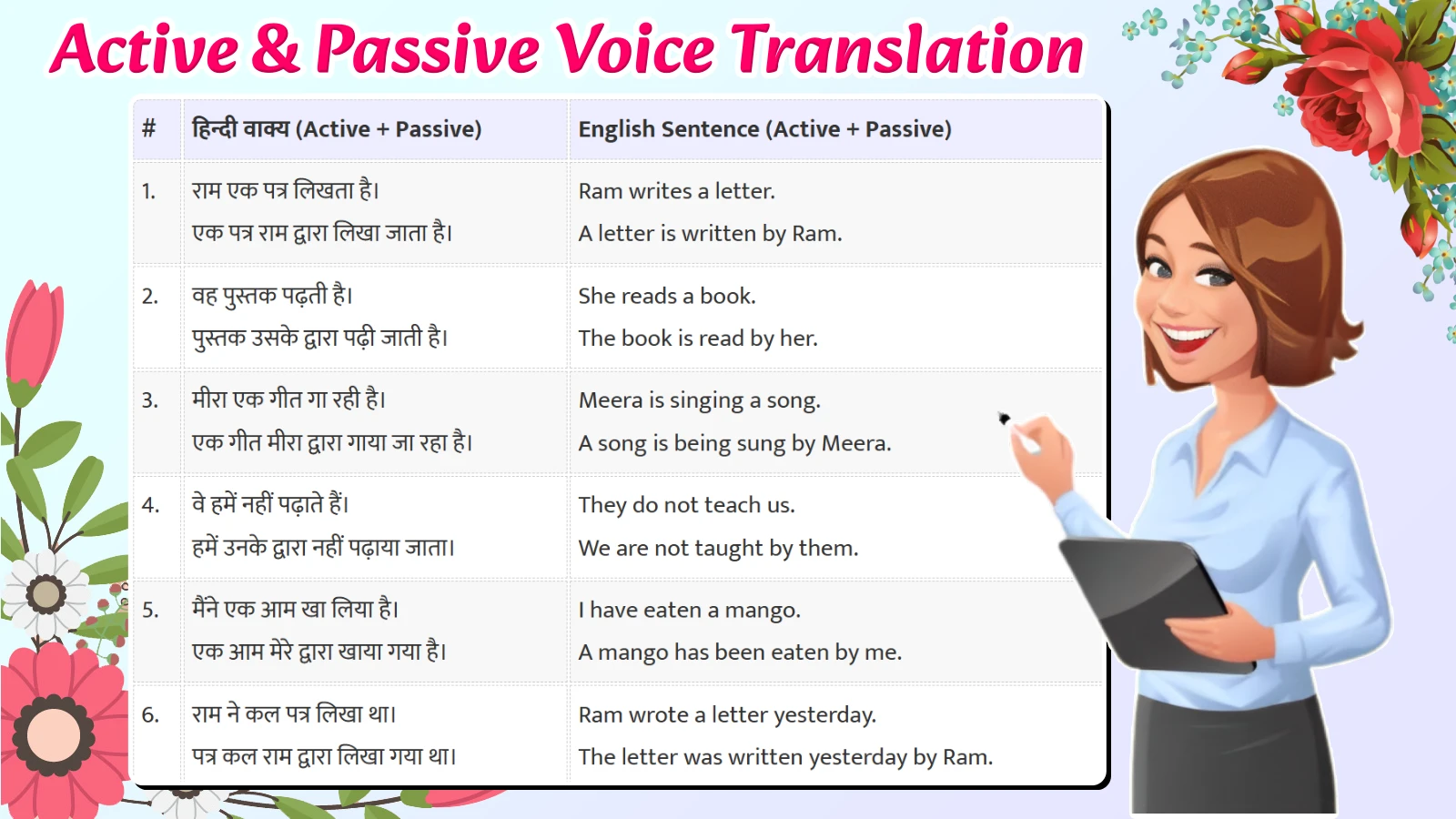
| # | हिन्दी वाक्य (Active + Passive) | English Sentence (Active + Passive) |
|---|---|---|
| 1. | राम एक पत्र लिखता है। एक पत्र राम द्वारा लिखा जाता है। |
Ram writes a letter. A letter is written by Ram. |
| 2. | वह पुस्तक पढ़ती है। पुस्तक उसके द्वारा पढ़ी जाती है। |
She reads a book. The book is read by her. |
| 3. | मीरा एक गीत गा रही है। एक गीत मीरा द्वारा गाया जा रहा है। |
Meera is singing a song. A song is being sung by Meera. |
| 4. | वे हमें नहीं पढ़ाते हैं। हमें उनके द्वारा नहीं पढ़ाया जाता। |
They do not teach us. We are not taught by them. |
| 5. | मैंने एक आम खा लिया है। एक आम मेरे द्वारा खाया गया है। |
I have eaten a mango. A mango has been eaten by me. |
| 6. | राम ने कल पत्र लिखा था। पत्र कल राम द्वारा लिखा गया था। |
Ram wrote a letter yesterday. The letter was written yesterday by Ram. |
| 7. | तुमने उन्हें क्यों नहीं बुलाया था? उन्हें तुम्हारे द्वारा क्यों नहीं बुलाया गया था? |
Why did you not call them? Why were they not called by you? |
| 8. | शीला आम खरीद रही थी। आम शीला द्वारा खरीदे जा रहे थे। |
Sheela was buying mangoes. Mangoes were being bought by Sheela. |
| 9. | उसने निबंध लिखा था। निबंध उसके द्वारा लिखा गया था। |
He had written an essay. The essay had been written by him. |
| 10. | किसान खेत जोत चुके होंगे। खेत किसानों द्वारा जोते जा चुके होंगे। |
The farmers will have ploughed the fields. The fields will have been ploughed by the farmers. |
| 11. | सोहन हमीद की सहायता करेगा। हमीद की सहायता सोहन द्वारा की जाएगी। |
Sohan will help Hamid. Hamid will be helped by Sohan. |
| 12. | मैं तुम्हारी सहायता करूँगा। तुम्हारी सहायता मेरे द्वारा की जाएगी। |
I shall help you. You will be helped by me. |
| 13. | कृपया दरवाज़ा खोलिए। आपसे दरवाज़ा खोलने की प्रार्थना की जाती है। |
Please open the door. You are requested to open the door. |
| 14. | दरवाज़ा खोलो। दरवाज़ा खोला जाने दो। |
Open the door. Let the door be opened. |
| 15. | नौकर को बुलाओ। नौकर को बुलाया जाने दो। |
Call the servant. Let the servant be called. |
| 16. | क्या वह पत्र नहीं लिख रही है? क्या पत्र उसके द्वारा नहीं लिखा जा रहा है? |
Is she not writing a letter? Is a letter not being written by her? |
| 17. | क्या उसने तुम्हें नहीं बुलाया? क्या तुम्हें उसके द्वारा नहीं बुलाया गया? |
Did he not call you? Were you not called by him? |
| 18. | उसने मुझे एक पेन दिया। मुझे उसके द्वारा एक पेन दिया गया। |
She gave me a pen. I was given a pen by her. |
| 19. | उसने मुझे एक पेन दिया। एक पेन मुझे उसके द्वारा दिया गया। |
She gave me a pen. A pen was given to me by her. |
| 20. | मैं तुम्हारी सहायता करना चाहता हूँ। मैं चाहता हूँ कि तुम्हारी सहायता की जाए। |
I want to help you. I want you to be helped. |
| 21. | वह चाहता है कि वे कार्य पूरा करें। वह अपेक्षा करता है कि कार्य पूरा किया जाए। |
He expects them to finish the work. He expects the work to be finished. |
| 22. | मुझे याद है किसी ने मुझे अंग्रेज़ी सिखाई थी। मुझे याद है कि मुझे अंग्रेज़ी सिखाई गई थी। |
I remember someone teaching me English. I remember being taught English. |
| 23. | वह लोगों की प्रशंसा से घृणा करती है। वह प्रशंसा किया जाना पसंद नहीं करती। |
She hates people praising her. She hates being praised. |
| 24. | तुम इस समस्या को हल कर सकते हो। यह समस्या तुम्हारे द्वारा हल की जा सकती है। |
You can solve this problem. This problem can be solved by you. |
| 25. | हमें नियमों का पालन करना चाहिए। नियमों का पालन हमारे द्वारा किया जाना चाहिए। |
We should obey rules. Rules should be obeyed by us. |
| 26. | उसे कार्य पूरा करना ही होगा। कार्य उसके द्वारा पूरा किया जाना चाहिए। |
He must finish the work. The work must be finished by him. |
| 27. | उन्होंने उसे कार चुराते हुए देखा। उसे कार चुराते हुए देखा गया। |
They saw him steal the car. He was seen to steal the car. |
| 28. | मैंने उसे गीत गाते हुए सुना। उसे गीत गाते हुए सुना गया। |
I heard her sing a song. She was heard to sing a song. |
| 29. | लोग कहते हैं कि वह ईमानदार है। कहा जाता है कि वह ईमानदार है। |
People say he is honest. It is said that he is honest. |
| 30. | सब मानते हैं कि वह निर्दोष है। यह माना जाता है कि वह निर्दोष है। |
Everyone believes she is innocent. It is believed that she is innocent. |
| 31. | मैंने किसी से कमरा साफ करवाया। मैंने कमरा साफ करवाया गया। |
I had someone clean the room. I had the room cleaned. |
| 32. | उसने किसी से अपनी गाड़ी ठीक करवाई। उसने अपनी गाड़ी ठीक करवाई गई। |
She got someone to repair her car. She got her car repaired. |
| 33. | वे उस पर हँसे। उस पर हँसा गया। |
They laughed at him. He was laughed at. |
| 34. | किसी ने बच्चे की देखभाल की। बच्चे की देखभाल की गई। |
Someone looked after the child. The child was looked after. |
| 35. | मीरा एक पत्र लिखती है। एक पत्र मीरा द्वारा लिखा जाता है। |
Meera writes a letter. A letter is written by Meera. |
| 36. | यह पत्र राम द्वारा लिखा गया है। यह पत्र लिखा गया है। |
This letter has been written by Ram. The letter has been written. |
| 37. | कमला आम खरीद रही है। आम कमला द्वारा खरीदे जा रहे हैं। |
Kamla is buying mangoes. Mangoes are being bought by Kamla. |
| 38. | मैंने अपना कार्य कर लिया है। मेरा कार्य कर लिया गया है। |
I have finished my work. My work has been finished. |
| 39. | इस बिल्ली ने आज दस चूहे मारे। आज दस चूहे इस बिल्ली द्वारा मारे गए। |
This cat killed ten mice today. Ten mice were killed by this cat today. |
| 40. | शेर ने भेड़िये को मार दिया। भेड़िया शेर द्वारा मारा गया। |
The lion killed the wolf. The wolf was killed by the lion. |
| 41. | उसने सूर्यास्त से पहले पाठ याद कर लिया था। सूर्यास्त से पहले पाठ उसके द्वारा याद किया गया था। |
He had learnt the lesson before sunset. The lesson had been learnt by him before sunset. |
| 42. | सूर्योदय से पहले उसे चाय पिला दी गयी थी। चाय उसे सूर्योदय से पहले पिला दी गयी थी। |
He had been given tea before sunrise. Tea had been given to him before sunrise. |
| 43. | वह एक उपन्यास खरीद रहा है। उपन्यास उसके द्वारा खरीदा जा रहा है। |
He is buying a novel. The novel is being bought by him. |
| 44. | तुम्हारे द्वारा समाचार-पत्र पढ़ा जा रहा है। समाचार-पत्र तुम्हारे द्वारा पढ़ा जा रहा है। |
The newspaper is being read by you. A newspaper is being read by you. |
| 45. | यह कुर्सी क्यों बनायी जा रही है? | Why is this chair being made? |
| 46. | क्या ऐसा कहा जा रहा था? | Was it being said so? |
| 47. | ऐसा क्यों कहा जा रहा है? | Why is it being said so? |
| 48. | मैं अपने अध्यापक की आज्ञा मान रहा था। मेरे अध्यापक की आज्ञा मानी जा रही थी। |
I was obeying my teacher’s order. My teacher’s order was being obeyed. |
| 49. | तुम्हारे भाई ने चार आम खा लिए हैं। चार आम तुम्हारे भाई द्वारा खाए गए हैं। |
Your brother has eaten four mangoes. Four mangoes have been eaten by your brother. |
| 50. | तुम्हारे भाई ने पत्र कल नहीं लिखा था। पत्र कल तुम्हारे भाई द्वारा नहीं लिखा गया था। |
Your brother had not written the letter yesterday. The letter had not been written by your brother yesterday. |
Translate the following sentences into English:
EXERCISE 1. Hindi to English
| हिन्दी वाक्य (Active/Passive Practice) | English Translation |
|---|---|
| मीरा एक पत्र लिखती है। | Meera writes a letter. |
| यह पत्र राम द्वारा लिखा गया है। | This letter has been written by Ram. |
| कमला आम खरीद रही है। | Kamala is buying mangoes. |
| उनके द्वारा यह कार्य किया जाता है। | This work is done by them. |
| मैंने अपना कार्य कर लिया है। | I have completed my work. |
| इस बिल्ली ने आज दस चूहे मार दिये। | This cat has killed ten mice today. |
| शेर ने भेड़िये को मार दिया। | The lion killed the wolf. |
| उसने सूर्यास्त से पहले पाठ याद कर लिया था। | He had learnt the lesson before sunset. |
| सूर्योदय से पहले उसे चाय पिला दी गयी थी। | He had been given tea before sunrise. |
| वह एक उपन्यास खरीद रहा है। | He is buying a novel. |
| तुम्हारे द्वारा समाचार-पत्र पढ़ा जा रहा है। | The newspaper is being read by you. |
| यह कुर्सी क्यों बनायी जा रही है? | Why is this chair being made? |
| क्या ऐसा कहा जा रहा था? | Was it being said so? |
| ऐसा क्यों कहा जा रहा है? | Why is it being said so? |
| मैं अपने अध्यापक की आज्ञा मान रहा था। | I was obeying my teacher’s order. |
Difficult words: सूर्यास्त = sunset; सूर्योदय = dawn/daybreak; उपन्यास = novel; समाचार-पत्र = newspaper; ऐसा = so; आज्ञा मानना = to obey.
EXERCISE 2. Hindi to English
| हिन्दी वाक्य (Active/Passive Practice) | English Translation |
|---|---|
| तुम्हारे भाई ने चार आम खा लिए हैं। | Your brother has eaten four mangoes. |
| दुकान की सफेदी करा दी गयी है। | The shop has been whitewashed. |
| यह कमरा सजा दिया गया है। | This room has been decorated. |
| निबन्ध पढ़ लिया गया है। | The essay has been read. |
| मुझे स्टेशन से बुलाया गया है। | I have been called from the station. |
| चोर पकड़ लिया गया। | The thief was caught. |
| चोर पकड़ लिया गया है। | The thief has been caught. |
| चोर पकड़ लिया जायेगा। | The thief will be caught. |
| इन बच्चों द्वारा यह पाठ याद नहीं किया जा रहा है। | This lesson is not being learnt by these children. |
| ये बच्चे अपना पाठ याद नहीं कर रहे हैं। | These children are not learning their lesson. |
| तुम्हारे भाई ने पत्र कल नहीं लिखा था। | Your brother had not written the letter yesterday. |
| यह पत्र कल लिख दिया गया था। | This letter had been written yesterday. |
| कुछ आम खरीदे जा रहे थे? | Were some mangoes being bought? |
| बारिश होने से पहले तुम्हारे भाई बुला लिए गये थे। | Your brothers had been called before it rained. |
| बारिश होने के पश्चात तुम्हारा भाई बुला लिया जायेगा। | Your brother will be called after it rains. |
Difficult words: सफेदी करना = to whitewash; सजाना = to decorate; बारिश होना = to rain; बारिश होने के पश्चात = after raining.
Learn other English Grammar in Hindi Translation: