

Finite & Non-Finite Verbs
वे क्रियाएँ जो वाक्य के कर्ता (Subject) और Tense (काल) के अनुसार बदलती हैं, उन्हें Finite Verbs कहते हैं। जैसे: go, goes, went, is going आदि। वे क्रियाएँ जो Tense या Subject के अनुसार नहीं बदलतीं, और क्रिया का मूल रूप, infinitive, gerund या participle होती हैं, उन्हें Non-Finite Verbs कहते हैं। जैसे: to go, going, gone आदि।
| Category | Definition | Examples |
|---|---|---|
| Finite Verbs | वे क्रियाएँ जो Subject और Tense (काल) के अनुसार बदलती हैं। | I go, He goes, They went, She is eating |
| Non-Finite Verbs | वे क्रियाएँ जो Subject या Tense के अनुसार नहीं बदलतीं। यह क्रिया का infinitive, gerund या participle रूप होती हैं। | to eat, eating, eaten, to play, playing |
Types of Non-Finite Verbs:
| Type | Description | Examples |
|---|---|---|
| Infinitive | क्रिया के पहले to आता है | to go, to read |
| Gerund | क्रिया + ing जो संज्ञा की तरह काम करे | swimming, reading |
| Participle | क्रिया + ing / ed / en जो विशेषण का काम करे | running water, broken glass, eaten food |
नोट: Non-Finites के अन्तर्गत Infinitive, Participle तथा Gerund का समावेश होता है।
पहिचान और अनुवाद के नियम
पहिचान-
क्रिया के ऐसे रूपों को Non-finite forms of the Verb (Non-Finites) कहते हैं जो वाक्य के Person तथा Number से प्रभावित नहीं होते हैं और न Tense का बोध ही कराते हैं; जैसे-
- I want to go.
He wants to go. - He came here weeping.
You do not come here weeping. - He hates spending money.
I hate spending money.
उपर्युक्त वाक्यों में want, wants, came, came, hates, hate-Finite form of the Verbs (Finite Verbs) हैं क्योंकि इनका स्वरूप कर्ता के Person और Number के अनुसार निर्धारित होता है।
To go, weeping, spending, के रूप कर्ता के Person और Number से प्रभावित नहीं होते हैं अतः इन्हें Non-finite forms of the Verb (अर्थात Non-Finites) कहते हैं।
Kinds of Non-Finite Verbs
- Infinitives, दो प्रकार के होते हैं-
- Simple Infinitive, तथा
- Gerundial Infinitive.
- Participles तीन प्रकार के होते हैं-
- Present Participle,
- Past Participle, तथा
- Perfect Participle.
अनुवाद के नियम-
1. Infinitive
Gerund क्रिया की First Form में -ing लगाने से बनता है और वाक्य में Noun का कार्य करता है। इसका हिन्दी अनुवाद करने पर अन्त में ‘ना’ आता है; जैसे-
- Seeing is believing.
देखना ही विश्वास करना है।
Seeing = See + ing देखना;
Believing = Believe + ing विश्वास करना।
Some other examples:
1. दोष निकालना सुगम हैं।
To find fault is easy.
2. उसने मेरी आज्ञा मानने से इन्कार कर दिया।
He refused to obey my order.
3. हर कोई जीवन का आनंद उठाना चाहता है।
Everybody wants to enjoy life.
4. क्या तुम तारों को गिनने की आशा करते हो?
Can you hope to count the stars?
5. रेलगाड़ी आने वाली है।
The train is about to come.
6. तुम्हें वहाँ जाने की आवश्यकता नहीं है।
You need not go there.
7. मैंने उसे चिल्लाते हुए सुना था।
I heard him cry.
8. अब मुझे काम करने दो।
Let me work now.
9. मैं तुम्हें जाने नहीं दूंगा।
I shall not let you go.
10. मैं यहाँ पढ़ने के लिए आया हूँ।
I have come here to read (study).
11. ये आम खाने में अच्छे हैं।
These mangoes are good to eat.
12. यह मकान किराये के लिए खाली है।
This house is to let.
13. मुझे यह सुनकर दुःख हुआ है।
I am sorry to hear this.
14. यह खेलने का समय नहीं है।
This is not the time to play.
2. Gerund (Gerundial Infinitive)
Infinitive की रचना Verb के First Form से पहले “to’ लगाने से होती है। Simple Infinitive संज्ञा (Noun) का कार्य करता है जबकि Gerundial Infinitive- विशेषण (Adjective) तथा क्रिया-विशेषण का कार्य करता है।
15. घास पर टहलना निषिद्ध (वर्जित) है।
Walking on the grass is forbidden.
16. खेलना बन्द करो।
Stop playing.
17. वह तैरने का शौकीन है।
He is fond of swimming.
18. शतरंज खेलना मेरा मनपसन्द कार्य है। (मेरा मनपसन्द कार्य शतरंज खेलना है।)
My hobby is playing chess.
3. Participle
Present Participle:
Present Participle-Verb की First form के अन्त में -ing बढ़ाने से बनता है। यह Adjective का कार्य करता है। इसका हिन्दी अनुवाद करने पर अन्त में ‘करके’ या ‘हुए’ आता है; जैसे-
- He came here weeping.
यह यहाँ रोता हुआ आया था। - Do not get off the moving bus.
चलती हुई बस से मत उतरी।
Some other examples:
19. आवाज सुनकर लड़का जाग पड़ा।
Hearing the noise, the boy woke up.
20. मैंने तूफान को आते हुए देखा।
I saw the storm approaching.
21. वह कल यहाँ रोता हुआ आया था।
Yesterday he came here weeping.
Past Participle:
Past Participle में Verb की Third Form आती है; जैसे-
- I found my lost purse.
मुझे अपना खोया हुआ पर्स मिल गया।
Some other examples:
22. जला हुआ बच्चा आग से डरता है।
A burnt child dreads the fire.
23. खोया हुआ अवसर कभी वापिस नहीं आता है।
A lost opportunity never returns.
Perfect Participle:
Perfect Participle में Having के साथ Verb की Third Form आती है। हिन्दी अनुवाद करने पर इसके अन्त में ‘के बाद’ आता है; जैसे-
- Having finished my work, I shut the door.
अपना कार्य करने के बाद मैंने दरवाजा बन्द कर दिया।
Some other examples:
24. काम समाप्त करने के बाद, वह सो गया।
Having finished his work, he slept.
25. समाचार सुनने के पश्चात यह गिर पड़ी।
Having heard the news, she fell down.
नोट: Bid, let, make, see, hear, watch, notice, feel के बाद Infinitive का चिन्ह ‘to’ नहीं आता है। इन्हें Bare Infinitive कहते हैं।
| Verb | English Sentence | Hindi Translation |
|---|---|---|
| Bid | He bid me go. | उसने मुझे जाने को कहा। |
| Bid | She bid the children sit. | उसने बच्चों को बैठने को कहा। |
| Let | Let him come. | उसे आने दो। |
| Let | Let them play. | उन्हें खेलने दो। |
| Make | They made him work. | उन्होंने उसे काम करवाया। |
| Make | The teacher made the students stand. | शिक्षक ने छात्रों को खड़ा किया। |
| See | I saw him cross the road. | मैंने उसे सड़क पार करते देखा। |
| See | I saw the boy run away. | मैंने लड़के को भागते देखा। |
| Hear | We heard her sing a song. | हमने उसे गीत गाते सुना। |
| Hear | We heard the baby cry. | हमने बच्चे को रोते हुए सुना। |
Bare Infinitive क्या होता है?
Bare Infinitive वह क्रिया रूप है जिसमें to नहीं लगता, अर्थात्:
- Bare Infinitive = Verb का मूल रूप (base form), जैसे – go, come, see, play, read, write, eat
Bare Infinitive कब प्रयोग होता है?
Rule 1. कुछ विशेष क्रियाओं के बाद “Let, Make, Bid, See, Hear, Feel, Watch + object + bare infinitive” → इनके बाद आने वाली क्रिया के पहले to नहीं आता।
For Examples:
- Let him go.उसे जाने दो।
- They made him work.उन्होंने उससे काम करवाया।
- I saw him run.मैंने उसे भागते देखा।
Rule 2. Modal Verbs जैसे → “can, could, may, might, must, shall, should, will, would, need, dare“आदि के बाद हमेशा bare infinitive आता है।
For Examples:
- You must study.
- She can sing.
- They will come.
- You must go now.
Rule 3. Some expressions के बाद, जैसे: had better, would rather, would sooner इत्यादि।
For Examples:
- You had better go now.
तुम्हारे लिए अभी जाना अच्छा है। - I would rather stay here.
मैं यहाँ रहना पसंद करूँगा।
Bare Infinitive और Full Infinitive में अंतर
| Bare Infinitive | Full Infinitive |
|---|---|
| verb का base रूप | to + verb |
| go, come, eat | to go, to come, to eat |
| modal verbs, let, make, see, hear के बाद | decide, want, hope, plan आदि के बाद |
| She can sing. | She wants to sing. |
Examples of Non-Finites Hindi to English Translation
Infinitive Examples
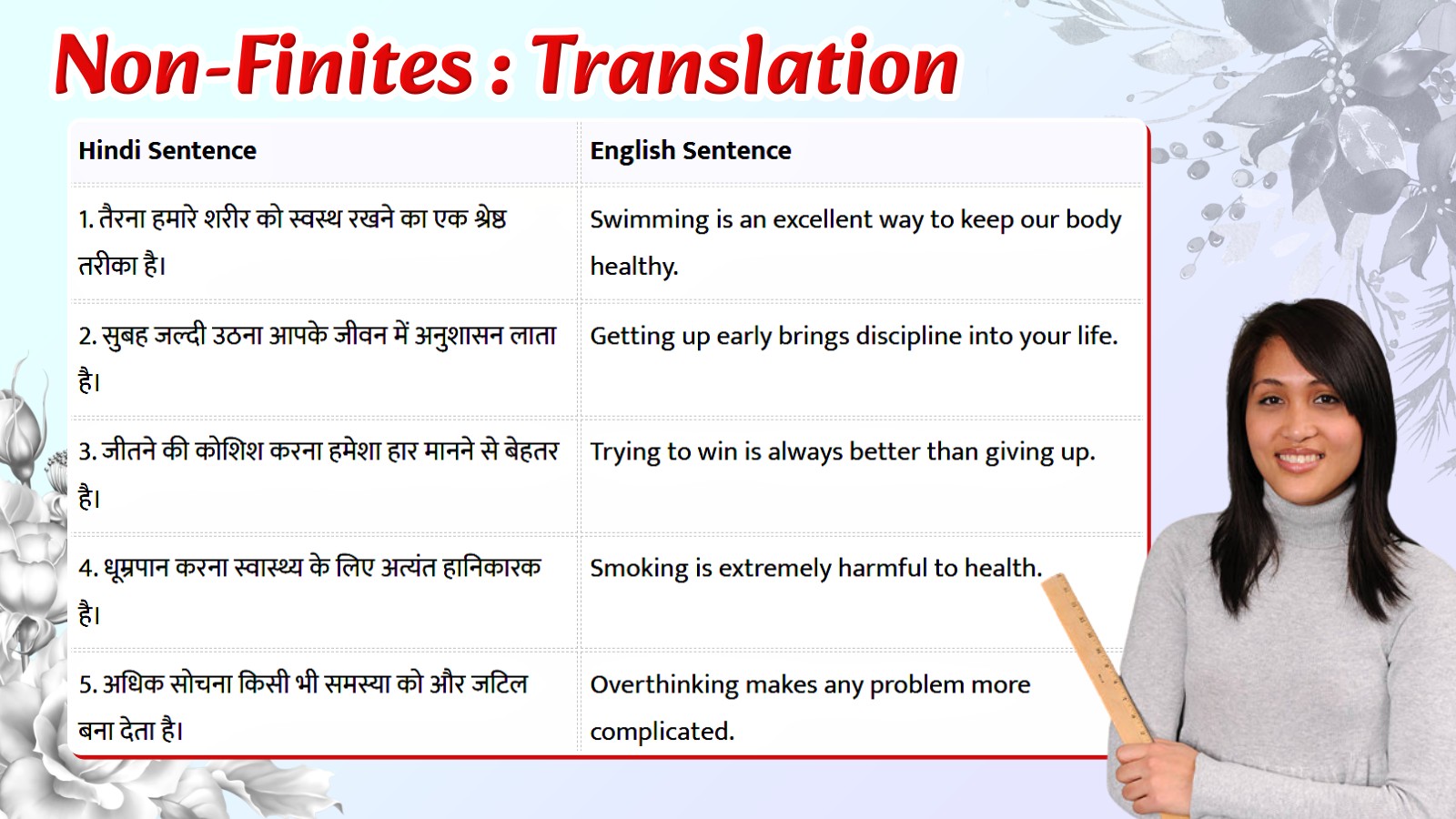
| Hindi Sentence | English Sentence |
|---|---|
| 1. तैरना हमारे शरीर को स्वस्थ रखने का एक श्रेष्ठ तरीका है। | Swimming is an excellent way to keep our body healthy. |
| 2. सुबह जल्दी उठना आपके जीवन में अनुशासन लाता है। | Getting up early brings discipline into your life. |
| 3. जीतने की कोशिश करना हमेशा हार मानने से बेहतर है। | Trying to win is always better than giving up. |
| 4. धूम्रपान करना स्वास्थ्य के लिए अत्यंत हानिकारक है। | Smoking is extremely harmful to health. |
| 5. अधिक सोचना किसी भी समस्या को और जटिल बना देता है। | Overthinking makes any problem more complicated. |
| 6. पढ़ना ज्ञान बढ़ाने का सबसे अच्छा साधन है। | Reading is the best means to gain knowledge. |
| 7. ईमानदारी से काम करना सफलता का पहला चरण है। | Working honestly is the first step to success. |
| 8. खेलना शरीर और मन दोनों के लिए महत्वपूर्ण है। | Playing is important for both body and mind. |
| 9. समय पर पहुँचना अच्छे व्यवहार की पहचान है। | Reaching on time is a sign of good manners. |
| 10. दयालु होना इंसान की सबसे अच्छी विशेषता है। | Being kind is the best quality of a human. |
Infinitive (to + verb) Examples
| Hindi Sentence | English Sentence |
|---|---|
| 11. उसने परीक्षा में अच्छा प्रदर्शन करने के लिए बहुत मेहनत की। | He worked very hard to perform well in the exam. |
| 12. मैं विश्व प्रसिद्ध स्थानों को देखने के लिए विदेश जाना चाहता हूँ। | I want to go abroad to see world-famous places. |
| 13. उसने अपने परिवार की सहायता करने के लिए नौकरी की। | She took a job to help her family. |
| 14. हम प्रकृति की सुंदरता देखने के लिए पहाड़ों पर गए। | We went to the mountains to see the beauty of nature. |
| 15. मैंने अंग्रेजी सुधारने के लिए नया कोर्स जॉइन किया। | I joined a new course to improve my English. |
| 16. वह दुनिया घूमने के लिए पैसे बचा रहा है। | He is saving money to travel the world. |
| 17. मैं तुम्हें इस समस्या को समझाने के लिए आया हूँ। | I have come to explain this problem to you. |
| 18. उसने मेरा मन बहलाने के लिए एक कहानी सुनाई। | She told a story to entertain me. |
| 19. वे यहाँ शांत वातावरण का आनंद लेने के लिए आए हैं। | They have come here to enjoy the peaceful atmosphere. |
| 20. मैं इस नौकरी को पाने के लिए इंटरव्यू देने जा रहा हूँ। | I am going to give an interview to get this job. |
Bare Infinitive Examples (without “to”)
| Hindi Sentence | English Sentence |
|---|---|
| 21. मैंने उसे तेज़ी से दौड़ते हुए देखा। | I saw him run fast. |
| 22. शिक्षक ने छात्रों को खड़े होने को कहा। | The teacher made the students stand. |
| 23. माता-पिता बच्चों को अपने सपने पूरे करने देते हैं। | Parents let their children follow their dreams. |
| 24. उसने मुझे तुरंत अंदर आने को कहा। | He bid me enter immediately. |
| 25. हमने पक्षियों को सुबह गाते हुए सुना। | We heard the birds sing in the morning. |
| 26. डॉक्टर ने उसे आराम करने दिया। | The doctor let him rest. |
| 27. पुलिस ने चोर को भागने नहीं दिया। | The police did not let the thief escape. |
| 28. उन्होंने मुझे मंच पर बोलने दिया। | They let me speak on the stage. |
| 29. मैंने बच्चों को पार्क में खेलते हुए देखा। | I saw the children play in the park. |
| 30. मालिक ने नौकर को दरवाजा बंद करने को कहा। | The master made the servant shut the door. |
Present Participles (Verb + ing)
| Hindi Sentence | English Sentence |
|---|---|
| 31. हँसता हुआ बच्चा सबका मन मोह लेता है। | A laughing child wins everyone’s heart. |
| 32. सुबह उगता हुआ सूरज बहुत सुंदर लगता है। | The rising sun looks very beautiful. |
| 33. सड़क पर दौड़ती हुई कार अचानक रुक गई। | The running car stopped suddenly. |
| 34. रोता हुआ बच्चा धीरे-धीरे शांत हुआ। | The crying child calmed down slowly. |
| 35. गाता हुआ पक्षी मुझे बहुत अच्छा लगा। | The singing bird pleased me a lot. |
| 36. मैदान में खेलते हुए बच्चे खुश दिखाई दे रहे थे। | The children playing in the field looked happy. |
| 37. मुस्कुराता हुआ चेहरा हमेशा सकारात्मक प्रभाव डालता है। | A smiling face always creates a positive impact. |
| 38. चलते हुए मैं गिर पड़ा। | Walking, I slipped. |
| 39. बारिश में भीगते हुए वह घर पहुँचा। | Getting wet in the rain, he reached home. |
| 40. पढ़ते-पढ़ते उसे नींद आ गई। | Reading, he fell asleep. |
Past Participles (Verb + ed / en / irregular)
| Hindi Sentence | English Sentence |
|---|---|
| 41. टूटा हुआ खिलौना जमीन पर पड़ा था। | The broken toy was lying on the floor. |
| 42. पका हुआ भोजन मेज पर रखा था। | The cooked food was kept on the table. |
| 43. खोई हुई चाबी आखिर मिल गई। | The lost key was finally found. |
| 44. सीखी हुई बातें जीवनभर काम आती हैं। | The learned lessons remain useful for life. |
| 45. लिखा हुआ पत्र उसने भेज दिया। | The written letter was sent by him. |
| 46. किया हुआ कार्य कभी व्यर्थ नहीं जाता। | The done work never goes waste. |
| 47. देखी हुई फिल्म मुझे याद है। | I remember the watched movie. |
| 48. खरीदा हुआ सामान वापस नहीं लिया जाएगा। | The purchased goods will not be returned. |
| 49. खोई हुई उम्मीद समय के साथ वापस आ सकती है। | Lost hope may return with time. |
| 50. बनाई हुई योजना सफल रही। | The planned strategy worked. |
Perfect Participles (having + V3)
| Hindi Sentence | English Sentence |
|---|---|
| 51. खाना खा लेने के बाद वह काम पर चला गया। | Having eaten food, he went to work. |
| 52. अपना होमवर्क पूरा कर लेने के बाद मैंने टीवी देखा। | Having finished my homework, I watched TV. |
| 53. परीक्षा की तैयारी कर लेने के बाद वह निश्चिन्त हो गई। | Having prepared for the exam, she felt relaxed. |
| 54. बारिश रुकने के बाद वे बाहर निकले। | Having stopped raining, they went outside. |
| 55. काम पूरा कर लेने के बाद मजदूर घर चले गए। | Having completed the work, the workers went home. |
| 56. पैसे जमा कर लेने के बाद उसने कार खरीदी। | Having saved money, he bought a car. |
| 57. गलती समझ कर उसने माफी माँगी। | Having realized the mistake, he apologized. |
| 58. बातचीत समाप्त करके वह चला गया। | Having finished the conversation, he left. |
| 59. सत्य जानकर उसने निर्णय लिया। | Having known the truth, he made the decision. |
| 60. कड़ी मेहनत करने के बाद वह सफल हुआ। | Having worked hard, he succeeded. |
Mixed Non-Finites (Gerund + Infinitive + Participles)
| Hindi Sentence | English Sentence |
|---|---|
| 61. बच्चों को पढ़ाना एक महान कार्य है। | Teaching children is a noble task. |
| 62. उसने हमें हँसाने के लिए मज़ेदार कहानी सुनाई। | He told a funny story to make us laugh. |
| 63. वह किताब पढ़ते हुए सो गया। | He fell asleep while reading the book. |
| 64. तैरना सीखने के लिए धैर्य की आवश्यकता होती है। | To learn swimming, patience is needed. |
| 65. बहते हुए पानी की आवाज़ बहुत मधुर लगती है। | The sound of flowing water feels very pleasant. |
| 66. उसने धूप से बचने के लिए छाता लिया। | She took an umbrella to avoid the sunlight. |
| 67. मुझे देरी करने की आदत अच्छी नहीं लगती। | I do not like the habit of delaying. |
| 68. मुस्कुराते हुए बात करना लोगों को अच्छा लगता है। | Talking while smiling pleases people. |
| 69. मैंने तुम्हें मदद करने का वादा किया है। | I have promised to help you. |
| 70. समय बचाने के लिए हमें जल्दी निकलना चाहिए। | To save time, we should leave early. |
Translate the following sentences into English:
EXERCISE 1. Use of Gerund
| No. | Hindi Sentence | English Translation (Gerund Use) |
|---|---|---|
| 1 | तैरना स्वास्थ्य के लिए लाभदायक है। | Swimming is good for health. |
| 2 | मुझे क्रिकेट खेलना पसन्द है। | I like playing cricket. |
| 3 | देखना ही विश्वास करना है। | Seeing is believing. |
| 4 | उसे पाँच रुपये चुराने के लिए पीटा गया। | He was beaten for stealing five rupees. |
| 5 | मैं कॉफी पीने का शौकीन हूँ। | I am fond of drinking coffee. |
| 6 | क्रिकेट खेलना अच्छी आदत है। | Playing cricket is a good habit. |
| 7 | पुस्तकों को गंदा करना अच्छा कार्य नहीं है। | Making books dirty is not a good habit. |
| 8 | अब लिखना बन्द करो। | Stop writing now. |
| 9 | हमने ताश खेलना जारी रखा। | We continued playing cards. |
| 10 | सब कुछ पिताजी के आने पर निर्भर है। | Everything depends on father’s coming. |
| 11 | अंग्रेजी में अच्छे अंक प्राप्त करना कठिन है। | Getting good marks in English is difficult. |
| 12 | पक्षियों के गीत गाने का समय आ गया है। | It is time for birds’ singing. |
| 13 | मुझे तैरना सिखाइये। | Teach me swimming. |
| 14 | उसे झूठ बोलने के कारण दण्डित किया गया। | He was punished for telling lies. |
| 15 | प्रश्न पूछना उनके उत्तर देने से अधिक सरल है। | Asking questions is easier than answering them. |
| 16 | कंजूस धन खर्च करने से घृणा करता है। | A miser hates spending money. |
Difficult words: स्वास्थ्य health; चुराने के लिए for stealing: गंदा करना = spoiling; खेलना जारी रखा = continued playing; निर्भर है = depends; पिताजी के आने पर = on father’s coming; झूठ बोलने के कारण for telling a lie; अधिक सरल easier, कंजूस = miser.
EXERCISE 2. Use of Infinitives
| No. | Hindi Sentence | English Translation (Infinitive Use) |
|---|---|---|
| 1 | मैं आज खैर जाना चाहता हूँ। | I want to go to Khair today. |
| 2 | रेलगाड़ी शीघ्र ही आने वाली है। | The train is about to come soon. |
| 3 | मुझे अब खेलने दीजिए। | Allow me to play now. |
| 4 | मैंने उसे घर जाते हुए देखा है। | I have seen him go home. (Note: “go” after see → bare infinitive) |
| 5 | हम यहाँ पर पढ़ने आये हैं। | We have come here to study. |
| 6 | ये फल खाने में अच्छे हैं। | These fruits are good to eat. |
| 7 | मैं समय नष्ट करना नहीं चाहता हूँ। | I do not want to waste time. |
| 8 | मेरे पास ताश खेलने के लिए समय नहीं है। | I have no time to play cards. |
| 9 | आगे बढ़ना कठिन था। | To go forward was difficult. |
| 10 | पीछे लौटना असम्भव था। | To return back was impossible. |
| 11 | मेरी इच्छा रेडियो खरीदने की है। | My wish is to buy a radio. |
| 12 | मैं आगरा ताजमहल देखने गया था। | I went to Agra to see the Taj Mahal. |
| 13 | चपरासी ने आज्ञा मानने से इन्कार कर दिया। | The peon refused to obey the order. |
| 14 | उसने मेरी सहायता करने का वचन दिया। | He promised to help me. |
| 15 | हवा के बिना जीवित रहना असम्भव है। | It is impossible to live without air. |
Difficult words: शीघ्र ही soon; नष्ट करना to waste; आगे बढ़ना= to advance, to move forward; पीछे लौटना = to retreat, to return; इन्कार कर दिया refused; बिना = without; जीवित रहना = to live; असम्भव = impossible.
EXERCISE 3. Use of Participles
| No. | Hindi Sentence | English Translation (Participles) |
|---|---|---|
| 1 | आवाज सुनकर चोर भाग गया। | Hearing the sound, the thief ran away. |
| 2 | मुकेश कल यहाँ हँसता हुआ आया था। | Mukesh came here laughing yesterday. |
| 3 | बायीं ओर मुड़ने पर तुम्हें मन्दिर दिखाई देगा। | Turning to the left, you will see the temple. |
| 4 | मुझे आज अपनी खोई हुई ताली (चाबी) मिल गयी। | I found my lost key today. |
| 5 | एक बार का खोया हुआ समय कभी वापस नहीं आता है। | Lost time never returns. |
| 6 | एक बार का बेचा हुआ सामान वापस नहीं लिया जायेगा। | Goods once sold will not be taken back. |
| 7 | चलती हुई रेलगाड़ी से मत उतरिये। | Do not get down from a moving train. |
| 8 | परेशान होकर वह लौट आया। | Being worried, he returned. |
| 9 | शिकारी ने उड़ते हुए तोते को मार डाला। | The hunter shot the flying parrot. |
| 10 | पत्र लिखने के बाद वह सो गयी। | After writing the letter, she slept. |
| 11 | उन्होंने घायल सैनिकों की सहायता की। | They helped the wounded soldiers. |
| 12 | खाना खाने के बाद उसने धूम्रपान किया। | After eating food, he smoked. |
| 13 | कल उसने मुझे प्रतीक्षा में रखा। | He kept me waiting yesterday. |
| 14 | मौसम अच्छा होने पर मैं बाहर आया। | Finding the weather fine, I came out. |
| 15 | असंतुष्ट होने पर उसने इस्तीफा दे दिया। | Being dissatisfied, he resigned. |
| 16 | मुझे दरवाजा बंद मिला। | I found the door closed. |
Difficult words: बायीं ओर मुड़ने पर turning to the left; खोई हुई ताली (चाबी) = lost key; परेशान = worried; घायल = wounded; मुझे प्रतीक्षा में रखा = kept me waiting; धूम्रपान किया = smoked; असंतुष्ट होकर being dissatisfied; इस्तीफा दे दिया resigned; मिला = found; बंद = locked.
Learn other English Grammar in Hindi Translation: