

DIRECT AND INDIRECT SPEECH क्या है?
1. Direct Speech (सीधा कथन / प्रत्यक्ष वचन)
जब हम किसी व्यक्ति के सही-सही शब्दों को उसी के मूल रूप में लिखते या बोलते हैं, तो उसे Direct Speech कहते हैं।
पहचान:
- वाक्य में “ ” (उद्धरण चिह्न) लगे होते हैं।
- किसी व्यक्ति के exact words लिखे होते हैं।
- Reporting Verb के बाद comma + inverted commas आते हैं।
उदाहरण:
राम ने कहा, “मैं तुमसे कल मिलूँगा।”
→ इसमें “मैं तुमसे कल मिलूँगा।” राम के सही शब्द हैं।
2. Indirect Speech (परिवर्तित कथन / परोक्ष वचन)
जब किसी के शब्दों को अपने शब्दों में, अर्थ बदलाए बिना, बिना उद्धरण चिह्नों के लिखा जाता है, तो उसे Indirect Speech कहते हैं।
पहचान:
- उद्धरण चिह्न ( ” ” ) नहीं होते।
- वाक्य में प्रायः that, if, whether या question word का प्रयोग होता है।
- Tense, Person, Pronoun बदलते हैं।
- Time और Place words भी बदल जाते हैं (today → that day, here → there)।
उदाहरण:
राम ने कहा कि वह मुझसे अगले दिन मिलेगा।
→ यह Direct Speech का बदला हुआ रूप है।
Direct और Indirect Speech में क्या अंतर है?
| Direct Speech | Indirect Speech |
|---|---|
| व्यक्ति के ठीक-ठीक बोले हुए शब्द लिखे जाते हैं। | बोले हुए शब्दों को बदलकर भावानुसार लिखा जाता है। |
| “ ” उद्धरण चिह्न का प्रयोग होता है। | उद्धरण चिह्न नहीं होते। |
| Verb का Tense वही रहता है। | Tense प्रायः बदल जाता है (Past में)। |
| Person बदल सकता है या नहीं। | Pronoun (I → he/she) बदल जाता है। |
| Time, Place बदल सकते हैं। | Today → that day, here → there आदि। |
Direct से Indirect में बदलने के मुख्य नियम
1. Said → Told / Asked / Requested / Ordered
2. Tense बदलता है (यदि Reporting Verb Past में हो)
3. Pronoun बदलते हैं (I → he/she)
4. Time & Place बदलते हैं
- today → that day
- tomorrow → next day / the following day
- now → then
- here → there
5. Inverted commas हटाकर → that / if / whether / question word जोड़ते हैं।
उदाहरण
Direct Speech: राहुल ने कहा, “मैं क्रिकेट खेल रहा हूँ।”
Indirect Speech: राहुल ने कहा कि वह क्रिकेट खेल रहा था।
अनुवाद के नियम (Examples सहित)
(A) Assertive Sentences (विधिसूचक वाक्य)
RULE 1. यदि Reporting Verb Present या Future Tense में है तो Reported Speech की Verb का Tense नहीं बदलता है।
मोहन कहता है, “संदीप अच्छा व्यक्ति है।”
Mohan says, “Sandeep is a good man.” (Direct)
Mohan says that Sandeep is a good man. (Indirect)
RULE 2. यदि Reporting Verb भूतकाल (Past Tense) में है तो Reported Speech की Verb (क्रिया) को Past Tense में परिवर्तित कर दिया जाता है।
राम ने मोहन से कहा, “मेरे बड़े भाई देहली जायेंगे।”
Rama said to Mohan, “My elder brother will go to Delhi.” (Direct)
Rama told Mohan that his elder brother would go to Delhi. (Indirect)
अपवाद (Exception): यदि Reported Speech से सामान्य सत्य (Universal Truth) प्रकट हो रहा है तो Reported Speech की Verb ज्यों की त्यों रहती है।
मास्टर साहब ने हमसे कहा था, “पृथ्वी सूर्य के चारों ओर घूमती है।”
The teacher said to us, “The earth moves round the sun.” (Direct)
The teacher told us that the earth moves round the sun. (Indirect)
(B) Interrogative Sentences (Question Form)
RULE 1. प्रश्नवाचक वाक्यों में Reporting Verb ‘Said’ को ‘Asked’ में बदल दिया जाता है। यदि Reported Speech का पहला शब्द Primary Auxiliary या Modal Auxiliary हो तो if या whether का प्रयोग होता है। ऐसे वाक्यों में that-Conjunction का प्रयोग नहीं होता।
राम ने अकरम से कहा, “क्या तुम आज क्रिकेट खेलोगे?”
Rama said to Akram, “Will you play cricket today?” (Direct)
Rama asked Akram if he would play cricket that day. (Indirect)
मोहन ने शीला से कहा, “क्या तुम कल खैर जाओगी?”
Mohan said to Shila, “Will you go to Khair tomorrow?” (Direct)
Mohan asked Shila whether she would go to Khair the next day. (Indirect)
RULE 2. यदि Reported Speech का पहला शब्द कोई Question Word हो तो उसी Word से Sentence को जोड़ा जाता है। न if/whether, न that का प्रयोग होता है।
मैंने मदन से कहा, “तुम कहाँ रहते हो?”
I said to Madan, “Where do you live?” (Direct)
I asked Madan where he lived. (Indirect)
संकेत: Indirect Speech में प्रश्नवाचक चिन्ह (?) हटा दिया जाता है।
(C) Imperative Sentences (आज्ञासूचक वाक्य)
RULE 1. आज्ञासूचक वाक्यों में Ordered का प्रयोग होता है।
मास्टर साहब ने राम से कहा, “बाहर जाओ।”
The teacher said to Rama, “Go out.” (Direct)
The teacher ordered Rama to go out. (Indirect)
RULE 2. यदि वाक्य Do not से शुरू हुआ है तो not to के बाद क्रिया जोड़ दी जाती है।
पिताजी ने नौकर से कहा, “यहाँ मत बैठो।”
Father said to the servant, “Do not sit here.” (Direct)
Father ordered the servant not to sit there. (Indirect)
RULE 3. प्रार्थनासूचक वाक्यों में Said को Requested में बदल दिया जाता है। Sir, Please, Madam, Gentleman, Kindly आदि शब्द हटा दिए जाते हैं।
नौकर ने अपने मालिक से कहा, “श्रीमान, मुझे एक दिन की छुट्टी दे दीजिए।”
The servant said to his master, “Sir, give me one day’s leave.” (Direct)
The servant requested his master to give him one day’s leave. (Indirect)
मैंने अपने मित्र से कहा, “कृपया बैठ जाइये।”
I said to my friend, “Please sit down.” (Direct)
I requested my friend to sit down. (Indirect)
RULE 4. परामर्श देने वाले वाक्यों में Reporting Verb को Advised में बदल दिया जाता है। (वाक्य 9)
डॉक्टर साहब ने रोगी से कहा, “धूम्रपान करना छोड़ दो।”
The doctor said to the patient, “Give up smoking.” (Direct)
The doctor advised the patient to give up smoking. (Indirect)
(D) Exclamatory Sentences (विस्मयसूचक वाक्य)
RULE. विस्मयसूचक वाक्यों में Reporting Verb ‘Said’ को ‘Exclaimed’ में बदल दिया जाता है।
उसने कहा, “आह! मेरा सर्वनाश हो गया है।”
He said, “Alas! I am undone.” (Direct)
He exclaimed with sorrow that he was undone. (Indirect)
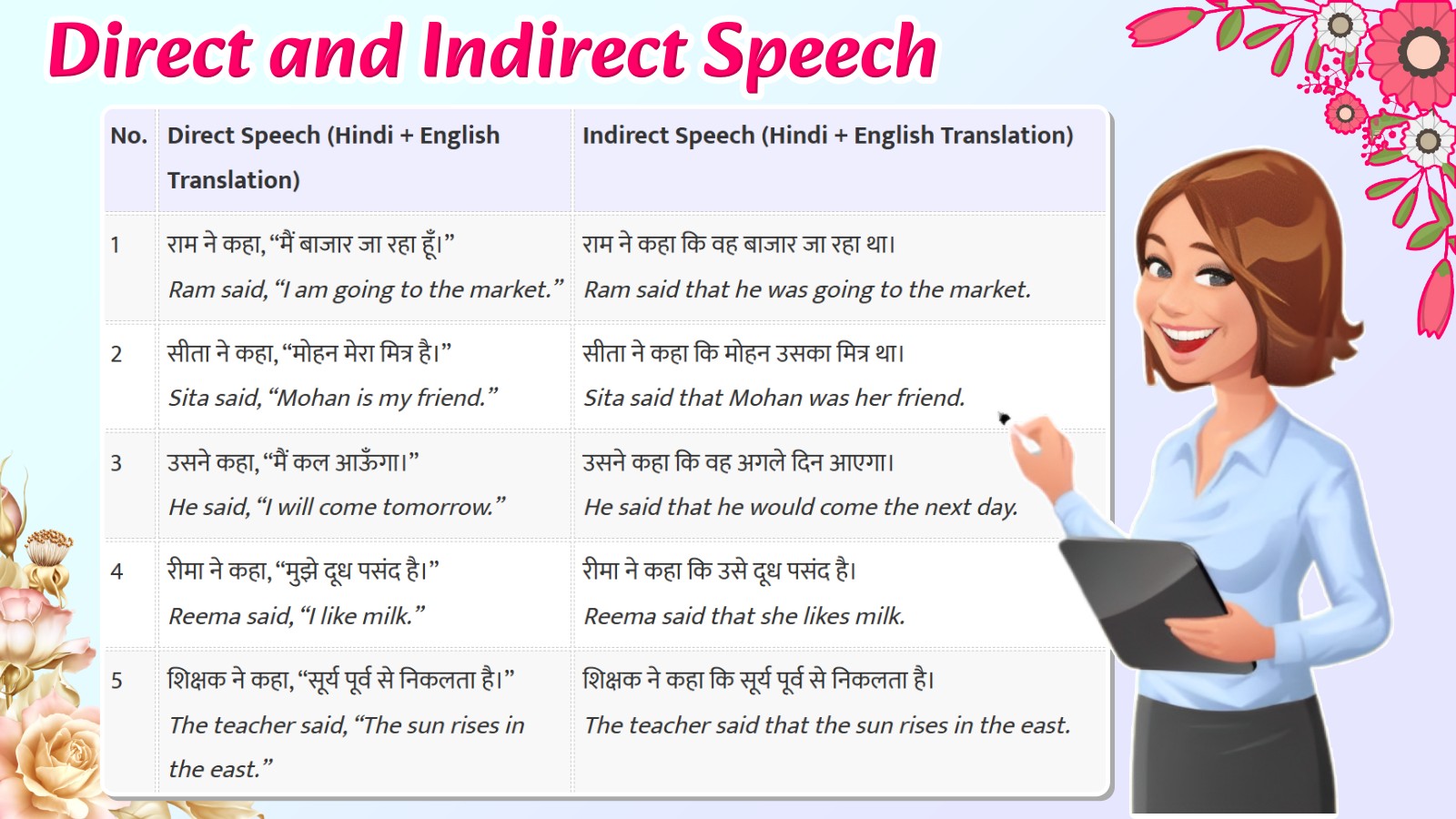
Examples of Direct & Indirect Speech
| No. | Direct Speech | Indirect Speech |
|---|---|---|
| 1 | राम ने कहा, “मैं बाजार जा रहा हूँ।” Ram said, “I am going to the market.” |
राम ने कहा कि वह बाजार जा रहा था। Ram said that he was going to the market. |
| 2 | सीता ने कहा, “मोहन मेरा मित्र है।” Sita said, “Mohan is my friend.” |
सीता ने कहा कि मोहन उसका मित्र था। Sita said that Mohan was her friend. |
| 3 | उसने कहा, “मैं कल आऊँगा।” He said, “I will come tomorrow.” |
उसने कहा कि वह अगले दिन आएगा। He said that he would come the next day. |
| 4 | रीमा ने कहा, “मुझे दूध पसंद है।” Reema said, “I like milk.” |
रीमा ने कहा कि उसे दूध पसंद है। Reema said that she likes milk. |
| 5 | शिक्षक ने कहा, “सूर्य पूर्व से निकलता है।” The teacher said, “The sun rises in the east.” |
शिक्षक ने कहा कि सूर्य पूर्व से निकलता है। The teacher said that the sun rises in the east. |
| 6 | मोहन ने पूछा, “क्या तुम ठीक हो?” Mohan said, “Are you fine?” |
मोहन ने पूछा कि क्या मैं ठीक था। Mohan asked whether I was fine. |
| 7 | उसने पूछा, “क्या बारिश होगी?” He asked, “Will it rain?” |
उसने पूछा कि क्या बारिश होगी। He asked whether it would rain. |
| 8 | रीना ने पूछा, “तुम कहाँ रहते हो?” Reena asked, “Where do you live?” |
रीना ने पूछा कि मैं कहाँ रहता था। Reena asked where I lived. |
| 9 | शिक्षक ने लड़के से कहा, “क्यों देर से आए?” Teacher said, “Why are you late?” |
शिक्षक ने लड़के से पूछा कि वह देर से क्यों आया था। Teacher asked the boy why he had come late. |
| 10 | मैंने उससे कहा, “तुम भोजन कर लो।” I said, “Take your meal.” |
मैंने उससे कहा कि वह भोजन कर ले। I told him to take his meal. |
| 11 | पिता ने कहा, “कड़ी मेहनत करो।” Father said, “Work hard.” |
पिता ने मुझे कड़ी मेहनत करने का आदेश दिया। Father ordered me to work hard. |
| 12 | माँ ने कहा, “यहाँ मत आओ।” Mother said, “Do not come here.” |
माँ ने मुझे वहाँ न आने को कहा। Mother told me not to come there. |
| 13 | डॉक्टर ने कहा, “धूम्रपान बंद करो।” Doctor said, “Quit smoking.” |
डॉक्टर ने उसे धूम्रपान बंद करने की सलाह दी। The doctor advised him to quit smoking. |
| 14 | नौकर ने कहा, “कृपया मुझे पानी दे दीजिए।” The servant said, “Please give me water.” |
नौकर ने मुझसे पानी देने का अनुरोध किया। The servant requested me to give him water. |
| 15 | उसने कहा, “वाह! कितनी सुन्दर जगह है!” He said, “Wow! What a beautiful place!” |
उसने आश्चर्य से कहा कि वह जगह बहुत सुन्दर थी। He exclaimed with wonder that it was a very beautiful place. |
| 16 | मोहन ने कहा, “अरे! मैं हार गया।” Mohan said, “Oh! I am defeated.” |
मोहन ने दुख के साथ कहा कि वह हार गया था। Mohan exclaimed with sorrow that he was defeated. |
| 17 | शिक्षक ने कहा, “शाबाश!” Teacher said, “Well done!” |
शिक्षक ने प्रशंसा की कि उसने अच्छा किया था। The teacher applauded that he had done well. |
| 18 | रानी ने कहा, “तुम मेरा इंतजार करो।” Rani said, “Wait for me.” |
रानी ने मुझे उसका इंतजार करने को कहा। Rani told me to wait for her. |
| 19 | पिता ने कहा, “घर जल्दी आ जाना।” Father said, “Come home early.” |
पिता ने कहा कि मैं घर जल्दी आऊँ। Father told me to come home early. |
| 20 | मैंने उससे कहा, “अपना नाम बताओ।” I said, “Tell me your name.” |
मैंने उससे उसका नाम बताने को कहा। I told him to tell me his name. |
| 21 | उसने पूछा, “तुम यहाँ क्यों आए हो?” He asked, “Why have you come here?” |
उसने पूछा कि मैं वहाँ क्यों आया था। He asked why I had come there. |
| 22 | लड़के ने पूछा, “क्या शिक्षक आएंगे?” The boy asked, “Will the teacher come?” |
लड़के ने पूछा कि क्या शिक्षक आएंगे। The boy asked whether the teacher would come. |
| 23 | मैंने पूछा, “तुम कब जाओगे?” I asked, “When will you go?” |
मैंने पूछा कि वह कब जाएगा। I asked when he would go. |
| 24 | रीमा ने कहा, “मैं जा रही हूँ।” Reema said, “I am leaving.” |
रीमा ने कहा कि वह जा रही थी। Reema said that she was leaving. |
| 25 | उसने कहा, “मेरी माँ बीमार है।” He said, “My mother is ill.” |
उसने कहा कि उसकी माँ बीमार थी। He said that his mother was ill. |
| 26 | शिक्षक ने कहा, “खिड़की खोलो।” Teacher said, “Open the window.” |
शिक्षक ने खिड़की खोलने का आदेश दिया। The teacher ordered to open the window. |
| 27 | पिताजी ने कहा, “झूठ मत बोलो।” Father said, “Do not lie.” |
पिताजी ने झूठ न बोलने की सलाह दी। Father advised not to lie. |
| 28 | मैंने उससे कहा, “मेरी सहायता करो।” I said, “Help me.” |
मैंने उससे मेरी सहायता करने को कहा। I told him to help me. |
| 29 | लड़की ने पूछा, “क्या तुम मुझे पहचानते हो?” The girl asked, “Do you recognize me?” |
लड़की ने पूछा कि क्या मैं उसे पहचानता था। The girl asked whether I recognized her. |
| 30 | श्याम ने पूछा, “क्या बारिश हो रही है?” Shyam asked, “Is it raining?” |
श्याम ने पूछा कि क्या बारिश हो रही थी। Shyam asked whether it was raining. |
| 31 | उसने कहा, “मैंने खाना खा लिया है।” He said, “I have eaten food.” |
उसने कहा कि उसने खाना खा लिया था। He said that he had eaten food. |
| 32 | रीमा ने कहा, “मैंने यह किताब पढ़ी है।” Reema said, “I have read this book.” |
रीमा ने कहा कि उसने वह किताब पढ़ी थी। Reema said that she had read that book. |
| 33 | मैंने कहा, “तुम सत्य बोलते हो।” I said, “You speak truth.” |
मैंने कहा कि वह सत्य बोलता था। I said that he spoke the truth. |
| 34 | लड़के ने कहा, “मैं क्रिकेट खेल रहा हूँ।” The boy said, “I am playing cricket.” |
लड़के ने कहा कि वह क्रिकेट खेल रहा था। The boy said that he was playing cricket. |
| 35 | पिता ने कहा, “मैं तुम्हें सिखाऊँगा।” Father said, “I will teach you.” |
पिता ने कहा कि वह मुझे सिखाएंगे। Father said that he would teach me. |
| 36 | लड़की ने कहा, “मैं तुमसे बात नहीं करूँगी।” The girl said, “I will not talk to you.” |
लड़की ने कहा कि वह मुझसे बात नहीं करेगी। The girl said that she would not talk to me. |
| 37 | मैंने पूछा, “क्या तुमने खाना बनाया?” I asked, “Did you cook the food?” |
मैंने पूछा कि क्या उसने खाना बनाया था। I asked whether he had cooked the food. |
| 38 | उसने पूछा, “तुम्हारा नाम क्या है?” He asked, “What is your name?” |
उसने पूछा कि मेरा नाम क्या था। He asked what my name was. |
| 39 | मोहन ने कहा, “मेरे पास समय नहीं है।” Mohan said, “I don’t have time.” |
मोहन ने कहा कि उसके पास समय नहीं था। Mohan said that he did not have time. |
| 40 | छात्र ने कहा, “मैंने अपना काम कर लिया है।” The student said, “I have done my work.” |
छात्र ने कहा कि उसने अपना काम कर लिया था। The student said that he had done his work. |
| 41 | शिक्षक ने कहा, “ध्यान से सुनो।” Teacher said, “Listen carefully.” |
शिक्षक ने ध्यान से सुनने को कहा। The teacher told to listen carefully. |
| 42 | माँ ने कहा, “दरवाजा बंद कर दो।” Mother said, “Close the door.” |
माँ ने दरवाजा बंद करने को कहा। Mother told to close the door. |
| 43 | लड़की ने कहा, “मैं पढ़ाई कर रही हूँ।” The girl said, “I am studying.” |
लड़की ने कहा कि वह पढ़ाई कर रही थी। The girl said that she was studying. |
| 44 | उसने कहा, “मैंने तुम्हें देखा।” He said, “I saw you.” |
उसने कहा कि उसने मुझे देखा था। He said that he had seen me. |
| 45 | रीना ने कहा, “मैं खुश हूँ।” Reena said, “I am happy.” |
रीना ने कहा कि वह खुश थी। Reena said that she was happy. |
| 46 | राम ने पूछा, “क्या तुम आओगे?” Ram asked, “Will you come?” |
राम ने पूछा कि क्या मैं आऊँगा। Ram asked whether I would come. |
| 47 | लड़के ने पूछा, “कौन आ रहा है?” The boy asked, “Who is coming?” |
लड़के ने पूछा कि कौन आ रहा था। The boy asked who was coming. |
| 48 | पिता ने कहा, “मैंने यह तुम्हारे लिए खरीदा है।” Father said, “I bought this for you.” |
पिता ने कहा कि उन्होंने वह मेरे लिए खरीदा था। Father said that he had bought that for me. |
| 49 | शिक्षक ने कहा, “अपनी गलतियाँ सुधारो।” Teacher said, “Correct your mistakes.” |
शिक्षक ने अपनी गलतियाँ सुधारने को कहा। The teacher told to correct the mistakes. |
| 50 | उसने पूछा, “तुम यहाँ कब आए?” He asked, “When did you come here?” |
उसने पूछा कि मैं वहाँ कब आया था। He asked when I had come there. |
EXERCISE 1. Translate the following sentences into Direct Speech:
| No. | Hindi Sentence | English Translation (Direct Speech) |
|---|---|---|
| 1 | राम कहता है, “राकेश यहाँ आज आयेगा।” | Ram says, “Rakesh will come here today.” |
| 2 | मैं मास्टर साहब से कह दूँगा, “राम ने मेरी पुस्तक चुरायी है।” | I shall tell the teacher, “Ram has stolen my book.” |
| 3 | श्याम ने मुझसे कहा था, “मीरा कल स्कूल आयेगी।” | Shyam had said to me, “Meera will come to school tomorrow.” |
| 4 | रोहित ने मेरे भाई से कहा, “तुम कहाँ रहते हो?” | Rohit said to my brother, “Where do you live?” |
| 5 | राम ने श्याम से पूछा, “क्या तुमने पत्र लिख दिया था?” | Ram asked Shyam, “Had you written the letter?” |
| 6 | मास्टर साहब ने विद्यार्थियों से कहा था, “अपनी पुस्तकें पढ़ो।” | The teacher had said to the students, “Read your books.” |
| 7 | पिताजी ने नौकर से कहा, “शोर मत मचाओ।” | Father said to the servant, “Do not make noise.” |
| 8 | अध्यापक ने बच्चों से कहा, “अपना कार्य करो।” | The teacher said to the children, “Do your work.” |
| 9 | नौकर ने मालिक से कहा, “कृपया मुझे खाने को कुछ दे दीजिए।” | The servant said to the master, “Please give me something to eat.” |
| 10 | बच्चों ने अपने अध्यापक से कहा, “श्रीमान, इस प्रश्न को पुनः हल कर दीजिए।” | The children said to their teacher, “Sir, please solve this question again.” |
| 11 | मोहन ने सविता से कहा, “क्या कल तुम मेरी सहायता नहीं करोगी?” | Mohan said to Savita, “Will you not help me tomorrow?” |
| 12 | पिताजी ने हमें बताया था, “सूर्य पृथ्वी से बड़ा है।” | Father had told us, “The sun is bigger than the earth.” |
| 13 | कृष्ण ने मीरा से कहा, “मेरे पिताजी आज बाहर गये हुए हैं।” | Krishna said to Meera, “My father is out today.” |
| 14 | राजू ने असगर से कहा, “यहाँ कल कौन आया था?” | Raju said to Asgar, “Who had come here yesterday?” |
| 15 | माताजी ने मेरी बड़ी बहन से कहा, “अब तुम क्या चाहती हो?” | Mother said to my elder sister, “What do you want now?” |
Difficult words: विद्यार्थियों= students; मालिक = master; नौकर = servant; पुनः = again; हल करना = to solve: पृथ्वी = earth.
EXERCISE 2. Translate the following sentences into Indirect Speech:
| No. | Hindi Sentence | English Translation (Indirect Speech) |
|---|---|---|
| 1 | उसने मुझसे पूछा कि क्या मोहन अध्यापक है। | He asked me whether Mohan was a teacher. |
| 2 | पांडेय जी ने मुझसे पूछा कि क्या मैं लखनऊ गया था। | Pandey ji asked me whether I had gone to Lucknow. |
| 3 | अध्यापक ने छात्र से पूछा कि वह देर से क्यों आया। | The teacher asked the student why he had come late. |
| 4 | मैंने उससे पूछा कि क्या तुमने काम खत्म कर लिया है। | I asked him whether he had finished the work. |
| 5 | मैंने सुधा से पूछा कि क्या तुम मुझे अपनी कलम दे सकती हो। | I asked Sudha whether she could give me her pen. |
| 6 | ग्राहक ने दुकानदार से पूछा कि इस किताब का मूल्य क्या है। | The customer asked the shopkeeper what the price of that book was. |
| 7 | मेरे चाचा जी ने रमेश से पूछा कि क्या उसने अजायबघर देखा है। | My uncle asked Ramesh whether he had seen the museum. |
| 8 | उसने मुझसे पूछा कि तुम यहाँ क्यों आये हो। | He asked me why I had come there. |
| 9 | पिता ने पुत्र से पूछा कि तुम्हारी किताबें नहीं खो गयी हैं। | The father asked the son whether his books had not been lost. |
| 10 | मैंने उसके भाई से पूछा कि तुम कहाँ जा रहे हो। | I asked his brother where he was going. |
| 11 | माली ने लड़के से पूछा कि तुम फूल क्यों तोड़ रहे हो। | The gardener asked the boy why he was plucking flowers. |
| 12 | अध्यापक ने लड़के से पूछा कि क्या उसने गृहकार्य कर लिया है। | The teacher asked the boy whether he had done his homework. |
| 13 | मैंने अपने मित्र से पूछा कि क्या तुम स्कूल जाने के लिए तैयार हो। | I asked my friend whether he was ready to go to school. |
| 14 | नौकर ने मालिक से प्रार्थना की कि क्या आप मुझे एक दिन का अवकाश दे सकते हैं। | The servant requested the master to grant him one day’s leave. |
| 15 | यात्री ने सुधा से पूछा कि तुम्हारा घर यहाँ से कितनी दूर है। | The traveler asked Sudha how far her house was from there. |
| 16 | यात्री ने उससे पूछा कि तुम्हारी क्या समस्या है। | The traveler asked him what his problem was. |
| 17 | मैंने उससे पूछा कि तुम्हारा घर कहाँ है। | I asked him where his house was. |
| 18 | यात्री ने स्टेशन मास्टर से पूछा कि बम्बई मेल कब आयेगी। | The traveler asked the station master when the Bombay Mail would arrive. |
Difficult words : पांडेय जी = Mr. Pandey; देर से late; ग्राहक = customer,, मूल्य= price: अजायब घर = museum; फूल तोड़ना = to pluck flower, तैयार = ready; अवकाण = leave; यात्री = traveller (वाक्य 15 में); कितनी दूर = how far; यात्री = passenger (बाक्य 18 में); स्टेशन मास्टर = station master.
Learn other English Grammar in Hindi Translation: