

Punctuation: Periods, Commas, Question Mark, Exclamation Mark, Quotation Mark
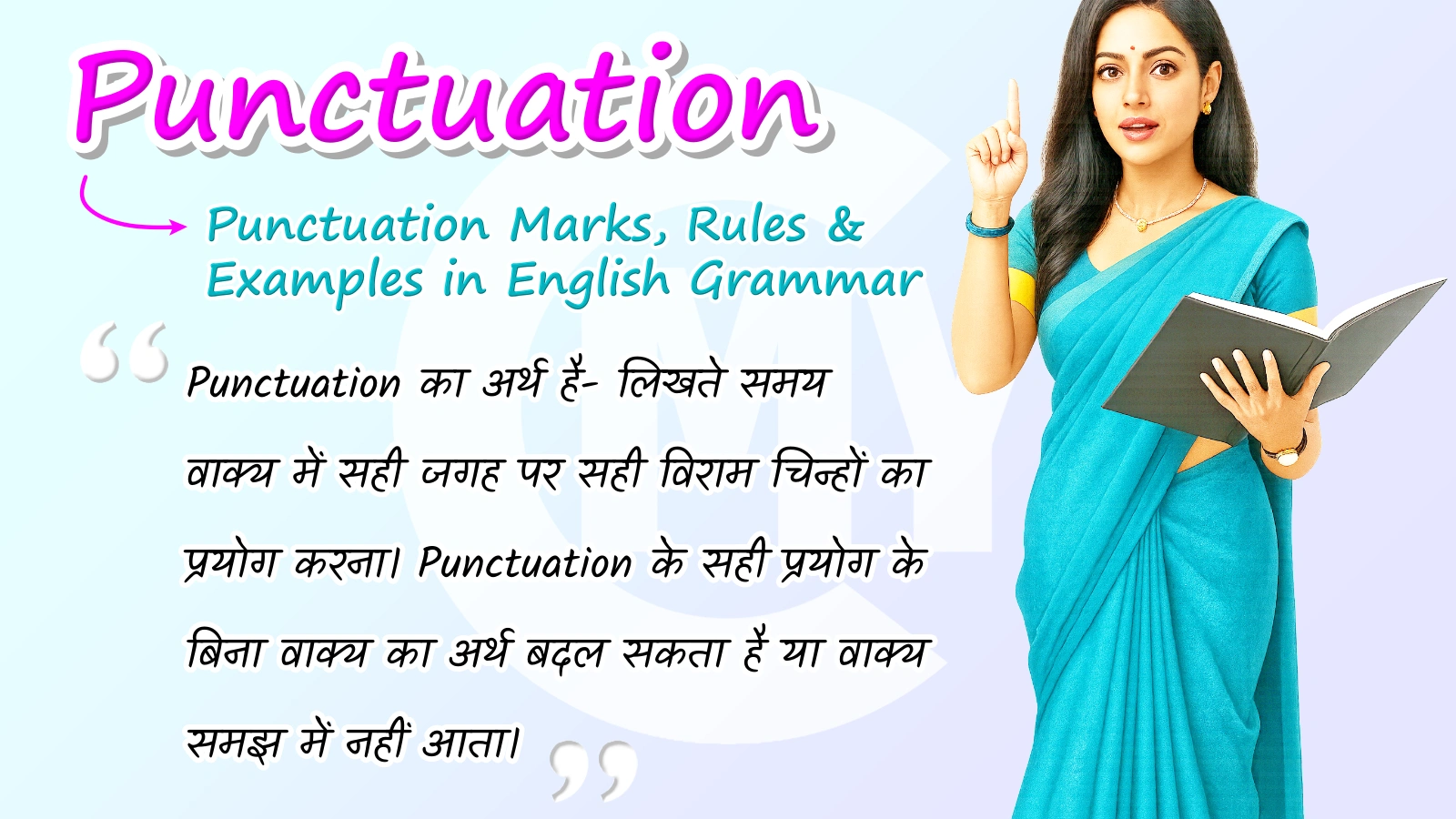
Punctuation (विराम-चिह्न-विधान): English में लिखते समय उचित विराम चिन्हों के प्रयोग को ‘Punctuation’ कहते है।
Punctuation का अर्थ है:
लिखते समय वाक्य में सही जगह पर सही विराम चिन्हों का प्रयोग करना।
Punctuation के बिना वाक्य का अर्थ बदल सकता है या वाक्य समझ में नहीं आता।
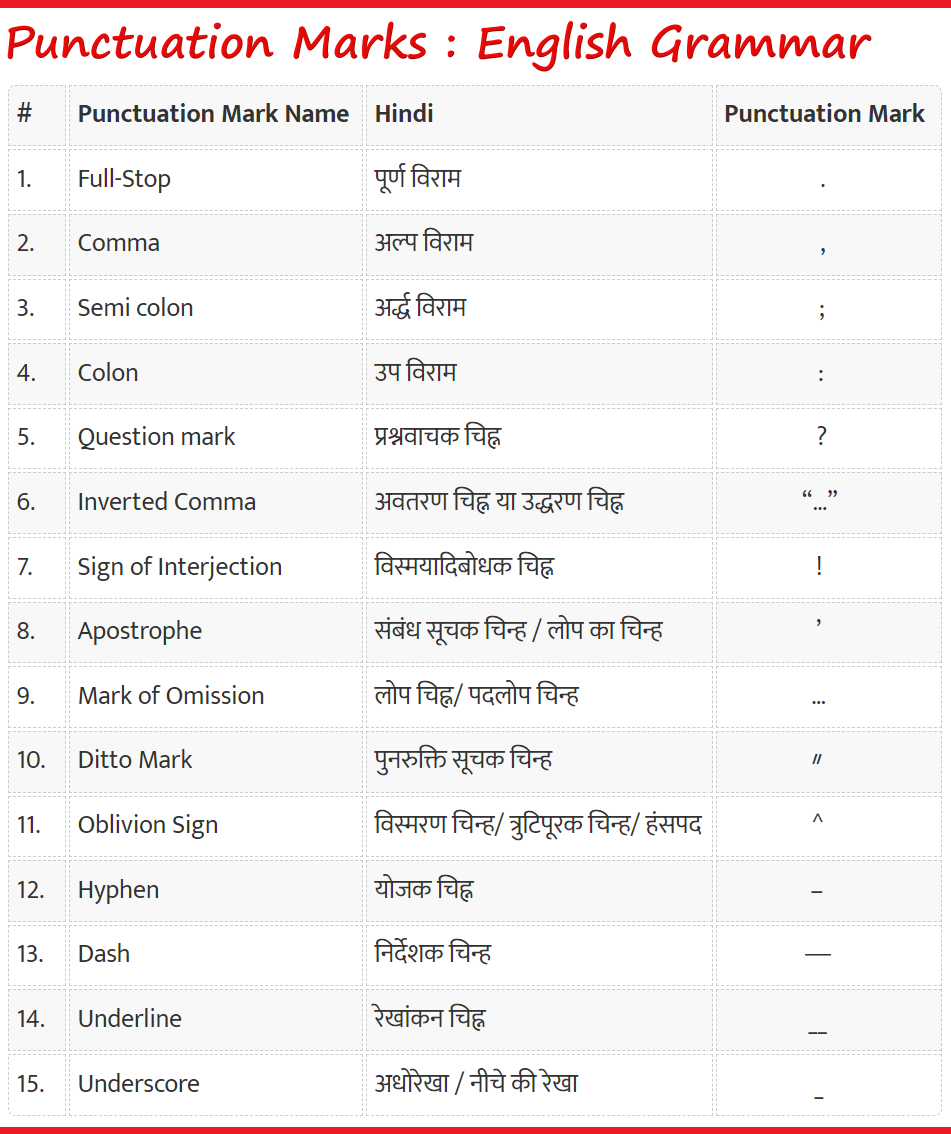
Punctuation Marks:
| # | Punctuation Mark Name | Hindi | Punctuation Mark |
| 1. | Full-Stop | पूर्ण विराम | . |
| 2. | Comma | अल्प विराम | , |
| 3. | Semi colon | अर्द्ध विराम | ; |
| 4. | Colon | उप विराम | : |
| 5. | Question mark | प्रश्नवाचक चिह्न | ? |
| 6. | Inverted Comma | अवतरण चिह्न या उद्धरण चिह्न | “…” |
| 7. | Sign of Interjection | विस्मयादिबोधक चिह्न | ! |
| 8. | Apostrophe | संबंध सूचक चिन्ह / लोप का चिन्ह | ’ |
| 9. | Mark of Omission | लोप चिह्न/ पदलोप चिन्ह | … |
| 10. | Ditto Mark | पुनरुक्ति सूचक चिन्ह | 〃 |
| 11. | Oblivion Sign | विस्मरण चिन्ह/ त्रुटिपूरक चिन्ह/ हंसपद | ^ |
| 12. | Hyphen | योजक चिह्न | – |
| 13. | Dash | निर्देशक चिन्ह | ― |
| 14. | Underline | रेखांकन चिह्न | __ |
| 15. | Underscore | अधोरेखा / नीचे की रेखा | _ |
Rules for Using Punctuation Marks
1. Full-Stop ( . )
Full Stop को Period या Stop भी कहते हैं। हिन्दी भाषा में इसे पूर्ण विराम कहा जाता है। इसका प्रयोग निम्न प्रकार होता है-
Rule 1. Assertive तथा Imperative वाक्यों के अन्त में, जैसे-
- He reads a book.
- Thank him.
- She does not write a letter.
- Keep quiet.
Rule 2. संक्षिप्त रूप वाले शब्दों (Abbreviation) तथा लघु हस्ताक्षरों (Initials) के साथ, जैसे-
- M.A.,
- B.A.,
- M.P.,
- M.L.A.,
- S.D.O.
- S.R. Sharma,
- M.L. Shrivastava.
आजकल Mr और Mrs के अन्त में Full Stop का प्रयोग नहीं किया जाता है किन्तु Smt. (श्रीमती) के अन्त में Full Stop लगाया जाता है।
2. Comma ( , )
Punctuation में Comma (अल्पविराम) सबसे अधिक महत्त्वपूर्ण है। इसका प्रयोग निम्नलिखित दशाओं में होता है-
Rule 1. एक ही Part of Speech के दो से अधिक शब्दों को पृथक करने के लिए, जैसे-
- Manish, Mahesh, Ramesh and Mukesh are brothers.
- The journey was long, dull and dangerous.
- He did his work neatly, quickly and correctly.
Rule 2. Nominative of Address अर्थात Vocative Case के Noun से पहले या बाद में, जैसे-
- Hari, do your work.
- Come here, Mohan.
Rule 3. Nominative Absolute Construction के बाद में, जैसे-
- God willing, we shall meet again. Mor
- It being a very hot day, I could not sleep.
नोट- Nominative Absolute Construction उस समय होता है जब Present Participle का प्रयोग हो और उसके कर्ता का सम्बन्ध किसी Finite Verb के साथ न हो।
Rule 4. Participial Phrase के बाद में, जैसे-
- Hearing the noise, the thief ran away.
नोट- Nominative Absolute Construction में Participle से पहले उसका Subject होता है। जबकि Participial Phrase में वाक्य की मुख्य क्रिया का Subject उसके बाद में आता है।
Rule 5. Case in Apposition के Noun से पहले और बाद में, जैसे-
- Kabir, the great reformer, was a weaver.
- Sachin, our vice-captain, is a good batsman.0 καλ
- We still remember Akbar, the son of Humayun.W
- Akbar, the son of Humayun, is still remembered.
Rule 6. Direct Speech में, जैसे-
- Mohan said, “Sita came here.” (Reporting Verb-said के बाद में अल्पविराम (,) लगा है।)
- “Where do you live”, said Anita. (Reporting Verb-said से पहले अल्पविराम (,) लगा है।)
Rule 7. Principal Clause से पूर्व प्रयुक्त Adverb Clause के बाद में, जैसे-
- When he came here, I was sleeping.
- If you work hard, you will pass.
- Though you are rich, you are not happy.
नोट- यदि Principal Clause के बाद में Adverb Clause आती है तो अल्पविराम (,) का प्रयोग नहीं करना चाहिए; जैसे-
- I was reading when he came here.
- You will pass if you work hard.
- You are not happy though you are rich.
Rule 8A. विशेषता प्रकट न करने वाली Adjective Clause से पहले, जैसे-
- I met Hari, who gave me your letter.
इस प्रकार के वाक्यों में Adjective Clause का प्रयोग Continuative (निरन्तरता) sense में होता है।
Rule 8B. यदि Adjective Clause का प्रयोग Restrictive Sense में (विशेषतासूचक) हो, तो Adjective Clause से पहले अल्पविराम (,) नहीं आता है, जैसे-
- Here is the boy who helped me yesterday.
3. Semi colon (;)
Semicolon ( ; ) Full Stop से कम और Comma से ज़्यादा रुकावट दिखाता है। इसका प्रयोग (Uses) निम्न रूप में होता है-
Rule 1. दो स्वतंत्र लेकिन आपस में जुड़े वाक्यों को जोड़ने के लिए, जब दोनों sentences का अर्थ related हो और उनके बीच Full Stop न लगाना हो। जैसे-
- He is poor; he is honest.
- I wanted to help him; he refused my help.
- It was raining; we stayed at home.
- He worked hard; therefore, he succeeded.
Rule 2. लंबी सूची (List) में Comma की जगह प्रयोग, जब list के items के अंदर पहले से comma हो। जैसे-
- I visited Delhi, India; Paris, France; and Rome, Italy.
Rule 3. Contrast या Balance दिखाने के लिए, जब दो ideas में तुलना या विरोध हो। जैसे-
- She likes tea; he prefers coffee.
4. Colon ( : )
Colon ( : ) ध्यान खींचने और आगे आने वाली जानकारी को स्पष्ट करने के लिए प्रयोग किया जाता है। इसका प्रयोग निम्न रूप में होता है-
Rule 1. सूची (List) शुरू करने के लिए, जब किसी वाक्य के बाद चीज़ों की सूची दी जाती है। जैसे-
- I need the following items: pen, pencil, and notebook.
- She bought three things: fruits, vegetables, and milk.
Rule 2. Explanation या Description देने के लिए, जब पहले कही गई बात की व्याख्या करनी हो। जैसे-
- He has one aim in life: to become a doctor.
- There is only one rule: be honest.
Rule 3.Direct Speech से पहले, जब किसी का कथन या बात लिखनी हो। जैसे-
- The teacher said: “Work hard.”
Rule 4. Time लिखने में (Hours : Minutes), समय दर्शाने के लिए। जैसे-
- The train arrives at 10:30 am.
- Meeting Time: 11:00 am.
Rule 5. Letter / Notice / Email में, Salutation या Subject के बाद। जैसे-
- Subject: English Grammar Test
- Dear Sir:
5. Sign of Interrogation / Question Mark ( ? )
प्रश्नवाचक चिन्ह (Question Mark) का प्रयोग प्रश्नवाचक वाक्यों के अन्त में होता है; जैसे-
- Are you going home?
- Will you help me?
- How are you?
- What is your name?
किन्तु Indirect Questions में प्रश्नवाचक चिन्ह (?) नहीं आता है; जैसे-
- He asked me where Sita lived.
- I do not know when John will be here.
6. Inverted Commas ( ” … ” )
Inverted Commas (Quotation Mark या Quotation) को उद्धरण चिन्ह कहते हैं। इनका प्रयोग Direct Speech में होता है; जैसे-
- He said, “Always speak the truth.”
- “Never tell a lie,” the teacher said.
- “Why are you late?” said the teacher.
7. Mark of Exclamation / Sign of Interjection ( ! )
विस्मयसूचक चिन्ह (!) का प्रयोग Exclamatory वाक्यों तथा Interjections के अन्त में होता है; जैसे-
- How beautiful the rain is
- What a hot day it is!
- What a shame!
- O! Oh! Bravo! आदि।
8. Apostrophe ( ‘ )
Apostrophe अर्थात सम्बन्धसूचक चिन्हं का प्रयोग निम्न दशाओं में होता है; जैसे-
Rule 1. Nouns के सम्बन्धवाचक कारक (Possessive Case) में, जैसे-
- Mohan’s father,
- Girl’s cycle;
- Girls’ college;
- James’ cycle आदि।
Rule 2. कुछ शब्दों को संक्षिप्त रूप में लिखने पर, जैसे-
- Don’t → Do not
- Can’t → cannot
- Let’s → Let us
- Wouldn’t → would not
- Won’t → will not
- Didn’t → Did not
9. Mark of Omission ( … )
Mark of Omission में तीन बिंदु ( … ) होते हैं, जिसे Ellipsis भी कहते हैं, इसका प्रयोग अनावश्यक शब्दों को हटाने या अधूरी बात दिखाने के लिए होता है; जैसे-
Rule 1. किसी शब्द या भाग को छोड़ने के लिए, जब वाक्य का कुछ हिस्सा जानबूझकर छोड़ दिया जाता है। जैसे-
- I saw many things in the fair … toys, food, games.
- He opened the door and … silence.
- She was angry … very angry.
Rule 2. अधूरा विचार या रुकावट दिखाने के लिए, जब वक्ता की बात बीच में रुक जाए। जैसे-
- If you do not listen to me, I will …
- I wanted to say something, but …
Rule 3. संकोच, सोच या भावना दिखाने के लिए, जब व्यक्ति सोचते-सोचते बोल रहा हो। जैसे-
- Well … I am not sure.
Rule 4. Quotation में कुछ शब्द हटाने के लिए, जब पूरे कथन की जगह केवल ज़रूरी भाग लिया जाए। जैसे-
- Gandhiji said, “Truth … always wins.”
10. Ditto Mark / Repeat Pointer Symbol ( 〃 )
Repeat Pointer Symbol (〃) का अर्थ है “ऊपर लिखा हुआ शब्द/वाक्य फिर से दोहराना”। इसे Ditto Mark भी कहा जाता है। Repeat Pointer Symbol (〃) का प्रयोग same word को repeat दिखाने के लिए होता है। इसका प्रयोग निम्न दशाओं में होता है-
- एक ही शब्द को बार-बार लिखने से बचाने के लिए, जब किसी कॉलम या पंक्ति में वही शब्द दोबारा आता है।
- Tables, Lists और Accounts में, ऊपर की entry को repeat दिखाने के लिए।
- Time और Space बचाने के लिए, Notes और records में लेखन को छोटा रखने के लिए।
Example 1 (Table में):
| Name | City |
|---|---|
| Ram | Delhi |
| Shyam | 〃 |
| Mohan | 〃 |
यहाँ 〃 का अर्थ है Delhi
Example 2 (List में):
- Pen – Blue
- Pencil – 〃
- Marker – 〃
यहाँ 〃 का अर्थ है = Blue
नोट:- यह सामान्य sentences में नहीं, बल्कि tables और records में ज़्यादा प्रयोग होता है।
11. Oblivion Sign / Caret Mark (^)
Oblivion Sign ( ^ ) को Caret Mark भी कहा जाता है। इसका अर्थ है “यहाँ कोई शब्द या अक्षर छूट गया है”। यह चिन्ह ज़्यादातर proof-reading, correction और editing में प्रयोग होता है। इसका प्रयोग निम्न दशाओं में होता है-
- छूटे हुए शब्द को जोड़ने के लिए, जब वाक्य में कोई शब्द लिखना भूल गए हों।
- Correction दिखाने के लिए, Student copies, answer sheets या manuscripts में।
- Sentence को grammatical रूप से सही करने के लिए।
For Example:
is
He ^ going to school.
^ बताता है कि यहाँ “is” जोड़ना है।
12. Hyphen (-)
Rule 1. दो शब्दों को जोड़कर एक शब्द बनाने के लिए, जब दो शब्द मिलकर एक ही meaning दें। अर्थात Hyphen ( – ) शब्द जोड़ता है। Hyphen, Dash से छोटा होता है। जैसे-
- well-known person
- part-time job
- He is a well-known teacher.
- She has a part-time job.
Rule 2. Compound Numbers लिखने में, 21 से 99 के बीच के numbers में। जैसे-
- twenty-one
- ninety-five
- I bought a twenty-five rupee pen.
Rule 3. Line के अंत में word break के लिए, जब शब्द पूरा न आ पाए। जैसे-
beau-
tiful
13. Dash (―)
Rule 3. अचानक रुकावट या जोर देने के लिए, Sentence में अचानक break दिखाने के लिए। अर्थात Dash ( — ) विचार जोड़ता/तोड़ता है। Dash, Hyphen से लंबा होता है। जैसे-
- He was going to speak — but stopped.
- She opened the door — and screamed.
Rule 3. Extra information देने के लिए, Brackets की तरह। जैसे-
- My brother — a doctor — lives in Delhi.
- I was late — again.
Rule 3. Strong contrast दिखाने के लिए, जैसे-
- Work hard — success will follow.
- Honesty — the best policy — should be followed.
14. Underline (__)
Underline का अर्थ है किसी शब्द या वाक्य के नीचे रेखा खींचना, ताकि उस पर ज़ोर (emphasis) दिया जा सके। इसका प्रयोग प्रायः ज़ोर दिखाने के लिए (Handwritten / Printed text) के लिए होता है। जैसे-
Rule 1. Important शब्द या वाक्य को Highlight करने के लिए
- I like English very much.
Rule 2. Title, Heading या Keywords दिखाने के लिए
- Honesty is the best policy.
Rule 3. Exam answer में important points दर्शाने के लिए
- He is a good boy.
15. Underscore (_)
Underscore का अर्थ है नीचे की रेखा ( _ ), जिसका प्रयोग ज़्यादातर typing और computer writing में होता है। इसका प्रयोग प्रायः Typing / Computer use के लिए ही होता है। जैसे-
Rule 1. Words को जोड़ने के लिए (spaces की जगह)
- my_name_is_ram
Rule 2. Usernames, email IDs और file names में
- english_grammar_notes
Rule 3. Blanks या missing words दिखाने के लिए-
- Fill in the blank: I _ happy today.
Capital Letters
Capital Letters (A–Z) का प्रयोग Sentence की शुरुआत में, Proper Noun (नाम, स्थान, देश) में, Pronoun “I” के लिए, Days, Months, Festivals, Languages आदि में किया जाता है।
Learn More: Use of Capital Letters, Rules and Examples in English Grammar.
Punctuate the following using Capital Letters where necessary as shown in the examples:
(A) Use of Capital Letters and Full Stop
| Incorrect | Correct |
|---|---|
| hari is my friend he is a good boy he lives in ghaziabad | Hari is my friend. He is a good boy. He lives in Ghaziabad. |
| i am poor and old my sons are self-centred they do not take care of me | I am poor and old. My sons are self-centred. They do not take care of me. |
| halku was a poor farmer he had no good clothes his life was miserableg | Halku was a poor farmer. He had no good clothes. His life was miserable. |
| wright brothers lived in america they invented aeroplanes they worked very hard | The Wright Brothers lived in America. They invented aeroplanes. They worked very hard. |
| socrates lived in athens plato and crito were his pupils they respected him very much | Socrates lived in Athens. Plato and Crito were his pupils. They respected him very much. |
| midas was a famous king he was very greedy he loved gold more than his life | Midas was a famous king. He was very greedy. He loved gold more than his life. |
| a king was ill he consulted many doctors they could do nothing for him | A king was ill. He consulted many doctors. They could do nothing for him. |
| there was a quarrel between a mountain and a squirrel the mountain was proud of its big size the squirrel was self-respecting | There was a quarrel between a Mountain and a Squirrel. The Mountain was proud of its big size. The Squirrel was self-respecting. |
(B) Use of Question Mark and Capital Letter
| Incorrect | Correct |
|---|---|
| do you like to go to agra | Do you like to go to Agra? |
| what do you want to say now and why did you not go to lucknow | What do you want to say now and why did you not go to Lucknow? |
| why are you not doing your work properly | Why are you not doing your work properly? |
| will you not help me tomorrow | Will you not help me tomorrow? |
| who are you to speak to me like this | Who are you to speak to me like this? |
| which of these chairs did hamid sit on | Which of these chairs did Hamid sit on? |
| what is madan thinking of | What is Madan thinking of? |
| should we not profit by experience | Should we not profit by experience? |
| why this machine failed he said | “Why did this machine fail?” he said. |
| which pen do you prefer | Which pen do you prefer? |
| which do you consider his most splendid victory | Which do you consider his most splendid victory? |
| who was the better king, babar or akbar | Who was the better king, Babar or Akbar? |
(C) Use of Capital Letters, where necessary:
| # | Incorrect Sentence | Correct Sentence |
|---|---|---|
| 1 | mr sharma who is a professor in lucknow university can help you | Mr. Sharma, who is a professor in Lucknow University, can help you. |
| 2 | giving help to the poor is working for the lord | Giving help to the poor is working for the Lord. |
| 3 | if you drop this glass it will break | If you drop this glass, it will break. |
| 4 | if it rains we cant play the match | If it rains, we can’t play the match. |
| 5 | unless you invite govind personally he wont come | Unless you invite Govind personally, he won’t come. |
| 6 | had you worked harder you would have got better marks | Had you worked harder, you would have got better marks. |
| 7 | if mohan had applied for it he might have got the job | If Mohan had applied for it, he might have got the job. |
| 8 | the weather being bad ram and rahim decided not to go out | The weather being bad, Ram and Rahim decided not to go out. |
| 9 | since he was lame he couldnt walk fast | Since he was lame, he couldn’t walk fast. |
| 10 | mira bought a pen a slate a pencil and a book | Mira bought a pen, a slate, a pencil, and a book. |
| 11 | gandhiji was a shy honest truthful and hardworking student | Gandhiji was a shy, honest, truthful, and hardworking student. |
| 12 | rashmi did her homework quickly neatly and correctly | Rashmi did her homework quickly, neatly, and correctly. |
| 13 | gita devi can understand speak read and write english well | Gita Devi can understand, speak, read, and write English well. |
| 14 | friends you must be ready to pay the price of freedom | Friends, you must be ready to pay the price of freedom. |
| 15 | hari sit down do your work and do not talk nonsense | Hari, sit down, do your work, and do not talk nonsense. |
ASKED IN UP BOARD EXAMINATION
| # | Incorrect | Correct |
|---|---|---|
| 1 | is this your final decision asked gopal i am afraid i cannot change my decision said anil i know my decision will give you some trouble but i find myself helpless excuse me | “Is this your final decision?” asked Gopal. “I am afraid I cannot change my decision,” said Anil. “I know my decision will give you some trouble, but I find myself helpless. Excuse me.” |
| 2 | anu said uncle may we come in i have a friend with me uncle turned to anu and said may i know the name of your friend | Anu said, “Uncle, may we come in? I have a friend with me.” The uncle turned to Anu and said, “May I know the name of your friend?” |
| 3 | if you prick us do we not bleed if you tickle us do we not laugh if you poison us do we not die and if you wrong us shall we not have revenge | “If you prick us, do we not bleed? If you tickle us, do we not laugh? If you poison us, do we not die? And if you wrong us, shall we not have revenge?” |
| 4 | is this your final decision asked ramesh i am afraid i cannot change my decision said alok | “Is this your final decision?” asked Ramesh. “I am afraid I cannot change my decision,” said Alok. |
| 5 | what is your name asked my senior i replied my name is amit | “What is your name?” asked my senior. I replied, “My name is Amit.” |
| 6 | archana said to her father will you buy me a new dress her father replied no you will get a new dress on your next birthday | Archana said to her father, “Will you buy me a new dress?” Her father replied, “No, you will get a new dress on your next birthday.” |
| 7 | is this your final decision asked harish yes i cannot change my decision said girish | “Is this your final decision?” asked Harish. “Yes, I cannot change my decision,” said Girish. |
| 8 | he said who are you to speak to me like this i am the master why should i help you it is your work not mine to draw the eart | He said, “Who are you to speak to me like this? I am the master. Why should I help you? It is your work, not mine, to draw the earth.” |
| 9 | anu said uncle may we come in no i am very busy in reading the ramayan at present replied the uncle | Anu said, “Uncle, may we come in?” “No, I am very busy reading the Ramayan at present,” replied the uncle. |
FAQs
Punctuation क्या है?
यह reader को बताता है कि कहाँ रुकना है, सवाल है या भावना है। Example:
Let’s eat, grandma.
Let’s eat grandma. (अर्थ बदल गया)
Punctuation Marks क्या होते हैं?
(. , ? ! : ; “ ” ’ — - …)
ये sentence की structure, meaning और tone स्पष्ट करते हैं।
Punctuation और Punctuation Marks में अंतर क्या है?
| Punctuation | Punctuation Marks |
|---|---|
| एक grammar system है | उस system के चिन्ह हैं |
| नियमों का समूह | चिन्हों का समूह |
| कैसे लिखना है बताता है | कहाँ कौन-सा चिन्ह लगाना है बताता है |