

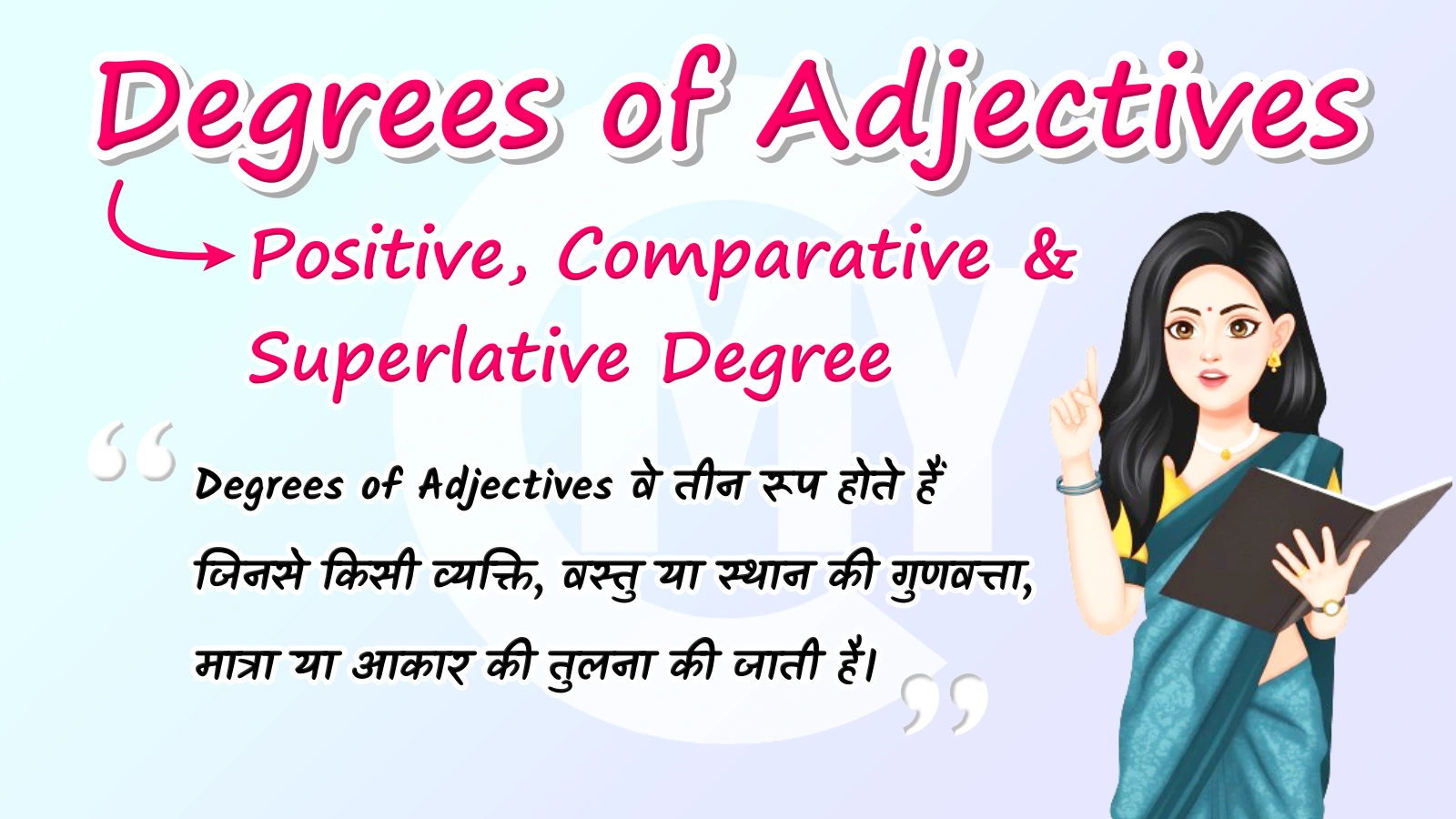
विशेषण (Adjectives) की डिग्री (Degrees of Adjectives) वे रूप होते हैं जिनका उपयोग दो या दो से अधिक संज्ञाओं (nouns) या सर्वनामों (pronouns) की विशेषताओं (qualities) की तुलना करने के लिए किया जाता है, और ये तीन प्रकार की होती हैं: Positive (मूलावस्था), Comparative (उच्चतर), और Superlative (उच्चतम), जो तुलना की अवस्था को दर्शाते हैं।
Degrees of Adjectives (विशेषण की अवस्थायें)
Degrees of Adjectives वे तीन रूप होते हैं जिनसे किसी व्यक्ति, वस्तु या स्थान की गुणवत्ता, मात्रा या आकार की तुलना की जाती है।
Degrees of adjectives refer to the different levels of comparison used to describe the intensity or quality of a noun. There are three degrees of comparison: positive, comparative, and superlative.
Types of Degrees of Adjectives
विशेषणों (Adjectives) की तुलनात्मक अवस्थायें (Degrees of comparison) तीन होती हैं-
- Positive Degree (मूल अवस्था)
- Comparative Degree (उच्चतर अवस्था)
- Superlative Degree (उच्चतम अवस्था)
Positive Degree (मूल अवस्था):
यह विशेषण का मूल रूप (base form) होता है, जो किसी व्यक्ति, वस्तु या स्थान की सामान्य विशेषता बताता है, बिना किसी तुलना के; जैसे-
The positive degree is the basic form of an adjective, without any comparison. It describes a noun without comparing it to others.
- उदाहरण: Tall, Big, Good, Fast (लंबा, बड़ा, अच्छा, तेज़)
- वाक्य:
- Mohan is a tall boy. (मोहन एक लंबा लड़का है।)
- The cat is cute.
- Mukesh is a tall boy.
- Hari is wise.
Positive Degree बिना तुलना के गुण बताता है।
Comparative Degree (उच्चतर अवस्था):
इसका उपयोग दो संज्ञाओं या सर्वनामों के बीच तुलना करने के लिए किया जाता है, जिसमें ‘से’ (than) का प्रयोग होता है। जैसे-
The comparative degree is used to compare two nouns or sets of nouns. It indicates that one noun has more or less of a quality compared to another. The comparative degree is formed by adding “-er” to shorter adjectives or by using “more” before longer adjectives.
- उदाहरण: Taller, Bigger, Better, Faster (ज़्यादा लंबा, ज़्यादा बड़ा, ज़्यादा अच्छा, ज़्यादा तेज़).
- वाक्य:
- Mohan is taller than Sohan. (मोहन, सोहन से लंबा है। )
- The cat is cuter than the dog.
- The cat is more playful than the dog.
- Mukesh is taller than Vijay.
- Hari is wiser than Prakash.
- Which of these two pens is the better?.
Superlative Degree (उच्चतम अवस्था):
इसका उपयोग दो से अधिक (समूह में) व्यक्तियों या वस्तुओं में से किसी एक की विशेषता को सबसे ज़्यादा या सबसे कम बताने के लिए किया जाता है, जिसमें ‘सबसे’ (the most/the -est) का प्रयोग होता है। जैसे-
The superlative degree is used to compare one noun or set of nouns to all others in a group. It indicates that one noun has the highest or lowest degree of a quality among all. The superlative degree is formed by adding “-est” to shorter adjectives or by using “most” before longer adjectives.
- उदाहरण: Tallest, Biggest, Best, Fastest (सबसे लंबा, सबसे बड़ा, सबसे अच्छा, सबसे तेज़).
- वाक्य:
- Mohan is the tallest boy in the class. (मोहन कक्षा का सबसे लंबा लड़का है।)
- The cat is the cutest in the neighborhood
- The cat is the most playful of all.
- Mukesh is the tallest boy in the family.
- Hari is the wisest boy in the class..
- This tree is the tallest of the three.
- This boy is the strongest in the class.
- A lion is the strongest of all the animals.
Superlative Degree तीन या अधिक में सबसे अधिक की बात करता है।
ध्यान रखें कि (Important Points to Remember):
- Positive Degree में Adjective की First form (Degree) का प्रयोग होता है।
- Comparative Degree में सामान्यतया Adjective की Second form (Degree) का प्रयोग होता है।
- Comparative (Second) Degree के Adjective के बाद Than आता है।
- Superlative Degree के Adjective से पहले The के साथ in / of आता है।
- एक वाक्य में एक ही Degree का प्रयोग होता है।
Formation of Comparative and Superlative Degrees
The comparative and superlative degrees of adjectives are formed using different patterns, depending on the length and structure of the adjective.
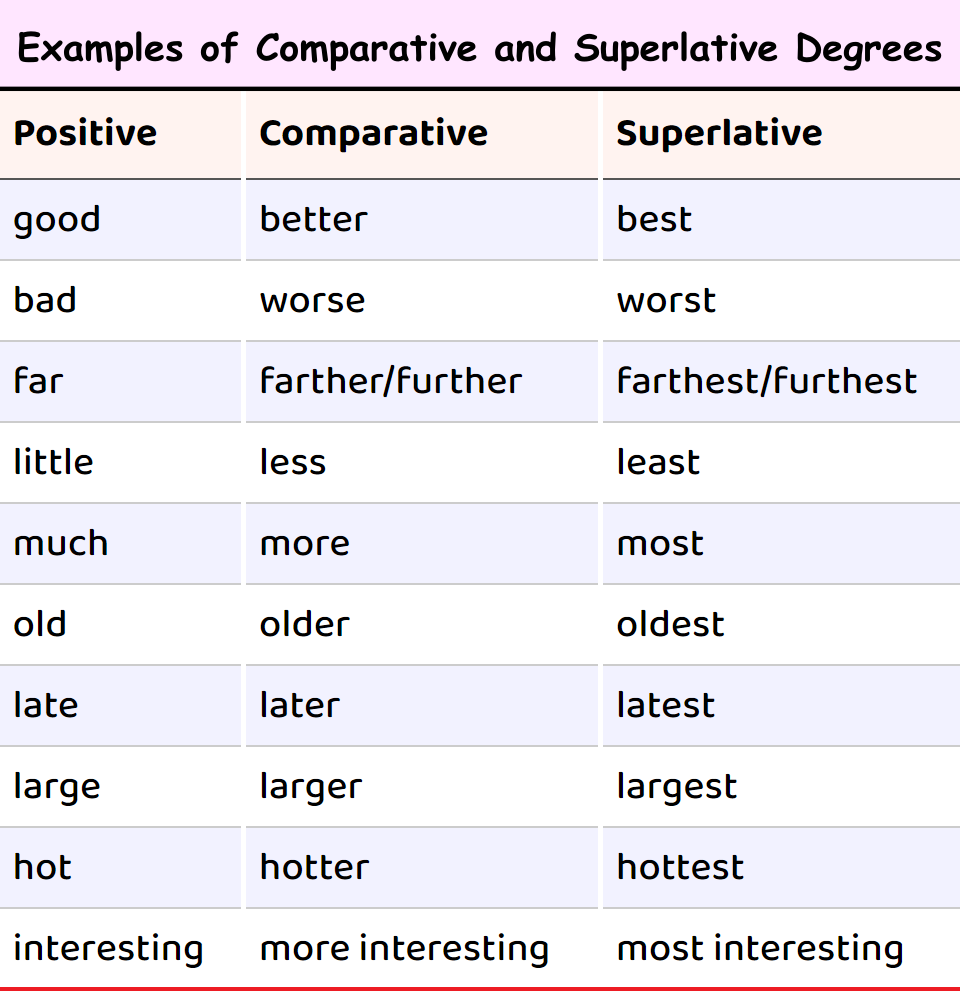
Here are the general rules for forming the comparative and superlative degrees:
Rule 1. One-syllable adjectives: Positive Degree के Adjective के बाद “er” बढ़ाने से Comparative Degree और “est” बढ़ाने से Superlative Degree के Adjective बन जाते हैं।
| Positive | Comparative | Superlative |
|---|---|---|
| tall | taller | tallest |
| fast | faster | fastest |
| large | larger | largest |
| brave | braver | bravest |
| strong | stronger | strongest |
| cold | colder | coldest |
| deep | deeper | deepest |
| great | greater | greatest |
| high | higher | highest |
| kind | kinder | kindest |
| poor | poorer | poorest |
| small | smaller | smallest |
Rule 2. One-syllable adjectives ending in “e”: यदि Positive Degree के Adjective के अंत में “e”तो Comparative Degree के अंत में “r” और Superlative Degree में “st” बढ़ाने से Adjective बन जाते हैं।
| Positive | Comparative | Superlative |
|---|---|---|
| large | larger | largest |
| fine | finer | finest |
| brave | braver | bravest |
| close | closer | closest |
| safe | safer | safest |
Rule 3. One-syllable adjectives ending “y” with a consonant before it: किसी Adjective के अंत में “y” हो और उससे पहले कोई व्यंजन हो तो “y” के स्थान पर “ier” बढ़ाने से Comparative Degree और “iest” बढ़ाने से Superlative Degree के Adjective बन जाते हैं।
| Positive | Comparative | Superlative |
|---|---|---|
| easy | easier | easiest |
| heavy | heavier | heaviest |
| merry | merrier | merriest |
| wealthy | wealthier | wealthiest |
| happy | happier | happiest |
| funny | funnier | funniest |
| pretty | prettier | prettiest |
| busy | busier | busiest |
| friendly | friendlier | friendliest |
| tidy | tidier | tidiest |
Rule 4. One-syllable adjectives ending in a single consonant with a vowel before it: किसी Adjective के अंत में व्यंजन हो और व्यंजन से पहले कोई स्वर (A, E, I, O, U) हो तो Comparative Degree में “er” और Superlative Degree में “est” बढ़ाने से पहले अंतिम व्यंजन दो बार लिखने से Adjective बन जाते हैं।
| Positive | Comparative | Superlative |
|---|---|---|
| big | bigger | biggest |
| fat | fatter | fattest |
| hot | hotter | hottest |
| red | redder | reddest |
| sad | sadder | saddest |
| wet | wetter | wettest |
Rule 5. Two or more syllable adjectives: कुछ Adjective में Comparative Degree से पहले “more” और Superlative Degree से पहले “most” का प्रयोग करते हैं।
| Positive | Comparative | Superlative |
|---|---|---|
| beautiful | more beautiful | most beautiful |
| intelligent | more intelligent | most intelligent |
| creative | more creative | most creative |
| delicious | more delicious | most delicious |
| peaceful | more peaceful | most peaceful |
| spacious | more spacious | most spacious |
| interesting | more interesting | most interesting |
| important | more important | most important |
| comfortable | more comfortable | most comfortable |
| powerful | more powerful | most powerful |
Rule 6. Irregular adjectives: कुछ Adjective के अनियमित और अतिशयोक्तिपूर्ण रूप हैं जो ऊपर उल्लिखित नियमों का पालन नहीं करते हैं। जिनके अद्वितीय रूप होते हैं जिन्हें याद ही करना पड़ता है।
| Positive | Comparative | Superlative |
|---|---|---|
| little | less | least |
| much | more | most |
| many | more | most |
| late | later | latest |
| well | better | best |
| good | better | best |
| bad | worse | worst |
| old | elder | eldest |
| old | older | oldest |
नोट:- Much का प्रयोग परिमाण (मात्रा) प्रकट करने के लिए होता है जबकि Many का प्रयोग संख्या (Number) प्रकट करने के लिए होता है; जैसे-
- I have to do much work.
- You have many friends.
- There should not be much talk and little work..
- I have taught you many things.
- There is much water in the tank.
- He made many mistakes in his essay.
Older और Oldest का प्रयोग व्यक्तियों और वस्तुओं दोनों के लिए होता है; जैसे-
- Hari is older than Majid. हरी मजीद से उम्र में बड़ा है।
- This is the oldest temple. यह मन्दिर सबसे अधिक पुराना है।
Elder और Eldest का प्रयोग एक ही परिवार के सदस्यों के लिए होता है; जैसे-
- Mira is my elder sister.
- Munish is my eldest brother.
- My elder brother is an engineer.
Elder के बाद Than नहीं आता है।
Junior, Senior, Superior, Inferior के पश्चात to का प्रयोग होता है। इनके साथ Than का प्रयोग नहीं होता है; जैसे-
- I am junior to you. मैं तुमसे छोटा हूँ।
- You are senior to me. तुम मुझसे बड़े हो ।
- This pen is inferior to yours. यह पैन तुम्हारे पैन से घटिया है।
- This model is superior to that. यह मॉडल उस मॉडल से बढ़िया है।
Changing Degrees of Adjectives
Changing Degrees का मतलब है कि एक ही Degree को Positive से Comparative से Superlative या किसी भी degree में बदला जाए, जबकि वाक्य का अर्थ (meaning) बदले बिना।
बदलने के नियम:
- Comparative में than
- Superlative में the + in / of
- “No other” हमेशा Positive degree में आता है
- Degree change में tense same रहना चाहिए
1. Positive से Comparative में बदलना
- Positive: No other + noun + is/was + as + adjective + as + subject
- Comparative: Subject + is/was + adjective-er / more + adjective + than + any other + noun
For Example:
- No other boy is as tall as Ram.
→ Ram is taller than any other boy. - No other boy is as brave as Ram.
→ Ram is braver than any other boy. - No other city is as clean as Chandigarh.
→ Chandigarh is cleaner than any other city. - No other animal is as fast as the cheetah.
→ The cheetah is faster than any other animal. - No other girl was as intelligent as Sita.
→ Sita was more intelligent than any other girl.
2. Positive से Superlative में बदलना
- Positive: No other + noun + is/was + as + adjective + as + subject
- Superlative: Subject + is/was + the + adjective-est / most + adjective + noun
For Example:
- No other city is as big as Delhi.
→ Delhi is the biggest city. - No other boy is as tall as Rohit.
→ Rohit is the tallest boy. - No other flower is as beautiful as the rose.
→ The rose is the most beautiful flower. - No other metal is as useful as iron.
→ Iron is the most useful metal. - No other student was as hardworking as Meena.
→ Meena was the most hardworking student.
3. Comparative से Positive में बदलना
- Comparative: Subject + is/was + adjective-er / more + adjective + than + any other + noun
- Positive: No other + noun + is/was + as + adjective + as + subject
For Example:
- Ram is stronger than any other boy.
→ No other boy is as strong as Ram. - Rahul is taller than any other boy.
→ No other boy is as tall as Rahul. - This story is more interesting than any other story.
→ No other story is as interesting as this story. - Gold is costlier than any other metal.
→ No other metal is as costly as gold. - English is easier than any other subject.
→ No other subject is as easy as English.
4. Comparative से Superlative में बदलना
- Comparative: Subject + is/was + adjective-er / more + adjective + than + all other + noun
- Superlative: Subject + is/was + the + adjective-est / most + adjective + noun
For Example:
- This book is better than all other books.
→ This book is the best book. - Raman is taller than all other boys in the class.
→ Raman is the tallest boy in the class. - This road is longer than all other roads.
→ This road is the longest road. - She is more intelligent than all other girls.
→ She is the most intelligent girl. - Winter is colder than all other seasons.
→ Winter is the coldest season.
5. Superlative से Comparative में बदलना
- Superlative: Subject + is/was + the + adjective-est / most + adjective + noun
- Comparative: Subject + is/was + adjective-er / more + adjective + than + any other + noun
For Example:
- Raman is the tallest boy in the class.
→ Raman is taller than any other boy in the class. - Sachin is the best player in the team.
→ Sachin is better than any other player in the team. - This is the highest building in the city.
→ This is higher than any other building in the city. - She is the most intelligent student.
→ She is more intelligent than any other student. - Iron is the strongest metal.
→ Iron is stronger than any other metal.
6. Superlative से Positive में बदलना
- Superlative: Subject + is/was + the + adjective-est / most + adjective + noun
- Positive: No other + noun + is/was + as + adjective + as + subject
For Example:
- Mount Everest is the highest mountain.
→ No other mountain is as high as Mount Everest. - Mount Everest is the highest mountain.
→ No other mountain is as high as Mount Everest. - Kalidas was the greatest poet.
→ No other poet was as great as Kalidas. - This is the best book in the library.
→ No other book is as good as this book. - She was the most beautiful actress.
→ No other actress was as beautiful as she.
FAQs
What are the degrees (forms) of adjectives?
1. Positive Degree – simple form (no comparison)
2. Comparative Degree – comparison between two
3. Superlative Degree – comparison among more than two
When do we use the comparative degree?
• Ram is taller than Mohan.
• This book is better than that one.
When do we use the superlative degree?
• She is the most intelligent girl in the class.
• Mount Everest is the highest mountain.
Can all adjectives take “-er” and “-est”?
Short adjectives take -er / -est
• Tall → Taller → Tallest
Long adjectives use more / most
• Beautiful → More beautiful → Most beautiful
Some adjectives are irregular
• Good → Better → Best