

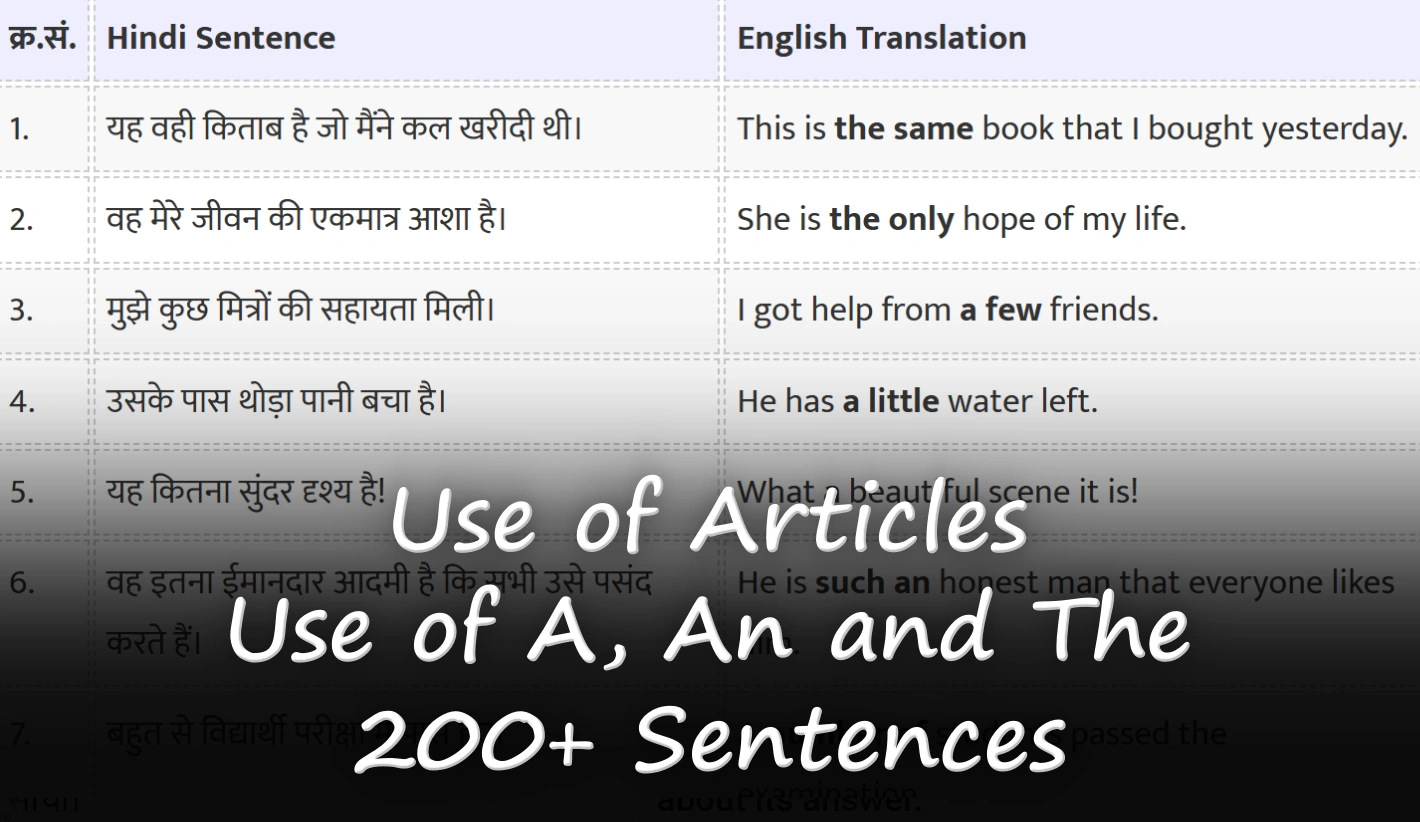
ARTICLES (आर्टिकल्स): A, An and The
Articles वे छोटे शब्द हैं जो noun (संज्ञा) से पहले लगाए जाते हैं ताकि यह बताया जा सके कि हम किस व्यक्ति या वस्तु की बात कर रहे हैं- किसी विशेष (specific) या अविशेष (general) वस्तु की। सरल शब्दों में- “Articles वे शब्द हैं जो noun से पहले लगाकर उस noun का अर्थ स्पष्ट करते हैं।”
Kinds of Articles (आर्टिकल्स के प्रकार)
अंग्रेजी भाषा में कुल तीन Articles- A, An और The है। “A, An” Indefinite Articles है। “The” Definite Article है।
| प्रकार | Articles | अर्थ |
|---|---|---|
| Indefinite Articles | A / An | किसी अविशिष्ट (non-specific) व्यक्ति या वस्तु के लिए |
| Definite Article | The | किसी विशिष्ट (specific) व्यक्ति या वस्तु के लिए |
1. Indefinite Articles – ‘A’ और ‘An’
‘A’ और ‘An’ का प्रयोग किसी एक व्यक्ति या वस्तु के लिए किया जाता है, जब वह वस्तु पहली बार बताई जा रही हो या सामान्य रूप से बात हो रही हो।
| Article | Use Before | Examples |
|---|---|---|
| A | Consonant sound (व्यंजन ध्वनि) | a boy, a pen, a dog, a car |
| An | Vowel sound (स्वर ध्वनि – a, e, i, o, u) | an apple, an egg, an umbrella, an honest man |
Note: “Sound” (ध्वनि) को देखना ज़रूरी है, spelling नहीं।
जैसे — an hour (क्योंकि ‘h’ मूक है → ‘our’ sound आता है)।
लेकिन a university (क्योंकि ‘u’ की ध्वनि ‘yu’ है)।
Examples of Uses of ‘A, An’::
| Hindi Sentence | English Sentence |
|---|---|
| मेरे पास एक किताब है। | I have a book. |
| वह एक ईमानदार आदमी है। | He is an honest man. |
| मैंने एक सेब खाया। | I ate an apple. |
| वह एक डॉक्टर है। | He is a doctor. |
| उसने एक नया पेन खरीदा। | He bought a new pen. |
2. Definite Article – ‘The’
‘The’ का प्रयोग तब किया जाता है जब किसी विशिष्ट व्यक्ति, वस्तु, स्थान, या चीज़ की बात हो, जिसे बोलने वाला और सुनने वाला दोनों जानते हों।
Examples of Uses of ‘The’:
| Use | Examples (English) | Meaning (Hindi) |
|---|---|---|
| किसी विशेष वस्तु के लिए | The book on the table is mine. | मेज़ पर रखी किताब मेरी है। |
| नदी, समुद्र, पहाड़, पर्वत आदि के नाम से पहले | The Ganga, The Pacific Ocean, The Himalayas | गंगा, प्रशांत महासागर, हिमालय |
| समाचार पत्र, प्रसिद्ध इमारतों, पवित्र पुस्तकों आदि के नाम से पहले | The Times of India, The Taj Mahal, The Bible | टाइम्स ऑफ इंडिया, ताजमहल, बाइबिल |
| जब कोई वस्तु केवल एक ही हो | The sun, The moon, The earth | सूर्य, चंद्रमा, पृथ्वी |
| दिशा के नाम से पहले | The East, The West, The North, The South | पूर्व, पश्चिम, उत्तर, दक्षिण |
| किसी समूह या समुदाय के लिए | The rich, The poor, The blind | अमीर लोग, गरीब लोग, अंधे लोग |
| क्रम संख्या (ordinal numbers) से पहले | The first, The second, The last | पहला, दूसरा, अंतिम |
| वाद्य यंत्रों के नाम से पहले | He plays the guitar. | वह गिटार बजाता है। |
| “Only” के साथ noun के पहले | The only girl in the class is Meena. | कक्षा में एकमात्र लड़की मीना है। |
No Article (जब Article नहीं लगता):
| Case | Examples (English) | Meaning (Hindi) |
|---|---|---|
| सामान्य नामों से पहले | Man is mortal. | मनुष्य नश्वर है। |
| भाषाओं, खेलों, भोजन के नाम से पहले | I play cricket. / I like tea. | मैं क्रिकेट खेलता हूँ। / मुझे चाय पसंद है। |
| Proper noun (व्यक्तिवाचक संज्ञा) के पहले | India is a large country. | भारत एक बड़ा देश है। |
| Months, Days, Seasons के पहले | January is cold. / Sunday is a holiday. | जनवरी ठंडी होती है। / रविवार छुट्टी का दिन है। |
Practice Questions – Fill in the blanks:
- ___ apple a day keeps ___ doctor away.
- She is ___ honest girl.
- I saw ___ moon last night.
- ___ Ganga is a holy river.
- He bought ___ car yesterday.
Answers:
- An, the
- an
- the
- The
- a
Examples of Translation, Hindi to English
1. सावित्री के पास एक पैन है।
Savitri has a pen.
2. मीरा के पास एक छाता है।
Mira has an umbrella.
3. मैंने सर्कस में एक हाथी देखा।
I saw an elephant in the circus.
4. जयपाल एक ईमानदार व्यक्ति है।
Jaipal is an honest man.
5. रामसिंह बेईमान व्यक्ति था।
Ram Singh was a dishonest man.
6. सूर्य पश्चिम में अस्त होता है।
The sun sets in the west.
7. मुकेश मेरे परिवार में सबसे अधिक लम्बा लड़का है।
Mukesh is the tallest boy in my family.
8. गरीबों का अपमान मत करो।
Do not insult the poor.
9. कालिदास भारत के शेक्सपियर थे।
Kalidas was the Shakespeare of India.
10. जितना अधिक तुम खाओगे, उतने ही अधिक तुम मोटे होगे।
The more you eat, the fatter you become.
अनुवाद के नियम
A और An का प्रयोग Indefinite Article की तरह होता है और The का प्रयोग Definite Article की तरह होता है। Examples: A pen, An apple, The sun, The Ganga
A का अर्थ है-कोई एक या एक। यह एकवचन (Singular Number) की जातिवाचक संज्ञा (Common Noun) से पहले आता है; जैसे– A boy, A girl, A pen, A horse, A chair, A table आदि। Examples: A dog is barking. / He bought a book.
A के प्रयोग के लिए यह आवश्यक है कि उसके पश्चात आने वाले Noun या Adjective का पहला अक्षर व्यंजन (Consonant) हो, अर्थात A, E, I, O, U (Vowels) में से कोई न हो। Examples: A car, A doctor, A university, A useful tool.
All का अर्थ भी कोई एक या एक है। इसका प्रयोग ऐसे Noun (संज्ञा) या Adjective (विशेषण) के पहले किया जाता है जिसका पहला अक्षर स्वर (Vowel) हो अर्थात A, E, I, O, U में से कोई एक हो। Examples: An apple, An orange, An elephant, An umbrella.
यदि कोई शब्द h से आरम्भ हो और h न बोला जाये तो ऐसे शब्द या Noun से पहले भी An का प्रयोग होता है। Examples: An hour, An honest man, An heir to the throne.
नदियों, खाड़ियों, द्वीप समूहों, समुद्रों, सूर्य, चाँद, आकाश, पृथ्वी और दिशाओं से पहले The आता है। Examples: The Ganga, The Pacific Ocean, The Himalayas, The Sun, The Moon, The Earth, The East.
Superlative Degree के Adjective से पहले The आता है। Examples: The best student, The most beautiful place, The tallest building.
जब किसी Adjective का प्रयोग Noun की तरह हो तो ऐसे Adjective से पहले The का प्रयोग होता है। जैसे- The poor = गरीब लोग, The rich = अमीर लोग, The weak = कमजोर व्यक्तियों आदि। Examples: The poor need help. / The rich should help the needy.
सामान्यतः Proper Noun से पहले किसी भी Article का प्रयोग नहीं होता है परन्तु कभी-कभी Proper Noun से पहले भी The का प्रयोग हो जाता है। ऐसे प्रयोग में Proper Noun का प्रयोग Common Noun की तरह होता है; जैसे- Kalidas was the Shakespeare of India. (the Shakespeare the greatest dramatist). Examples: The Gita, The Ramayana, The Himalayas, The Sahara Desert.
‘जितना…..उतना’ के वाक्यों में दो बार the (the…..the) का प्रयोग किया जाता है। प्रत्येक the के पश्चात Comparative Degree का Adjective प्रयुक्त होता है। Examples: The more you study, the more you learn. / The higher you go, the cooler it becomes.
EXERCISE 1. Translate the following sentences into English:
| क्र.सं. | Hindi Sentence | English Translation |
|---|---|---|
| 1. | तुम्हारे पास एक स्कूटर है। | You have a scooter. |
| 2. | उसके पास एक पुराना छाता है। | He has an old umbrella. |
| 3. | गुप्ताजी का सबसे छोटा पुत्र मुकेश एक ईमानदार इंजीनियर है। | Mr. Gupta’s youngest son, Mukesh, is an honest engineer. |
| 4. | अकबर बहुत अच्छा बादशाह था। | Akbar was a very good emperor. |
| 5. | क्या उसने कभी हाथी देखा है? | Has he ever seen an elephant? |
| 6. | क्या तुमने सफेद शेर देखा है? | Have you seen a white lion? |
| 7. | सूर्य पृथ्वी से बहुत अधिक बड़ा है। | The sun is much bigger than the earth. |
| 8. | आकाश में तारे चमका करते हैं। | Stars used to shine in the sky. |
| 9. | आकाश में तारे चमकते हैं। | Stars shine in the sky. |
| 10. | महेश मेरे परिवार में सबसे अधिक निर्धन व्यक्ति है। | Mahesh is the poorest person in my family. |
| 11. | मूर्खता के कारण तुम्हारी दशा दयनीय है। | Your condition is miserable because of your foolishness. |
| 12. | जितना दूध तुम पिओगे, उतने ही अधिक शक्तिशाली बनोगे। | The more milk you drink, the stronger you will become. |
| 13. | मेरी सर्वोत्तम पेय कॉफी है। | My best drink is coffee. |
| 14. | क्या तुम्हारा भाई विश्वविद्यालय में पढ़ता है? | Does your brother study at the university? |
| 15. | राष्ट्रपति लिंकन एक अमरीकन नागरिक थे। | President Lincoln was an American citizen. |
| 16. | क्या उसके पास इस समय एक रुपये का नोट है? | Does he have a one-rupee note at this time? |
| 17. | अंग्रेजी अंग्रेजों की भाषा है। | English is the language of the English. |
| 18. | डॉक्टर जॉन्सन यूरोपियन थे। | Dr. Johnson was a European. |
| 19. | कृपया शीघ्र ही एक मनोरंजक कहानी सुनाइये। | Please tell an interesting story soon. |
| 20. | प्रायः धनी व्यक्ति अभिमानी होते हैं। | Rich people are usually proud. |
| 21. | निर्धन व्यक्ति निराश होता है। | A poor man is often hopeless. |
| 22. | उर्दू भारत की एक लोकप्रिय भाषा है। | Urdu is a popular language of India. |
| 23. | कानपुर भारत का मानचेस्टर माना जाता है। | Kanpur is regarded as the Manchester of India. |
| 24. | अब आकाश साफ है। | The sky is clear now. |
| 25. | कालिदास भारत के शेक्सपियर थे। | Kalidas was the Shakespeare of India. |
| 26. | समुद्रगुप्त फ्रांस सम्राट नेपोलियन से कहीं अधिक वीर थे। | Samudragupta was much braver than the French emperor Napoleon. |
Difficult words: स्कूटर scooter; इंजीनियर = engineer; निर्धन poor; शक्तिशाली = strong, powerful; पेय drink; विश्वविद्यालय = university; एक रुपये का नोट = one rupee note; अंग्रेजों = the English; यूरोपियन European; मनोरंजक = interesting; प्रायः = often; निराश = dejected; लोकप्रिय = popular, भाषा = language; नेपोलियन = Napoleon; शेक्सपियर = Shakespeare; धनी व्यक्ति = the rich.
EXERCISE 2. Translate the following sentences into English:
| क्र.सं. | Hindi Sentence | English Translation |
|---|---|---|
| 1. | मेरे पास एक किताब है। | I have a book. |
| 2. | वह एक अच्छा लड़का है। | He is a good boy. |
| 3. | वह एक ईमानदार व्यक्ति है। | He is an honest man. |
| 4. | मैंने एक सेब खाया। | I ate an apple. |
| 5. | उसने एक पेन खरीदी। | He bought a pen. |
| 6. | उसने एक घंटे तक प्रतीक्षा की। | He waited for an hour. |
| 7. | मैं एक इंजीनियर हूँ। | I am an engineer. |
| 8. | वह एक डॉक्टर है। | She is a doctor. |
| 9. | मेरे पास एक पुरानी कार है। | I have an old car. |
| 10. | यह एक सुंदर फूल है। | This is a beautiful flower. |
| 11. | वह एक गरीब आदमी है। | He is a poor man. |
| 12. | यह एक अद्भुत कहानी है। | This is an amazing story. |
| 13. | मेरे पास एक कुत्ता है। | I have a dog. |
| 14. | उसने एक पत्र लिखा। | He wrote a letter. |
| 15. | वह एक ऊँचा पहाड़ है। | It is a high mountain. |
| 16. | वह एक बहादुर सैनिक था। | He was a brave soldier. |
| 17. | मुझे एक अवसर दीजिए। | Give me an opportunity. |
| 18. | यह एक बड़ा कमरा है। | This is a big room. |
| 19. | वह एक उपयोगी वस्तु है। | It is a useful thing. |
| 20. | वह एक यूरोपियन है। | He is a European. |
| 21. | यह एक नया विचार है। | This is a new idea. |
| 22. | वह एक अच्छा शिक्षक है। | He is a good teacher. |
| 23. | उसने एक सवाल पूछा। | He asked a question. |
| 24. | उसने एक उत्तर दिया। | She gave an answer. |
| 25. | क्या आपके पास एक छाता है? | Do you have an umbrella? |
| 26. | मैंने एक पक्षी देखा। | I saw a bird. |
| 27. | यह एक छोटी नदी है। | This is a small river. |
| 28. | वह एक महान राजा था। | He was a great king. |
| 29. | यह एक सुंदर चित्र है। | It is a beautiful picture. |
| 30. | वह एक संगीतकार है। | He is a musician. |
| 31. | सूरज पूर्व से उगता है। | The sun rises in the east. |
| 32. | चाँद रात में चमकता है। | The moon shines at night. |
| 33. | पृथ्वी सूर्य की परिक्रमा करती है। | The earth revolves around the sun. |
| 34. | गंगा भारत की पवित्र नदी है। | The Ganga is a holy river of India. |
| 35. | हिमालय भारत का सबसे ऊँचा पर्वत है। | The Himalayas are the highest mountains in India. |
| 36. | बच्चे आकाश में सितारे देख रहे हैं। | The children are watching the stars in the sky. |
| 37. | यह सबसे अच्छा समाधान है। | This is the best solution. |
| 38. | वह सबसे समझदार छात्र है। | He is the most intelligent student. |
| 39. | गरीबों की सहायता करो। | Help the poor. |
| 40. | अमीर लोग दान करते हैं। | The rich donate money. |
| 41. | कमजोरों को सहारा दो। | Support the weak. |
| 42. | सत्य सबसे अच्छी नीति है। | Honesty is the best policy. |
| 43. | वह भारत का नेपोलियन कहलाता था। | He was the Napoleon of India. |
| 44. | जितना अधिक पढ़ोगे, उतना अधिक सीखोगे। | The more you study, the more you learn. |
| 45. | जितनी तेजी से चलोगे, उतनी जल्दी पहुँचोगे। | The faster you walk, the sooner you will reach. |
| 46. | बच्चे पार्क में खेल रहे हैं। | The children are playing in the park. |
| 47. | लड़का मैदान में दौड़ रहा है। | The boy is running in the field. |
| 48. | शिक्षक कक्षा में हैं। | The teacher is in the classroom. |
| 49. | बिल्ली मेज़ पर बैठी है। | The cat is sitting on the table. |
| 50. | भारत एशिया का एक देश है। | India is a country in Asia. |
EXERCISE 3. Translate the following sentences into English:
Articles जिनमें the same, the only, a few, a little, such a, many a आदि विशेष प्रयोग शामिल हैं-
| क्र.सं. | Hindi Sentence | English Translation |
|---|---|---|
| 1. | यह वही किताब है जो मैंने कल खरीदी थी। | This is the same book that I bought yesterday. |
| 2. | वह मेरे जीवन की एकमात्र आशा है। | She is the only hope of my life. |
| 3. | मुझे कुछ मित्रों की सहायता मिली। | I got help from a few friends. |
| 4. | उसके पास थोड़ा पानी बचा है। | He has a little water left. |
| 5. | यह कितना सुंदर दृश्य है! | What a beautiful scene it is! |
| 6. | वह इतना ईमानदार आदमी है कि सभी उसे पसंद करते हैं। | He is such an honest man that everyone likes him. |
| 7. | बहुत से विद्यार्थी परीक्षा में पास हुए। | A number of students passed the examination. |
| 8. | मैंने कई बार उसे चेतावनी दी है। | I have warned him many a time. |
| 9. | यह एक असामान्य घटना थी। | It was an unusual incident. |
| 10. | आज का दिन बहुत ठंडा है। | It is a very cold day today. |
| 11. | वह वही व्यक्ति है जिसने तुम्हारी मदद की थी। | He is the same person who helped you. |
| 12. | यह मेरे जीवन का सबसे अच्छा अनुभव था। | It was the best experience of my life. |
| 13. | उस दिन सूरज तेज़ चमक रहा था। | The sun was shining brightly that day. |
| 14. | बच्चे पार्क में खेल रहे हैं। | The children are playing in the park. |
| 15. | क्या तुमने वह पत्र पढ़ा? | Did you read the letter? |
| 16. | उस आदमी के पास एक नया विचार है। | That man has a new idea. |
| 17. | मेरे पास एक पुरानी कार थी, लेकिन अब नहीं है। | I had an old car, but not now. |
| 18. | उसने एक ईमानदार जीवन जिया। | He lived an honest life. |
| 19. | उस शिक्षक ने बहुत सी किताबें लिखीं। | The teacher wrote a number of books. |
| 20. | यह एक आसान सवाल है। | This is an easy question. |
| 21. | वह सबसे अच्छा खिलाड़ी है। | He is the best player. |
| 22. | मैं एक बहुत बड़ी गलती कर चुका हूँ। | I have made a very big mistake. |
| 23. | वहाँ कुछ छात्र हैं जो अंग्रेजी बोल सकते हैं। | There are a few students who can speak English. |
| 24. | उसके पास थोड़ा दूध है। | He has a little milk. |
| 25. | तुम्हारे पास बहुत कम समय है। | You have little time. |
| 26. | मेरे पास कुछ दोस्त हैं जिन पर मैं भरोसा कर सकता हूँ। | I have a few friends I can trust. |
| 27. | यह दुनिया का सबसे ऊँचा पर्वत है। | This is the highest mountain in the world. |
| 28. | वह लड़की सबसे सुंदर है। | She is the most beautiful girl. |
| 29. | वह कक्षा का सबसे बुद्धिमान छात्र है। | He is the most intelligent student in the class. |
| 30. | कृपया वह खिड़की खोलिए। | Please open the window. |
| 31. | मैंने एक रुपये का सिक्का पाया। | I found a one-rupee coin. |
| 32. | वह सबसे प्रसिद्ध वैज्ञानिक है। | He is the most famous scientist. |
| 33. | यह वही लड़का है जिसने कल फोन किया था। | This is the same boy who called yesterday. |
| 34. | उसने एक प्याला चाय पी। | He drank a cup of tea. |
| 35. | वह एक महत्वपूर्ण निर्णय था। | It was an important decision. |
| 36. | यह एक शानदार अवसर है। | This is a wonderful opportunity. |
| 37. | वह भारत का गांधी कहलाता है। | He is the Gandhi of India. |
| 38. | जितना जल्दी तुम जाओगे, उतना अच्छा रहेगा। | The sooner you go, the better it will be. |
| 39. | जितना अधिक पढ़ोगे, उतना अधिक जानोगे। | The more you read, the more you will know. |
| 40. | वह गरीबों की मदद करता है। | He helps the poor. |
| 41. | अमीर लोग हमेशा खुश नहीं होते। | The rich are not always happy. |
| 42. | कमजोरों को सुरक्षा की आवश्यकता होती है। | The weak need protection. |
| 43. | यह एक ऐतिहासिक स्थान है। | This is a historical place. |
| 44. | वह वही कार है जो मैंने देखी थी। | That is the same car I saw. |
| 45. | यह एक आसान काम नहीं है। | This is not an easy task. |
| 46. | यह उस दिन की सबसे बड़ी खबर थी। | It was the biggest news of the day. |
| 47. | वह मेरे जीवन का सबसे बुरा समय था। | That was the worst time of my life. |
| 48. | तुम्हारे पास एक अच्छा मौका है। | You have a good chance. |
| 49. | यह एक प्रसिद्ध कहानी है। | It is a famous story. |
| 50. | यह वह उत्तर है जिसकी मुझे तलाश थी। | This is the answer I was looking for. |
EXERCISE 4. Translate the following sentences into English:
Idiomatic Uses of Articles (A, An, The)” के साथ 50 उपयोगी वाक्य (हिन्दी + अंग्रेज़ी)। इन वाक्यों में “A”, “An” और “The” का प्रयोग मुहावरेदार (idiomatic) रूप में हुआ है-
| क्र.सं. | Hindi Sentence | English Translation |
|---|---|---|
| 1. | वह जल्दी में है। | He is in a hurry. |
| 2. | उसने एक बार फिर कोशिश की। | He tried once again. |
| 3. | मैं जल्दी में घर से निकला। | I left home in a hurry. |
| 4. | वह सुबह में आता है। | He comes in the morning. |
| 5. | मैं दोपहर में आराम करता हूँ। | I rest in the afternoon. |
| 6. | वे शाम में टहलने जाते हैं। | They go for a walk in the evening. |
| 7. | मैं अंत में सच्चाई जान गया। | I came to know the truth in the end. |
| 8. | उसने बैठक के अंत में बात की। | He spoke at the end of the meeting. |
| 9. | उन्होंने एक बैठक की। | They had a meeting. |
| 10. | उसने मुझे एक कॉल किया। | He gave me a call. |
| 11. | हम सभी ने एक पार्टी की। | We had a party. |
| 12. | उसने पूरी रात जागकर काम किया। | He worked the whole night. |
| 13. | पूरी कहानी बहुत रोचक है। | The whole story is very interesting. |
| 14. | मैंने पहली बार लंदन देखा। | I saw London for the first time. |
| 15. | वह आखिरी बार मुझसे मिला था। | He met me for the last time. |
| 16. | यह मेरा पहला अनुभव था। | It was a first experience for me. |
| 17. | यह मेरे लिए एक झटका था। | It was a shock to me. |
| 18. | उसने एक गलती की। | He made a mistake. |
| 19. | यह एक रहस्य है। | It is a secret. |
| 20. | उसने अंधेरे में रास्ता खोजा। | He found the way in the dark. |
| 21. | वे प्रकाश में पढ़ रहे हैं। | They are reading in the light. |
| 22. | वह काम के बीच में था। | He was in the middle of the work. |
| 23. | उसने अचानक हँसना शुरू कर दिया। | He burst out laughing all of a sudden. |
| 24. | वह एक दिन में लौट आएगा। | He will return in a day. |
| 25. | उसने एक घंटे में यह कार्य पूरा किया। | He completed the work in an hour. |
| 26. | उन्होंने पूरा प्रयास किया। | They made the best effort. |
| 27. | यह मेरे जीवन का सबसे अच्छा दिन है। | This is the best day of my life. |
| 28. | वे एक होटल में ठहरे हुए हैं। | They are staying in a hotel. |
| 29. | वह रेलवे स्टेशन पर है। | He is at the railway station. |
| 30. | वह बस स्टॉप पर खड़ा है। | He is at the bus stop. |
| 31. | वह डॉक्टर के पास गया। | He went to the doctor. |
| 32. | यह सबसे खराब समय था। | It was the worst time. |
| 33. | यह एक कठिन प्रश्न है। | This is a difficult question. |
| 34. | उसने अचानक उत्तर दिया। | He answered at a moment’s notice. |
| 35. | मैं एक बार वहाँ गया था। | I went there once upon a time. |
| 36. | उसने जल्दी में फैसला किया। | He decided in a hurry. |
| 37. | यह एक सुंदर दिन था। | It was a beautiful day. |
| 38. | यह एक दुर्लभ अवसर है। | This is a rare opportunity. |
| 39. | यह भारत की राजधानी है। | This is the capital of India. |
| 40. | बच्चे बगीचे में खेल रहे हैं। | The children are playing in the garden. |
| 41. | मैंने पहली बार विमान में यात्रा की। | I traveled by plane for the first time. |
| 42. | वह एक अच्छा विचार था। | That was a good idea. |
| 43. | उसने एक लंबी कहानी सुनाई। | He told a long story. |
| 44. | यह एक कठिन परिस्थिति है। | This is a difficult situation. |
| 45. | उसने सच्चाई के लिए लड़ाई लड़ी। | He fought for the truth. |
| 46. | मैं सिनेमा देखने जा रहा हूँ। | I am going to the cinema. |
| 47. | उसने रेस्तराँ में खाना खाया। | He ate food at the restaurant. |
| 48. | वह ट्रेन से गया। | He went by the train. |
| 49. | यह शहर के बीचोंबीच है। | It is in the heart of the city. |
| 50. | मैं आम तौर पर जल्दी उठता हूँ। | I usually get up in the morning. |
EXERCISE 5. Translate the following sentences into English:
Articles with Common Expressions” (A, An, The) के साथ 50 उपयोगी वाक्य (हिन्दी + अंग्रेज़ी)–
| क्र.सं. | Hindi Sentence | English Translation |
|---|---|---|
| 1. | वह परेशानी में है। | He is in a fix. |
| 2. | उसने गुस्से में बोल दिया। | He spoke in a rage. |
| 3. | मुझे एक नज़र देखने दो। | Let me have a look. |
| 4. | उसने ज़ोर से आवाज़ की। | He made a noise. |
| 5. | मैं आदत से जल्दी उठता हूँ। | I am in the habit of getting up early. |
| 6. | उसने एक कोशिश की। | He made a try. |
| 7. | उसने सच्चाई बताई। | He told the truth. |
| 8. | उसने झूठ बोला। | He told a lie. |
| 9. | उसने मुझसे सलाह ली। | He took advice (❌ not an advice) — advice is uncountable. |
| 10. | उसने एक सुझाव दिया। | He gave a suggestion. |
| 11. | उसने एक गलती की। | He made a mistake. |
| 12. | उसने एक योजना बनाई। | He made a plan. |
| 13. | उसने गाना गाया। | He sang a song. |
| 14. | मुझे एक कहानी सुनाओ। | Tell me a story. |
| 15. | यह एक अच्छी आदत है। | It is a good habit. |
| 16. | यह मेरे जीवन का सबसे अच्छा समय था। | It was the best time of my life. |
| 17. | वह एक महान आदमी था। | He was a great man. |
| 18. | यह एक अद्भुत दृश्य है। | This is a wonderful sight. |
| 19. | उसने मेरी मदद की। | He lent me a hand. |
| 20. | मैंने उससे एक प्रश्न पूछा। | I asked him a question. |
| 21. | यह मेरे जीवन का एक नया अध्याय है। | This is a new chapter of my life. |
| 22. | वह अचानक रोने लगा। | He began to cry all of a sudden. |
| 23. | वह एक सम्मानित व्यक्ति है। | He is a respected man. |
| 24. | वह बहुत ही विनम्र व्यक्ति है। | He is a polite man. |
| 25. | यह एक कठिन कार्य है। | It is a difficult task. |
| 26. | उसने एक बुरा काम किया। | He did a bad deed. |
| 27. | उसने मेरे लिए एक पत्र लिखा। | He wrote a letter for me. |
| 28. | यह एक मीठा फल है। | It is a sweet fruit. |
| 29. | वह ईमानदारी का व्यक्ति है। | He is a man of honesty. |
| 30. | यह एक पुराना महल है। | It is an old palace. |
| 31. | वह एक ईमानदार अधिकारी है। | He is an honest officer. |
| 32. | उसने मुझे एक अवसर दिया। | He gave me an opportunity. |
| 33. | यह एक बहुत ही उपयोगी वस्तु है। | It is a very useful thing. |
| 34. | यह मेरे जीवन का एक सुनहरा अवसर है। | It is a golden opportunity of my life. |
| 35. | वह बहुत ही महत्वाकांक्षी लड़की है। | She is an ambitious girl. |
| 36. | मैं इस शहर में एक डॉक्टर को जानता हूँ। | I know a doctor in this city. |
| 37. | वह संगीत की दुनिया में एक नाम है। | He is a name in the world of music. |
| 38. | वह इस टीम का सर्वश्रेष्ठ खिलाड़ी है। | He is the best player of this team. |
| 39. | उसने पूरे मन से प्रयास किया। | He made the best effort. |
| 40. | वह मेरे परिवार का एक सदस्य है। | He is a member of my family. |
| 41. | उसने अपना कर्तव्य निभाया। | He did his duty (❌ not a duty). |
| 42. | यह एक आसान प्रश्न है। | It is an easy question. |
| 43. | यह एक कठिनाई है। | It is a difficulty. |
| 44. | वह बहुत चालाक व्यक्ति है। | He is a clever man. |
| 45. | यह एक गंभीर मामला है। | It is a serious matter. |
| 46. | उसने एक दिलचस्प बात कही। | He said an interesting thing. |
| 47. | यह एक सुखद अनुभव था। | It was a pleasant experience. |
| 48. | वह एक प्रसिद्ध वैज्ञानिक था। | He was a famous scientist. |
| 49. | यह एक मूल्यवान पुस्तक है। | It is a valuable book. |
| 50. | वह हमारे देश का सबसे बड़ा नेता था। | He was the greatest leader of our country. |
Omission of Articles – जहाँ Articles का प्रयोग नहीं किया जाता
1. Proper Nouns (व्यक्तिवाचक संज्ञा) से पहले ‘A / An / The’ नहीं लगता।
1. राम ईमानदार है। → Ram is honest.
2. दिल्ली भारत की राजधानी है। → Delhi is the capital of India.
3. नेहरू महान नेता थे। → Nehru was a great leader.
2. Abstract Nouns (भाववाचक संज्ञा) जब सामान्य रूप में हों, तब Article नहीं लगता।
4. ईमानदारी सबसे अच्छी नीति है। → Honesty is the best policy.
5. ज्ञान शक्ति है। → Knowledge is power.
6. सत्य अमर है। → Truth is immortal.
3. Material Nouns (पदार्थवाचक संज्ञा) के पहले भी Article नहीं लगता।
7. सोना बहुमूल्य धातु है। → Gold is a precious metal.
8. पानी जीवन के लिए आवश्यक है। → Water is essential for life.
9. दूध बच्चों के लिए अच्छा है। → Milk is good for children.
4. Languages, Subjects, Sports आदि के पहले ‘The’ नहीं लगता।
10. वह अंग्रेजी सीखता है। → He learns English.
11. मैं गणित पढ़ता हूँ। → I study Mathematics.
12. हम क्रिकेट खेलते हैं। → We play cricket.
5. Meals (Breakfast, Lunch, Dinner) के पहले Article नहीं लगता।
13. हमने नाश्ता किया। → We had breakfast.
14. वह रात का खाना खा रहा है। → He is having dinner.
15. मैं दोपहर का भोजन नहीं करता। → I never take lunch.
6. Diseases (बीमारियाँ) के पहले सामान्यतः Article नहीं लगता।
16. उसे बुखार है। → He is suffering from fever.
17. उसे खाँसी है। → She has cough.
18. वह कैंसर से मरा। → He died of cancer.
लेकिन “The measles, The flu” जैसे कुछ अपवाद हैं
7. Seasons, Months, Days, Festivals आदि के पहले Article नहीं लगता।
19. बसन्त ऋतु आई है। → Spring has come.
20. जनवरी में बहुत ठंड होती है। → It is very cold in January.
21. हम रविवार को पिकनिक पर जाते हैं। → We go for a picnic on Sunday.
22. दिवाली बहुत प्रसिद्ध त्योहार है। → Diwali is a famous festival.
8. School, College, Church, Prison आदि जब अपने मूल कार्य के लिए प्रयोग हों।
23. वह स्कूल जाता है। → He goes to school.
24. वह जेल में है। → He is in prison.
25. हम रविवार को चर्च जाते हैं। → We go to church on Sunday.
लेकिन जब स्थान के रूप में कहा जाए, तब ‘the’ लगता है — “He went to the school to meet the principal.”
9. Meals, Games, Modes of Transport के पहले Article नहीं लगता।
26. हम ट्रेन से दिल्ली गए। → We went to Delhi by train.
27. वह बस से स्कूल जाता है। → He goes to school by bus.
28. वे कार से यात्रा करते हैं। → They travel by car.
10. Names of Relations, Possessives के पहले Article नहीं लगता।
29. मेरी माँ बहुत दयालु हैं। → My mother is very kind.
30. उसका भाई सैनिक है। → His brother is a soldier.
31. उनकी बेटी डॉक्टर है। → Their daughter is a doctor.
11. जब किसी Noun से पहले Demonstrative / Possessive Adjective हो।
32. यह पुस्तक मेरी है। → This book is mine.
33. उसका घर बड़ा है। → His house is big.
34. वे लोग ईमानदार हैं। → Those people are honest.
12. Uncountable Nouns के पहले सामान्य अर्थ में Article नहीं लगता।
35. हमें मेहनत करनी चाहिए। → We should do hard work.
36. उसे धैर्य की आवश्यकता है। → He needs patience.
37. संगीत आत्मा का भोजन है। → Music is the food of soul.
13. जब किसी स्थान का नाम, पर्वत, झील, शहर आदि एकवचन Proper Noun हो।
38. नैनीताल बहुत सुंदर स्थान है। → Nainital is a beautiful place.
39. एवरेस्ट सबसे ऊँचा पर्वत है। → Everest is the highest mountain.
40. यमुना दिल्ली से होकर बहती है। → Yamuna flows through Delhi.
ADVANCE & EXCEPTION PART OF ARTICLES
1. ‘The’ का प्रयोग जब Proper Noun को Common Noun की तरह प्रयोग किया जाए।
| क्रमांक | हिंदी वाक्य | English Sentence |
|---|---|---|
| 1 | कालिदास भारत के शेक्सपियर थे। | Kalidas was the Shakespeare of India. |
| 2 | नेहरू भारत के लिंकन थे। | Nehru was the Lincoln of India. |
| 3 | गांधी भारत के महान पैगंबर थे। | Gandhi was the prophet of India. |
2. ‘The’ का प्रयोग उन पर्वत, नदियों, सागरों, समूहों के नामों से पहले होता है।
| क्रमांक | हिंदी वाक्य | English Sentence |
|---|---|---|
| 4 | गंगा भारत की पवित्र नदी है। | The Ganga is a holy river of India. |
| 5 | हिमालय भारत में स्थित है। | The Himalayas are situated in India. |
| 6 | भूमध्य सागर बहुत गहरा है। | The Mediterranean Sea is very deep. |
| 7 | अंडमान द्वीप समूह सुंदर हैं। | The Andaman Islands are beautiful. |
3. ‘The’ का प्रयोग उन देशों के नाम से पहले होता है जिनके नाम बहुवचन या “of” के साथ हों।
| क्रमांक | हिंदी वाक्य | English Sentence |
|---|---|---|
| 8 | संयुक्त राज्य अमेरिका शक्तिशाली देश है। | The United States is a powerful country. |
| 9 | नीदरलैंड्स यूरोप में है। | The Netherlands is in Europe. |
| 10 | यूनाइटेड किंगडम एक विकसित देश है। | The United Kingdom is a developed country. |
4. जब किसी व्यक्ति के नाम से पहले ‘a / an’ लगाया जाए तो उसका अर्थ ‘ऐसा व्यक्ति’ होता है।
| क्रमांक | हिंदी वाक्य | English Sentence |
|---|---|---|
| 11 | एक शर्मा जी तुमसे मिलने आए हैं। | A Mr. Sharma has come to meet you. |
| 12 | एक गांधी जैसा व्यक्ति दुर्लभ होता है। | A Gandhi is rare to find. |
| 13 | एक नेहरू जैसा नेता अब नहीं है। | A Nehru is no more now. |
5. जब किसी वस्तु का नाम दोहराया जाए तो दूसरी बार ‘the’ प्रयोग होता है।
| क्रमांक | हिंदी वाक्य | English Sentence |
|---|---|---|
| 14 | मैंने एक पेन खरीदा। पेन बहुत महंगा था। | I bought a pen. The pen was very costly. |
| 15 | हमने एक घर खरीदा। घर बड़ा था। | We bought a house. The house was large. |
6. ‘The’ Superlative Degree के पहले लगता है।
| क्रमांक | हिंदी वाक्य | English Sentence |
|---|---|---|
| 16 | वह सबसे सुंदर लड़की है। | She is the most beautiful girl. |
| 17 | यह सबसे ऊँची इमारत है। | This is the tallest building. |
| 18 | ताजमहल दुनिया की सबसे खूबसूरत इमारत है। | The Taj Mahal is the most beautiful monument in the world. |
7. ‘The’ का प्रयोग जब Adjective Noun की तरह प्रयोग हो।
| क्रमांक | हिंदी वाक्य | English Sentence |
|---|---|---|
| 19 | अमीर लोग अभिमानी होते हैं। | The rich are proud. |
| 20 | गरीबों की मदद करनी चाहिए। | We should help the poor. |
| 21 | अंधे को सड़क पार करने में मदद दो। | Help the blind to cross the road. |
| 22 | बीमारों की सेवा पुण्य का कार्य है। | To serve the sick is a noble deed. |
8. दो comparative degree वाले वाक्यों में ‘the…the’ प्रयोग होता है।
| क्रमांक | हिंदी वाक्य | English Sentence |
|---|---|---|
| 23 | जितना अधिक पढ़ोगे, उतना अधिक सीखोगे। | The more you study, the more you learn. |
| 24 | जितनी जल्दी उठोगे, उतना अच्छा रहेगा। | The earlier you rise, the better it is. |
| 25 | जितना अधिक मेहनत करोगे, उतनी जल्दी सफलता मिलेगी। | The harder you work, the sooner you will succeed. |
9. Musical Instruments के पहले ‘the’ लगता है।
| क्रमांक | हिंदी वाक्य | English Sentence |
|---|---|---|
| 26 | वह बाँसुरी बजा सकती है। | She can play the flute. |
| 27 | वह पियानो बहुत अच्छा बजाता है। | He plays the piano very well. |
| 28 | उसने बचपन में गिटार सीखा। | He learnt to play the guitar in childhood. |
10. Newspapers, Oceans, Directions के पहले भी ‘the’ लगता है।
| क्रमांक | हिंदी वाक्य | English Sentence |
|---|---|---|
| 29 | मैं ‘द टाइम्स ऑफ इंडिया’ पढ़ता हूँ। | I read the Times of India. |
| 30 | सूर्य पूर्व में उगता है। | The sun rises in the east. |
| 31 | प्रशांत महासागर सबसे बड़ा सागर है। | The Pacific Ocean is the largest ocean. |
11. जब “whole class” को दिखाना हो (Species sense) तब भी ‘the’ लगता है।
| क्रमांक | हिंदी वाक्य | English Sentence |
|---|---|---|
| 32 | बाघ खतरनाक जानवर है। | The tiger is a dangerous animal. |
| 33 | गाय उपयोगी पशु है। | The cow is a useful animal. |
| 34 | हाथी बहुत बलवान होता है। | The elephant is a strong animal. |
12. किसी वस्तु का एक ही होना दर्शाने पर ‘the’ लगता है।
| क्रमांक | हिंदी वाक्य | English Sentence |
|---|---|---|
| 35 | सूर्य चमक रहा है। | The sun is shining. |
| 36 | चाँद पूरा है। | The moon is full. |
| 37 | पृथ्वी गोल है। | The earth is round. |
| 38 | आकाश नीला है। | The sky is blue. |
13. Historical Buildings / Monuments / Famous Books
| क्रमांक | हिंदी वाक्य | English Sentence |
|---|---|---|
| 39 | मैंने ताजमहल देखा। | I saw the Taj Mahal. |
| 40 | मैंने बाइबिल पढ़ी है। | I have read the Bible. |
| 41 | हम रामायण पढ़ते हैं। | We read the Ramayana. |
| 42 | मैंने कुरान देखी। | I saw the Quran. |
14. जब किसी विशेष वस्तु की बात की जाए तो ‘the’ का प्रयोग।
| क्रमांक | हिंदी वाक्य | English Sentence |
|---|---|---|
| 43 | वह वही पुस्तक है जो मैंने माँगी थी। | That is the book I asked for. |
| 44 | यह वही लड़की है जिसे मैं जानता हूँ। | This is the girl whom I know. |
15. जब किसी समूह का नाम हो या राष्ट्र का प्रतीक हो।
| क्रमांक | हिंदी वाक्य | English Sentence |
|---|---|---|
| 45 | भारतीयों को गर्व है। | The Indians are proud. |
| 46 | ब्रिटिश अपने अनुशासन के लिए प्रसिद्ध हैं। | The British are famous for their discipline. |
16. News, Museums, Hotels, Cinemas, Famous Buildings के नामों के पहले ‘the’।
| क्रमांक | हिंदी वाक्य | English Sentence |
|---|---|---|
| 47 | हम ताज होटल में ठहरे थे। | We stayed at the Taj Hotel. |
| 48 | वह नेशनल म्यूज़ियम गया। | He went to the National Museum. |
| 49 | मैं रिट्ज सिनेमा गया था। | I went to the Ritz Cinema. |
| 50 | वह लोटस टेंपल गया। | He went to the Lotus Temple. |
Summary of All Rules of Articles (A / An / The)
From Basic to Advanced – Complete Chart for Quick Revision:
| Rule No. | Rule / Concept (नियम) | Key Idea (मुख्य बात) | Example (उदाहरण) |
|---|---|---|---|
| 1 | Articles तीन होते हैं – A, An, The | A/An = Indefinite (अनिश्चित), The = Definite (निश्चित) | A boy, An apple, The sun |
| 2 | A का प्रयोग उस शब्द के पहले होता है जो व्यंजन (Consonant Sound) से शुरू हो। | “A” = किसी एक वस्तु या व्यक्ति के लिए | A pen, A chair, A dog |
| 3 | An का प्रयोग स्वर (Vowel Sound – a, e, i, o, u) से शुरू शब्दों के पहले होता है। | “An” = किसी एक व्यक्ति/वस्तु, स्वर ध्वनि के साथ | An apple, An egg, An umbrella |
| 4 | अगर “h” मूक (silent) हो तो An का प्रयोग होता है। | “h” silent = जैसे “honour” में | An honest man, An hour, An heir |
| 5 | A / An का प्रयोग केवल Singular Countable Noun से पहले होता है। | गिनने योग्य, एकवचन शब्दों से पहले | A boy, An orange, A table |
| 6 | The का प्रयोग किसी specific (विशिष्ट) वस्तु, व्यक्ति या स्थान के पहले होता है। | जब बात किसी “जानी-पहचानी” चीज़ की हो | Give me the pen (जो मैंने माँगा था)। |
| 7 | किसी वस्तु के दोबारा उल्लेख पर “the” लगता है। | दूसरी बार उस वस्तु का ज़िक्र हो | I bought a pen. The pen is blue. |
| 8 | नदियों, समुद्रों, पर्वत श्रृंखलाओं, द्वीप समूह आदि से पहले “the” लगता है। | Natural features के नामों से पहले | The Ganga, The Himalayas, The Pacific Ocean |
| 9 | Superlative Degree से पहले “the” लगता है। | सर्वोत्तम रूप दर्शाने के लिए | The best student, The most beautiful girl |
| 10 | जब Adjective Noun की तरह प्रयुक्त हो तो “the” लगता है। | “the + adjective” = पूरे वर्ग का नाम | The rich, The poor, The blind |
| 11 | सूर्य, चाँद, आकाश, पृथ्वी, दिशाओं आदि से पहले “the” लगता है। | केवल एक ही वस्तु / दिशा | The sun, The moon, The sky, The east |
| 12 | जिन देशों के नाम बहुवचन हों या “of” शामिल हो, उनके पहले “the” लगता है। | Plural या compound names | The Netherlands, The United States, The Philippines |
| 13 | किसी व्यक्ति के नाम के पहले “a / an” लगाकर “ऐसा व्यक्ति” दिखाया जाता है। | Comparison or type दिखाने हेतु | A Gandhi, A Newton, A Mr. Sharma |
| 14 | “the…the” का प्रयोग तुलना वाले वाक्यों में होता है। | जितना…उतना | The more you work, the better you get. |
| 15 | Musical instruments के नाम से पहले “the” लगता है। | जब कोई वाद्य यंत्र बजाना दर्शाना हो | He plays the piano, She plays the flute |
| 16 | News Papers, Oceans, Directions, Historical Monuments से पहले “the” लगता है। | Fixed proper names के साथ | The Times of India, The Taj Mahal |
| 17 | जब एक ही वस्तु या Unique Thing की बात हो तो “the” लगता है। | One-of-a-kind चीज़ें | The earth, The sun, The sky |
| 18 | पूरे वर्ग (species) को दर्शाने पर “the” लगता है। | Generic sense में भी प्रयोग | The cow is a useful animal. |
| 19 | Proper Noun से पहले सामान्यतः Article नहीं लगता। | नाम के साथ article नहीं | Ram is a good boy. |
| 20 | लेकिन जब Proper Noun को Common Noun की तरह प्रयोग करें, “the” लगता है। | Comparison sense | Kalidas was the Shakespeare of India. |
| 21 | किसी विशिष्ट वस्तु या व्यक्ति को Identify करने पर “the” लगता है। | Specific reference | This is the man who helped me. |
| 22 | किसी पूरे समूह को दर्शाने वाले Nationality Adjectives के साथ “the” लगता है। | National groups | The Indians, The French, The Japanese |
| 23 | जब किसी पुस्तक, समाचारपत्र, प्रसिद्ध इमारत, होटल, संग्रहालय का नाम हो। | Proper title sense | The Bible, The Taj Hotel, The National Museum |
| 24 | “A / An” का प्रयोग किसी Profession के साथ। | किसी का पेशा बताने हेतु | He is a teacher, She is an engineer. |
| 25 | “A / An” का प्रयोग Quantity (मात्रा) दिखाने में भी होता है। | Rough quantity sense | A little water, A few friends |
| 26 | “An” का प्रयोग उस शब्द से पहले भी होता है जो “u” की sound consonant की तरह दे। | “u” = you sound | A university, A union, A European |
| 27 | लेकिन यदि “u” vowel sound दे तो “an” लगता है। | sound आधारित नियम | An umbrella, An uncle |
| 28 | “A” का प्रयोग किसी एक उदाहरण के रूप में। | one of many | A tiger is a dangerous animal. |
| 29 | किसी Abstract noun से पहले article नहीं लगता जब सामान्य अर्थ में प्रयोग हो। | Generic abstract nouns | Honesty is the best policy. (no article before honesty) |
| 30 | पर यदि किसी विशेष भावना की बात हो, “the” लगता है। | Specific abstract | The honesty of this man is known to all. |
| 31 | Plural Common Nouns से पहले “A / An” नहीं लगता। | केवल singular nouns के साथ | We saw boys in the park. ❌ not a boys |
| 32 | किसी वस्तु के साथ ‘of + noun’ structure में “the” लगता है। | Possessive sense | The leg of the table is broken. |
| 33 | जब कोई वाक्य “by + transport” में आए तो आमतौर पर article नहीं। | Means of transport sense | I go by bus, by car, by train. |
| 34 | पर यदि उस transport के साथ adjective हो, “the” लगता है। | modified transport | I came by the morning train. |
| 35 | Meals के नामों से पहले article नहीं लगता। | Routine meals | We eat breakfast at 8. ❌ not the breakfast |
| 36 | लेकिन यदि meal के पहले adjective हो तो “a / the” लगता है। | qualified meal | I had a delicious breakfast. |
| 37 | Languages, Sports, Subjects के नामों से पहले article नहीं। | General subjects | He speaks English. She plays cricket. |
| 38 | पर “the” लगता है जब किसी भाषा का परिवार या समूह दर्शाना हो। | Family sense | The English of England differs from the English of America. |
| 39 | Mount, Lake, Fort जैसे proper words के साथ “the” नहीं लगता। | Exception | Mount Everest, Lake Victoria, Fort William |
| 40 | लेकिन “the” लगता है जब plural या descriptive हो। | Series / description sense | The Himalayas, The Great Lakes |
| 41 | Roads, Streets, Parks आदि के पहले आम तौर पर “the” नहीं लगता। | Proper place names | Park Street, Connaught Place |
| 42 | पर यदि descriptive हों तो “the” लगता है। | Descriptive names | The Ring Road, The Mall Road |
| 43 | किसी institution, school, college के नाम से पहले article नहीं जब उसका purpose हो। | General sense | He goes to school, She is in prison. |
| 44 | लेकिन जब विशेष संस्था की बात हो तो “the” लगता है। | Specific sense | He went to the school to meet the principal. |
| 45 | Unique inventions या discoveries के पहले “the” लगता है। | Unique reference | The telephone was invented by Bell. |
| 46 | किसी invention के सामान्य नाम से पहले article नहीं। | Common mention | Television is a great invention. |
| 47 | Newspaper, Magazine के नाम से पहले “the” लगता है। | Fixed titles | The Hindustan Times, The Indian Express |
| 48 | Diseases के नाम से पहले सामान्यतः article नहीं। | Illness names | He has cancer. |
| 49 | लेकिन “the” कुछ पुराने रोगों के नामों से पहले आता है। | Historical disease | The plague, The flu, The measles |
| 50 | “the + comparative, the + comparative” structure में intensity दिखाते हैं। | Comparative linking | The higher you go, the cooler it becomes. |