

USE OF APOSTROPHE AND CASE IN APPOSITION
Apostrophe का प्रयोग अंग्रेज़ी में स्वामित्व या संबंध बताने के लिए किया जाता है। इससे वाक्य संक्षिप्त और स्पष्ट बनते हैं। चाहे वह व्यक्ति, स्थान, वस्तु या समूह का स्वामित्व हो, Apostrophe की सही समझ और उपयोग लिखने की दक्षता को बढ़ाते हैं। इसका अभ्यास भाषा को अधिक प्रभावी और सटीक बनाता है।
Apposition का प्रयोग उस समय किया जाता है जब किसी संज्ञा का विस्तार या स्पष्टीकरण उसी वाक्य में एक दूसरे संज्ञा के रूप में किया जाए। यह भाषा में सूचनात्मकता और स्पष्टता लाता है। Apposition से वाक्य संरचना समृद्ध और ज्ञानपूर्ण बनती है और यह विशेषकर औपचारिक लेखन में उपयोगी है।
(A) Apostrophe का प्रयोग, अनुवाद के नियम-
सम्बन्ध प्रकट करने के लिए Apostrophe (एपोस्ट्रॉफी) का प्रयोग किया जाता है; जैसे-
- Rama’s sister (राम की बहिन)
- Mohan’s book (मोहन की किताब)
- Children’s toys (बच्चों के खिलौने)
- Boys’ school (लड़कों का स्कूल)
- Girls’ college (लड़कियों का कॉलिज)
- Socrates’ wife = Socrates’s wife) (सुकरात की पत्नी)
लिखने की विधि-
- Singular Noun के बाद कुछ जगह छोड़कर s लिखिए। Noun और 3 के बीच में Apostrophe का चिन्ह (सम्बन्धसूचक चिन्ह) लगाइये।
- कुछ Plural Nouns ऐसे होते हैं जिनके अन्त में होता है; जैसे- girls, boys, sons, kings, queens आदि। इनके अन्त में Apostrophe लगाइये।
- यदि बहुवचन में s होता है तो दूसरा s नहीं बढ़ाया जाता है बल्कि बहुवचन के Nouns के अन्तिम अक्षर s के ऊपर ही Apostrophe लगा देते हैं; जैसे Girls और Boys के सब अक्षरों को एक साथ लिखकर के ऊपर दाहिनी ओर Apostrophe लगाया जाता है। जैसे- Boys’, Girls’, Kings’, Queens’ आदि।
- यदि एकवचन के Noun के अन्त में s हो तो ऐसे Nouns के साथ Apostrophe लगाने के लिए अंत में s बढ़ाया जा सकता है, या फिर उसी s के ऊपर Apostrophe लगा सकते हैं।
Examples of Using the Apostrophe:
1. राम की बहिन कल यहाँ आयी थी।
Ram’s sister came here yesterday.
2. यह मोहन की पुस्तक है।
This is Mohan’s book.
3. बच्चों के खिलौने कीमती होते हैं।
Children’s toys are costly.
4. कल्पना लड़कों के स्कूल में पढ़ती है।
Kalpana reads in a Boys’ school.
5. शर्माजी लड़कियों के कॉलिज में हैड क्लर्क थे।
Mr. Sharma was the head clerk in a Girls’ college.
6. सुकरात की स्त्री बदमिजाज थी।
Socrates’s wife was ill-tempered. (OR) Socrates’ wife was ill-tempered.
7. सुकरात के शिष्य ने उसका ऋण चुकाया।
Socrates’s pupil paid his debt. (OR) Socrates’ pupil paid his debt.
8. लोगों के साथ बात करने में सुकरात का क्या उद्देश्य था?
What was Socrates’s aim in talking to people? (OR) What was Socrates aim in talking to people?
(B) Case in Apposition का प्रयोग, अनुवाद के नियम-
Case in Apposition: जब दो Nouns से एक ही व्यक्ति प्रकट हो तो बाद में प्रयुक्त Noun पहले Noun का Case in Apposition होता है। Case in Apposition के Noun के पहले और बाद में कौमा (,) लगाया जाता है।
निम्नलिखित वाक्य को भी ध्यानपूर्वक पढ़िए-
कल मेरी मुलाकात हमारे सेवानिवृत्त शिक्षक श्री गुप्ता से हुई।
Yesterday I met Mr. Gupta, our retired teacher.
इसमें Mr. Gupta और our retired teacher को केवल एक कौमा (,) से ही अलग किया गया है क्योंकि वाक्य के अन्त में Full stop (.) है।
Examples of Using case in Apposition:
9 . अकबर का पुत्र जहाँगीर अपने न्याय के लिए प्रसिद्ध था।
Jahangir, Akbar’s son, was famous for his justice.
10. भारत के उपकप्तान सचिन अच्छे बल्लेबाज हैं।
Sachin, India’s vice-captain, is a good batsman.
11. भारत के प्रथम प्रधानमन्त्री पंडित नेहरू प्रसिद्ध देशभक्त थे।
Pandit Nehru, the first Prime Minister of India, was a famous patriot.
12. पंडित नेहरू की पुत्री इन्दिरा गांधी साहसी महिला थी।
Indira Gandhi, the daughter of Pandit Nehru, was a courageous lady.
Translate the following sentence into English
(A) Translate the following sentence into English Using the Apostrophe:
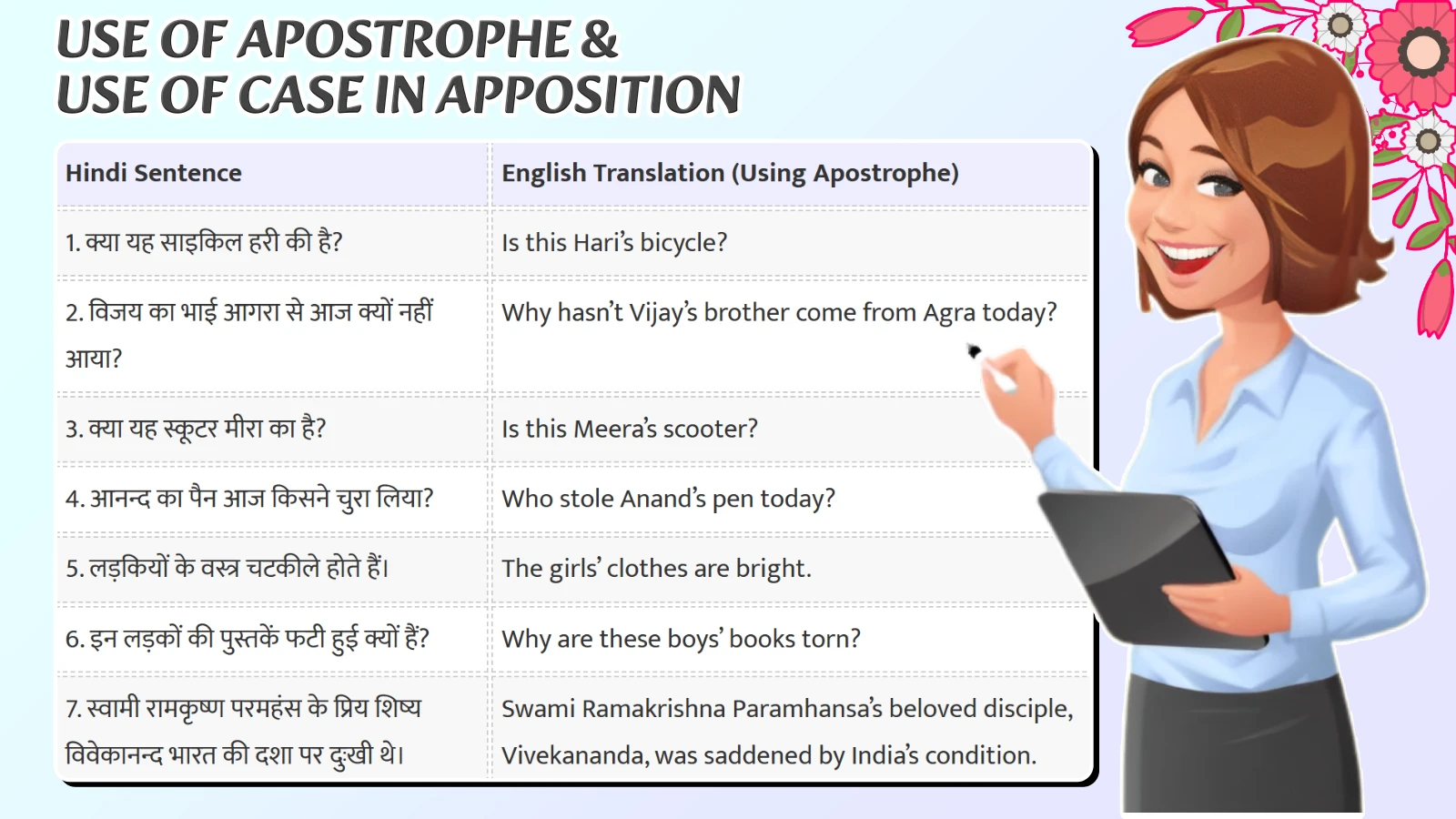
| Hindi Sentence | English Translation (Using Apostrophe) |
|---|---|
| 1. क्या यह साइकिल हरी की है? | Is this Hari’s bicycle? |
| 2. विजय का भाई आगरा से आज क्यों नहीं आया? | Why hasn’t Vijay’s brother come from Agra today? |
| 3. क्या यह स्कूटर मीरा का है? | Is this Meera’s scooter? |
| 4. आनन्द का पैन आज किसने चुरा लिया? | Who stole Anand’s pen today? |
| 5. लड़कियों के वस्त्र चटकीले होते हैं। | The girls’ clothes are bright. |
| 6. इन लड़कों की पुस्तकें फटी हुई क्यों हैं? | Why are these boys’ books torn? |
| 7. स्वामी रामकृष्ण परमहंस के प्रिय शिष्य विवेकानन्द भारत की दशा पर दुःखी थे। | Swami Ramakrishna Paramhansa’s beloved disciple, Vivekananda, was saddened by India’s condition. |
| 8. सुकरात का प्रिय शिष्य अफलातून आदर्शवादी दार्शनिक था। | Socrates’ beloved disciple, Plato, was an idealistic philosopher. |
| 9. कंस के पिता बहुत उदार शासक थे। | Kans’ father was a very generous ruler. |
| 10. अशोक के उत्तराधिकारी मौर्य साम्राज्य की रक्षा न कर सके। | Ashoka’s successors could not protect the Maurya Empire. |
| 11. रावण का भाई कुम्भकरण विशालकाय था। | Ravan’s brother, Kumbhakarna, was gigantic. |
| 12. पंडित मोतीलाल के इकलौते पुत्र 1947 में भारत के प्रधानमन्त्री हुए। | Pandit Motilal’s only son became India’s Prime Minister in 1947. |
(B) Translate the following sentence into English Using case in Apposition:
| Hindi Sentence | English Translation (Using Case in Apposition) |
|---|---|
| 13. हमारे कप्तान अजहर शारजाह के अन्तिम मैच में केवल चार रन बना पाये। | Our captain, Azhar, could score only four runs in the last match at Sharjah. |
| 14. हमें भारत के सर्वश्रेष्ठ बल्लेबाज सचिन पर गर्व है। | We are proud of Sachin, India’s greatest batsman. |
| 15. इटली के निवासी कोलम्बस ने अमरीका की खोज की। | Columbus, a native of Italy, discovered America. |
| 16. शाहजहाँ के पुत्र मुगल सम्राट औरंगजेब का जीवन बहुत सादा था। | Aurangzeb, the Mughal emperor and son of Shah Jahan, led a very simple life. |
| 17. शिवाजी, जीजाबाई के पुत्र ने हिन्दुओं के मान की रक्षा की। | Shivaji, the son of Jijabai, protected the honor of the Hindus. |
| 18. गुरु गोविन्द सिंह, गुरु तेगबहादुर के पुत्र ने जीवन में बहुत कष्ट उठाये। | Guru Gobind Singh, the son of Guru Tegh Bahadur, endured many hardships in life. |
| 19. चन्द्रगुप्त मौर्य के प्रधानमन्त्री अपने युग में कूटनीति के अद्वितीय व्यक्ति थे। | Chanakya, the prime minister of Chandragupta Maurya, was an unparalleled diplomat of his time. |
| 20. नूरजहाँ बेगम, सम्राट जहाँगीर की प्रिय रानी के पिता ईरान के रहने वाले थे। | The father of Nur Jahan Begum, the beloved queen of Emperor Jahangir, was a native of Iran. |
| 21. आगरा के गौरव ताज को मुगल सम्राट शाहजहाँ ने बनवाया था। | The Taj, the pride of Agra, was built by the Mughal emperor Shah Jahan. |
| 22. महासिंह के पुत्र रणजीत सिंह को पंजाब केसरी कहा जाता था। | Ranjit Singh, the son of Mahan Singh, was called the Lion of Punjab. |
| 23. इंग्लैण्ड की महारानी विक्टोरिया बहुत अधिक दयावान थीं। | Queen Victoria, the queen of England, was very compassionate. |
| 24. आजाद हिन्द फौज के प्रमुख नेताजी सुभाषचन्द्र बोस एक अतुलनीय सेनानी थे। | Netaji Subhas Chandra Bose, the chief of the Indian National Army, was an incomparable warrior. |
| 25. पृथ्वीराज चौहान को देहली के अन्तिम शासक मुहम्मद गोरी ने 1192 ई० में तराइन के मैदान में हराया था। | Prithviraj Chauhan was defeated by Muhammad Ghori, the last ruler of Delhi, in the battlefield of Tarain in 1192 A.D. |
Difficult words: (A) स्कूटर = scooter; चटकीले = gaudy, bright; फटी हुई = torn: सुकरात = Socrates; अफलातून = Plato; नादर्शवादी = idealist; दार्शनिक = philosopher; उत्तराधिकारी = heirs; साम्राज्य = empire; विशालकाय = huge; इकलौते = only.
(B) हमें गर्व है = we are proud; खोज की = discovered; मान = honour, कूटनीति = diplomacy; अद्वितीय = matchless; गौरव = glory; पंजाब केसरी = the lion of Punjab; आजाद हिन्द फौज = Indian National Army; प्रमुख = chief; सेनानी = freedom fighters; अतुलनीय = matchless.
Examples of Apostrophe (Possessive Case): Various Tenses
| Sentence | Using Apostrophe (Possessive Case) |
|---|---|
| 1. यह रोहन की कार है। | This is Rohan’s car. |
| 2. रीता का फोन बज रहा है। | Rita’s phone is ringing. |
| 3. मोहन का भाई पढ़ रहा था। | Mohan’s brother was studying. |
| 4. सिया की किताब खो गई है। | Siya’s book has been lost. |
| 5. नेहा का कुत्ता बहुत प्यारा है। | Neha’s dog is very cute. |
| 6. अजय का कमरा साफ था। | Ajay’s room was clean. |
| 7. बच्चे की गेंद नदी में गिर गई। | The child’s ball fell into the river. |
| 8. लड़कों की साइकिलें बाहर खड़ी हैं। | The boys’ bicycles are parked outside. |
| 9. लड़कियों की आवाज़ गूंज रही थी। | The girls’ voices were echoing. |
| 10. बिल्ली के बच्चे सो रहे हैं। | The cat’s kittens are sleeping. |
| 11. डॉक्टर की सलाह अच्छी थी। | The doctor’s advice was good. |
| 12. छात्रों की परीक्षा समाप्त हो गई। | The students’ exam has ended. |
| 13. अनिल की नौकरी चली गई थी। | Anil’s job had been lost. |
| 14. बच्चों के खिलौने टूट चुके थे। | The children’s toys had been broken. |
| 15. सूरज की किरणें चमक रही थीं। | The sun’s rays were shining. |
| 16. पृथ्वी की सतह गर्म हो रही है। | The Earth’s surface is getting warmer. |
| 17. टीचर का लेक्चर शुरू हो चुका था। | The teacher’s lecture had begun. |
| 18. राहुल की माँ खाना बना रही थी। | Rahul’s mother was cooking food. |
| 19. भाई का जन्मदिन अगले सप्ताह है। | Brother’s birthday is next week. |
| 20. कंपनी का मुनाफा बढ़ रहा है। | The company’s profit is increasing. |
| 21. किसान के खेत सूख गए थे। | The farmer’s fields had dried up. |
| 22. टीम का कप्तान मैच जीत चुका था। | The team’s captain had won the match. |
| 23. लड़की की मुस्कान प्यारी है। | The girl’s smile is lovely. |
| 24. लड़कों की टीमें तैयार होंगी। | The boys’ teams will be ready. |
| 25. मोहन की चाबी मिल गई है। | Mohan’s key has been found. |
| 26. बहन के पत्र का उत्तर आएगा। | The sister’s letter will get a reply. |
| 27. सूरी के घर की सफाई हो रही है। | Suri’s house is being cleaned. |
| 28. बच्चे की आँखें चमक रही थीं। | The child’s eyes were shining. |
| 29. दादी का स्वास्थ्य बेहतर है। | Grandma’s health is better. |
| 30. कुत्ते का भोजन पकड़ में है। | The dog’s food is in reach. |
| 31. भीड़ की आवाज़ सुनाई दे रही थी। | The crowd’s voice was audible. |
| 32. छात्र का प्रोजेक्ट सबमिट हो चुका है। | The student’s project has been submitted. |
| 33. सेना की गाड़ियाँ रवाना होंगी। | The army’s vehicles will depart. |
| 34. नदी का पानी ठंडा हो गया था। | The river’s water had cooled down. |
| 35. मित्रों की योजनाएँ लग रही हैं। | The friends’ plans seem appropriate. |
| 36. बच्चे की इच्छा पूरी होगी। | The child’s wish will be fulfilled. |
| 37. पार्टी का निमंत्रण आ चुका था। | The party’s invitation had arrived. |
| 38. अजय की कविता प्रसिद्ध है। | Ajay’s poem is famous. |
| 39. शेर के दाँत तेज होते हैं। | The lion’s teeth are sharp. |
| 40. अमित की घड़ी खो गई होगी। | Amit’s watch must have been lost. |
| 41. अध्यापक का परिवर्तन हो चुका है। | The teacher’s transfer is complete. |
| 42. बिल्ली के बच्चे खेलेंगे। | The cat’s kittens will play. |
| 43. आदमी का चेहरा परिचित लगा। | The man’s face looked familiar. |
| 44. जहाज का सफर लंबा होगा। | The ship’s journey will be long. |
| 45. गाँव का भोजन स्वादिष्ट था। | The village’s food was delicious. |
| 46. लड़की की आवाज़ मधुर थी। | The girl’s voice was sweet. |
| 47. मुर्गियों के अंडे बिक चुके थे। | The hens’ eggs had been sold. |
| 48. लड़कों का घूमना शुरू हो गया है। | The boys’ wandering has begun. |
| 49. सूर्य की गर्मी असहनीय है। | The sun’s heat is unbearable. |
| 50. खिलाड़ी की चोट ठीक हो रही है। | The player’s injury is healing. |
| 51. दर्शकों की तालियाँ गूँज रही थीं। | The audience’s applause was echoing. |
| 52. माता का आशीर्वाद अमूल्य है। | Mother’s blessing is priceless. |
| 53. राजू के कपड़े इस्त्री हो चुके हैं। | Raju’s clothes have been ironed. |
| 54. दोस्त के शब्द दिल छू गए। | The friend’s words touched the heart. |
| 55. कलाकार की पेंटिंग बिक गई थी। | The artist’s painting had been sold. |
| 56. भारत की जनसंख्या बढ़ती जा रही है। | India’s population is increasing. |
| 57. पहाड़ों की चढ़ाई कठिन थी। | The mountains’ climb was tough. |
| 58. रेखा की आँखें चमक रही हैं। | Rekha’s eyes are sparkling. |
| 59. वैज्ञानिक की खोज महान थी। | The scientist’s discovery was great. |
| 60. बच्चे की हँसी प्यारी है। | The child’s laughter is lovely. |
| 61. ट्रेन की आवाज़ सुनाई दे रही थी। | The train’s sound was audible. |
| 62. लड़की का उत्तर सही था। | The girl’s answer was correct. |
| 63. मंत्री का भाषण लंबा था। | The minister’s speech was long. |
| 64. लेखक की किताबें प्रकाशित होंगी। | The writer’s books will be published. |
| 65. कुत्ते का भौंकना तेज था। | The dog’s barking was loud. |
| 66. स्कूल के नियम सख्त हैं। | The school’s rules are strict. |
| 67. बस का पहिया पंचर हो गया था। | The bus’s tire had been punctured. |
| 68. पिता के शब्द प्रेरणादायक थे। | Father’s words were inspiring. |
| 69. महिला की साड़ी सुंदर थी। | The woman’s saree was beautiful. |
| 70. नेता के निर्णय महत्त्वपूर्ण थे। | The leader’s decisions were important. |
Examples of Case in Apposition: Various Tenses
| Sentence | Using Case in Apposition |
|---|---|
| 1. आइंस्टीन, विश्वविख्यात वैज्ञानिक, सापेक्षता का सिद्धांत दिया। | Einstein, the world-famous scientist, proposed the theory of relativity. |
| 2. गांधीजी, राष्ट्रपिता, भारत के महान नेता थे। | Gandhiji, the Father of the Nation, was a great leader of India. |
| 3. नेहरू, पहले प्रधानमंत्री, देश का नेतृत्व किया। | Nehru, the first Prime Minister, led the nation. |
| 4. अरस्तू, यूनानी दार्शनिक, प्लेटो का शिष्य था। | Aristotle, the Greek philosopher, was a disciple of Plato. |
| 5. भीमराव अंबेडकर, संविधान निर्माता, एक महान विद्वान थे। | B.R. Ambedkar, the architect of the Constitution, was a great scholar. |
| 6. अमिताभ बच्चन, मशहूर अभिनेता, अभिनय जारी रखे हुए हैं। | Amitabh Bachchan, the famous actor, is still acting. |
| 7. अब्दुल कलाम, पूर्व राष्ट्रपति, मिसाइल मैन के नाम से जाने जाते हैं। | A.P.J. Abdul Kalam, former President, is known as the Missile Man. |
| 8. रविन्द्रनाथ टैगोर, कवि, साहित्य में नोबेल पुरस्कार विजेता थे। | Rabindranath Tagore, the poet, was a Nobel laureate in literature. |
| 9. सी.वी. रमण, भारतीय भौतिकशास्त्री, ने रमण प्रभाव की खोज की। | C.V. Raman, the Indian physicist, discovered the Raman Effect. |
| 10. रानी लक्ष्मीबाई, झाँसी की रानी, वीरता का प्रतीक हैं। | Rani Laxmibai, the Queen of Jhansi, is a symbol of bravery. |
| 11. विवेकानन्द, महान संन्यासी, ने भारत का नाम ऊँचा किया। | Vivekananda, the great monk, made India proud. |
| 12. सुभाषचंद्र बोस, आज़ाद हिंद फौज के नेता, अमर हैं। | Subhash Chandra Bose, the leader of the INA, is immortal. |
| 13. मदर टेरेसा, परोपकारी, को नोबेल शांति पुरस्कार मिला। | Mother Teresa, the philanthropist, received the Nobel Peace Prize. |
| 14. लता मंगेशकर, संगीत की रानी, ने हजारों गाने गाए। | Lata Mangeshkar, the queen of music, sang thousands of songs. |
| 15. विराट कोहली, क्रिकेटर, विश्व रिकॉर्ड बना रहे हैं। | Virat Kohli, the cricketer, is setting world records. |
| 16. एलन मस्क, उद्यमी, अंतरिक्ष अनुसंधान का नेतृत्व कर रहे हैं। | Elon Musk, the entrepreneur, is leading space research. |
| 17. राधाकृष्णन, दार्शनिक, शिक्षक दिवस पर याद किए जाते हैं। | Radhakrishnan, the philosopher, is remembered on Teachers’ Day. |
| 18. शेक्सपियर, नाटककार, ने विश्व साहित्य को समृद्ध किया। | Shakespeare, the playwright, enriched world literature. |
| 19. रोहित शर्मा, बल्लेबाज, रिकॉर्ड बना चुके होंगे। | Rohit Sharma, the batsman, must have set records. |
| 20. मोजार्ट, संगीतकार, ने अद्भुत रचनाएँ कीं। | Mozart, the composer, created incredible works. |
| 21. तुलसीदास, कवि, ने रामचरितमानस लिखी। | Tulsidas, the poet, wrote the Ramcharitmanas. |
| 22. हर्ष, विद्वान राजा, ने ज्ञान का आदर किया। | Harsh, the scholar king, respected knowledge. |
| 23. आइज़ैक न्यूटन, भौतिकशास्त्री, ने गति के नियम दिए। | Isaac Newton, the physicist, gave the laws of motion. |
| 24. सीता, राम की पत्नी, आदर्श नारी थीं। | Sita, the wife of Ram, was an ideal woman. |
| 25. कलाम, मिसाइल मैन, सादगी के लिए जाने जाते थे। | Kalam, the Missile Man, was known for his simplicity. |
| 26. झालिम सिंह, कवि, ने प्रकृति पर कविताएँ लिखीं। | Jhalim Singh, the poet, wrote poems on nature. |
| 27. दलाई लामा, आध्यात्मिक नेता, शांति के संदेशवाहक हैं। | Dalai Lama, the spiritual leader, is a messenger of peace. |
| 28. अर्जुन, योद्धा, महान धनुर्धर थे। | Arjun, the warrior, was a great archer. |
| 29. एपीजे अब्दुल कलाम, वैज्ञानिक, मिसाइल प्रौद्योगिकी में योगदान दिया। | A.P.J. Abdul Kalam, the scientist, contributed to missile technology. |
| 30. कबीर, संत, ने दोहे लिखे। | Kabir, the saint, wrote couplets. |
| 31. शेरलॉक होम्स, जासूस, काल्पनिक चरित्र है। | Sherlock Holmes, the detective, is a fictional character. |
| 32. कोलंबस, नाविक, ने अमेरिका की खोज की। | Columbus, the sailor, discovered America. |
| 33. नेल्सन मंडेला, स्वतंत्रता सेनानी, अफ्रीका के नायक थे। | Nelson Mandela, the freedom fighter, was a hero of Africa. |
| 34. प्लेटो, दार्शनिक, ने रिपब्लिक लिखी। | Plato, the philosopher, wrote the Republic. |
| 35. प्रफुल्ल चन्द्र राय, रसायनज्ञ, ने बंगाल केमिकल्स की स्थापना की। | Prafulla Chandra Ray, the chemist, founded Bengal Chemicals. |
| 36. रवीन्द्रनाथ, कवि, ने संगीत रचना की। | Rabindranath, the poet, composed music. |
| 37. थॉमस एडिसन, आविष्कारक, ने बल्ब का आविष्कार किया। | Thomas Edison, the inventor, invented the bulb. |
| 38. चाणक्य, मंत्री, नीतिशास्त्र के ज्ञाता थे। | Chanakya, the minister, was a scholar of policy. |
| 39. स्टीव जॉब्स, उद्यमी, ने एप्पल कंपनी बनाई। | Steve Jobs, the entrepreneur, founded Apple. |
| 40. कलाम, राष्ट्रपति, ने शिक्षा पर ज़ोर दिया। | Kalam, the President, emphasized education. |
| 41. सुकरात, दार्शनिक, प्रश्न पूछते थे। | Socrates, the philosopher, asked questions. |
| 42. ऐडम स्मिथ, अर्थशास्त्री, ने ‘द वेल्थ ऑफ नेशंस’ लिखी। | Adam Smith, the economist, wrote ‘The Wealth of Nations’. |
| 43. बेथोवन, संगीतकार, ने कई सिम्फनी लिखीं। | Beethoven, the composer, wrote many symphonies. |
| 44. न्यूटन, वैज्ञानिक, ने गुरुत्वाकर्षण खोजी। | Newton, the scientist, discovered gravity. |
| 45. शिवाजी, मराठा राजा, वीरता के लिए जाने जाते हैं। | Shivaji, the Maratha king, is known for bravery. |
| 46. विवेकानंद, सन्यासी, शिकागो में भाषण दिया। | Vivekananda, the monk, gave a speech in Chicago. |
| 47. मीराबाई, भक्त, कृष्ण की उपासना करती थीं। | Meerabai, the devotee, worshipped Krishna. |
| 48. अब्राहम लिंकन, राष्ट्रपति, ने दासप्रथा समाप्त की। | Abraham Lincoln, the President, abolished slavery. |
| 49. कबीर, संत, भक्ति आंदोलन के प्रमुख थे। | Kabir, the saint, was a leader of the Bhakti movement. |
| 50. रवि, खिलाड़ी, मैच जीत चुका है। | Ravi, the player, has won the match. |
| 51. मैरी क्यूरी, वैज्ञानिक, रेडियम की खोज की। | Marie Curie, the scientist, discovered radium. |
| 52. झांसी की रानी, वीरांगना, मराठा साम्राज्य की थीं। | Rani of Jhansi, the warrior queen, belonged to the Maratha empire. |
| 53. सीज़र, रोमन नेता, का हत्या कर दी गई। | Caesar, the Roman leader, was assassinated. |
| 54. टेस्ला, आविष्कारक, बिजली का काम करते थे। | Tesla, the inventor, worked on electricity. |
| 55. कबीर, संत, निर्गुण भक्ति का उपदेश देते थे। | Kabir, the saint, taught formless devotion. |
| 56. फ्रायड, मनोवैज्ञानिक, ने अवचेतन मन पर अध्ययन किया। | Freud, the psychologist, studied the subconscious mind. |
| 57. गांधीजी, स्वतंत्रता सेनानी, ने सत्याग्रह आंदोलन चलाया। | Gandhiji, the freedom fighter, led the Satyagraha movement. |
| 58. गांधी, नेता, शांति का संदेश देते थे। | Gandhi, the leader, preached peace. |
| 59. वाल्मीकि, कवि, ने रामायण लिखी। | Valmiki, the poet, wrote the Ramayana. |
| 60. पिकासो, चित्रकार, आधुनिक कला के अग्रदूत थे। | Picasso, the painter, was a pioneer of modern art. |
| 61. रॉबर्ट फ्रॉस्ट, कवि, ने ‘द रोड नॉट टेकन’ लिखी। | Robert Frost, the poet, wrote ‘The Road Not Taken’. |
| 62. होमर, लेखक, ने इलियड लिखा। | Homer, the author, wrote the Iliad. |
| 63. रामानुजन, गणितज्ञ, ने महत्वपूर्ण योगदान दिया। | Ramanujan, the mathematician, made significant contributions. |
| 64. पतंजलि, ऋषि, ने योग सूत्र लिखा। | Patanjali, the sage, wrote the Yoga Sutra. |
| 65. गौतम बुद्ध, प्रवर्तक, ने मध्यम मार्ग का उपदेश दिया। | Gautam Buddha, the preacher, taught the Middle Path. |
| 66. अमर्त्य सेन, अर्थशास्त्री, को नोबेल पुरस्कार मिला। | Amartya Sen, the economist, received the Nobel Prize. |
| 67. तुलसीदास, कवि, ने भक्ति साहित्य रचा। | Tulsidas, the poet, composed devotional literature. |
| 68. आदिवासी, मूल निवासी, प्रकृति के अनुरूप जीवन जीते हैं। | Adivasis, the indigenous people, live in harmony with nature. |
| 69. टाटा, उद्योगपति, भारत की सेवा की। | Tata, the industrialist, served India. |
| 70. कालिदास, नाटककार, संस्कृत भाषा के प्रतीक थे। | Kalidas, the playwright, was a symbol of Sanskrit literature. |